Many people search for The Genius Song by Dr. Lake because the sales video is built around its presenter, a man who calls himself “doctor Robert Lake”. The most important fact about him is printed in small type at the bottom of the seller’s own pages: “Robert Lake is a pen name used with the consent of our leading neuroscientist.” This post explains what that disclaimer says, what the video claims about him, and what it means if you are thinking of buying.
Quotes come from the seller’s /video/ and /text/ pages, the 39-minute sales video and the Terms page.
Read the Disclaimer Yourself
Our link opens the seller’s official site. The pen-name disclaimer is in the footer of the sales pages.
Visit the Official Website
90-day refund window, keep your receiptTable of Contents
The Disclaimer, Word for Word
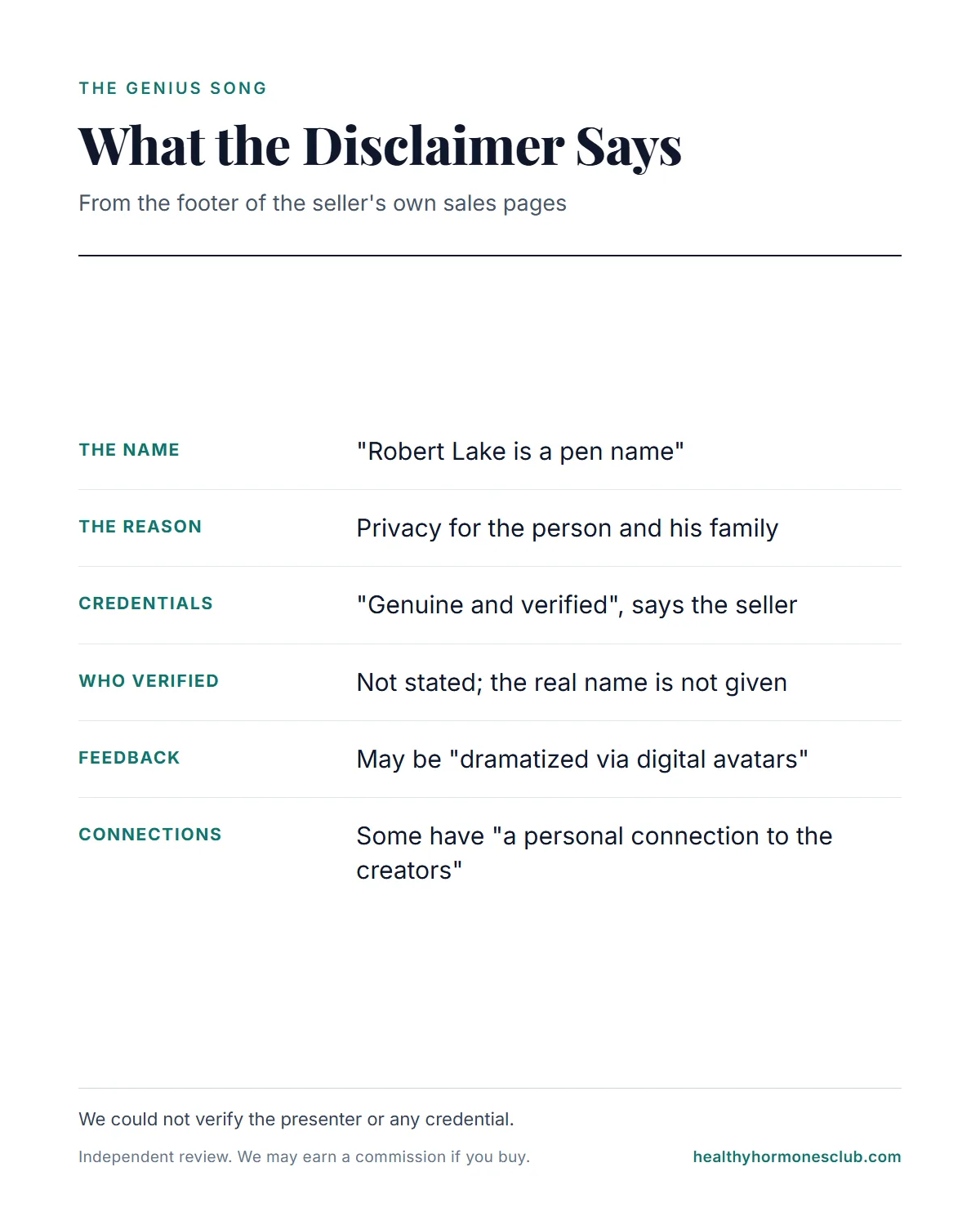
The footer of the seller’s /video/ and /text/ pages carries this disclaimer (the /text/ version writes “Dr. Robert Lake”):
“Robert Lake is a pen name used with the consent of our leading neuroscientist, who wishes to maintain personal privacy for himself and his family. The qualifications and credentials attributed to this name are genuine and verified. This measure is taken to protect the individual’s privacy without misleading our customers.”
Two things are going on in that paragraph. First, a plain admission: the name is not real. Second, a claim: the credentials behind it are “genuine and verified”. The seller does not say who verified them, or how, and it does not give the real name. So the second sentence is the seller’s statement, and nobody outside the company can check it. Whether this makes the product a scam is a separate question, which we look at in is The Genius Song a scam.
The same footer adds that featured feedback “may be dramatized via digital avatars”, and that some of the people featured have “a personal connection to the creators”.
What the Video Says About Dr. Lake
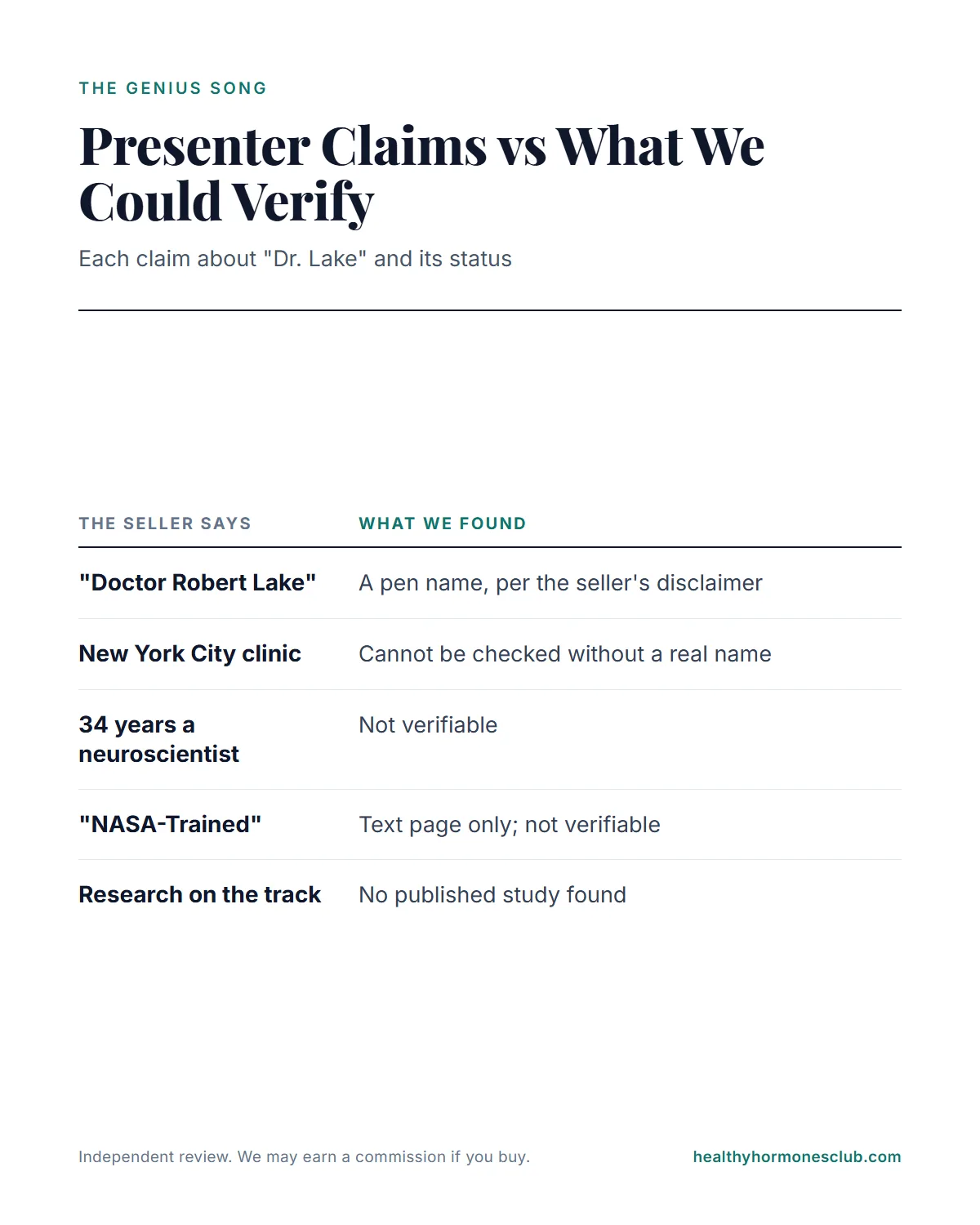
Across the video and the text page, the persona is given an impressive background. Here is each claim and where it appears:
| Claim | Where it appears |
|---|---|
| Introduces himself as “doctor Robert Lake” | Sales video, at about 1:43 |
| Runs a “New York City clinic” | Sales video, at about 18:00 |
| ”Thirty four years as a neuroscientist” | Sales video, at about 24:15 |
| ”NASA-Trained Neuroscientist” | Text version of the sales page |
| ”Top NASA Scientist” | Headline of the text page |
| His “PhDs” and “colleagues” built the track in “the lab” | Sales video |
Note that the two versions of the pitch do not tell quite the same story. The video cites a Princeton report and colleagues at the “Einstein Center in Berlin”; the text page tells the same story with NASA in place of Princeton and “colleagues in Japan” in place of Berlin. When the details of an expert’s background shift between versions of the same sales page, that is a reason for caution.
See the Presentation on the Official Site
Our link opens geniussongoriginal.com. Judge the claims with the disclaimer in mind.
Check the Current Price on the Official Site
90 days under the Terms and ClickBankWhat We Could and Could Not Verify
- Verified: the pen-name disclaimer exists on the seller’s pages, in the wording quoted above.
- Verified: the presenter’s research claims (an MIT finding that “all lucky, wealthy, successful people” share one brain wave, a “brand new discovery in twenty twenty six”, a paper said to be published in December 2025) are made in the video.
- Not verifiable: who the presenter is, any clinic, any NASA training, any years of practice. Without a real name, these cannot be checked.
- Not found: any published study of The Genius Song, by “Dr. Lake” or anyone else. We also found no published study showing that “all lucky, wealthy, successful people” share one brain wave.
- Worth knowing: the site’s 14-item reference list cites theta and general entrainment studies plus creativity articles. It is identical to the list on the seller’s Genius Wave page, while the video is about gamma.
To be fair, the presenter does say one careful thing. On a story about luck at a casino, he says: “there is, of course, no evidence to support that the genius song caused that.” That same standard applies to the rest of the stories in the video.
Pen Names Beyond the Presenter
The pen name is not a one-off. The seller’s Terms say:
- Names of people in the marketing “have been changed”, and “We use pen names for this purpose”.
- ”Some aspects of the marketing have been dramatized for entertainment effect.”
- Feedback may be acted out by “digital representations, avatars, or actors”.
- Some testimonial givers may be “early supporters, friends, or family members of the company’s founders”, and some were “compensated”.
- Testimonials “are exceptional results and may not reflect the experience of a typical customer”.
So the people in the video (for example “Rachel, a nurse from Tustin, California” or “Michael in Dallas”) should not be read as independent reviews. The Terms also describe the products as “for entertainment purposes only” and say brain entrainment “is not an exact science”.
Why the Pen Name Matters for Buyers
Pen names are legal and sometimes used for real privacy reasons. The problem here is how much of the pitch depends on the persona’s authority. The video asks you to trust a neuroscientist with decades of experience and NASA training. Once the seller tells you the name is not real, that authority becomes a claim you cannot test.
That leaves the product to be judged on what you can check: a $39 digital audio track the seller says lasts about 7 minutes, a ClickBank checkout, and a 90-day refund window stated in the Terms and on the checkout. Our Genius Song buy checklist walks through whether the purchase fits you, and our Genius Song discount guide explains the real price behind the crossed-out ones.
If You Still Want to Try It
The Genius Song is sold only through the seller’s site, geniussongoriginal.com, with a ClickBank checkout. The official site’s home page currently features the seller’s related audio, The Genius Wave; The Genius Song presentation is on the same site’s /video/ page. Check that the checkout names “The Genius Song” before you pay.
- Price: $39 once, shown in your currency plus local tax.
- Delivery: digital. The video says the track is emailed; the text page describes a “Private Audio Portal” login. No file format is stated.
- Bonuses: up to four digital extras, but the list differs between the video and the text page.
- Refund: 90 days via ClickBank (1-800-390-6035). Ignore the /TOS/refunds/ page, a leftover “NeuroActivate” bottle policy.
- Statement: CLKBANK*Genius Song.
Go to the Seller’s Official Site
Our link opens the official site. Payment, if you buy, goes through ClickBank.
Visit the Official Website
Statement shows CLKBANK*Genius SongOur Verdict
| Question | Our answer |
|---|---|
| Is “Dr. Robert Lake” a real name? | No, per the seller’s own disclaimer |
| Can his credentials be checked? | No; the real name is not given |
| Has he published a study of the track? | We found none |
| Is the checkout legitimate? | Yes: ClickBank, with a 90-day refund window |
| Our editorial score | 3.0 out of 5 (our own rating, not a customer average) |
The pen name does not make the purchase unsafe, but it removes the main reason the video gives you to believe its claims. If you try The Genius Song, treat it as the seller’s Terms do: a short audio experience, with no proven effects, that you can return within 90 days.
Frequently Asked Questions
Who is Dr. Lake in The Genius Song?
He is the presenter of the sales video, who introduces himself as “doctor Robert Lake”. The seller’s own disclaimer, in the footer of its sales pages, says “Robert Lake is a pen name used with the consent of our leading neuroscientist”.
Is Dr. Robert Lake a real person?
Someone presents the video, but “Robert Lake” is not their real name, according to the seller. Because the real name is not given, nobody outside the seller can check the person’s background.
Is Dr. Lake a NASA scientist?
The text version of the sales page calls him a “NASA-Trained Neuroscientist”, and the video describes a New York City clinic and 34 years as a neuroscientist. These are the seller’s claims about a pen-name persona. We could not verify any of them.
Why would a seller use a pen name?
The disclaimer says it is to protect the person’s privacy and their family. The seller’s Terms also say names in its marketing have been changed, pen names are used and some aspects are “dramatized for entertainment effect”.
Does the pen name mean The Genius Song is a scam?
Not by itself. The checkout is a normal ClickBank page with a 90-day refund window. But it does mean the expert authority in the video cannot be checked, so the claims rest on the seller’s word alone.
Has Dr. Lake published research on The Genius Song?
We found no published study of The Genius Song, under any author name. The site’s reference list cites general theta and entrainment studies and creativity articles, not a study of this track.
The Bottom Line
”The Genius Song by Dr. Lake” is really The Genius Song by a presenter using a pen name, as the seller’s own disclaimer says. His credentials, his clinic and his research stories cannot be checked, and the testimonials around him may be acted or compensated. If you buy, buy for the short listening routine, not for the authority of the name, and keep your ClickBank receipt for the 90-day refund window.
Visit the Official Site
One-time $39 for the audio track and the listed bonuses, paid through ClickBank.
Check the Current Price on the Official Site
90-day refund window under the seller’s Terms