The Genius Song reviews you find online come from very different places, and they do not deserve equal trust. Some are testimonials inside the seller’s own sales video. Some are viewer questions read out by the presenter. Some are review articles written by sites that earn a commission, like ours. A few may be buyers posting on forums. This guide sorts those sources, explains what the seller’s own Terms say about its testimonials, and gives you a simple way to weigh what you read before you spend $39.
The Genius Song is a digital audio track that the seller says runs about 7 minutes a day. It is sold for $39 through ClickBank, with a 90-day refund window.
See the Seller’s Page for Yourself
A one-time $39 digital audio track sold through ClickBank, with a 90-day refund window in the Terms and at checkout.
Visit the Official Website
All benefits are the seller’s claimsTable of Contents
Four Kinds of The Genius Song Reviews
When people search for reviews of this product, they usually land on one of four things:
- Seller testimonials. Stories told inside the sales video, such as a nurse from California or a man in Dallas.
- Viewer questions in the video. The presenter reads questions credited to people in places like Lakeway, Tampa, Las Vegas and Boston, then answers them himself.
- Review articles. Blog posts and pages, many of which link to the product and may earn a commission.
- Buyer comments. Forum posts, comment sections or refund stories from people who say they bought it.
Only the fourth kind is close to independent customer feedback, and it is also the hardest to verify. The first two come straight from the seller. The third depends entirely on how carefully the writer checked the sources.
What the Seller’s Testimonials Say
The sales video is presented by a man who introduces himself as “doctor Robert Lake.” The site’s own disclaimer says “Robert Lake is a pen name used with the consent of our leading neuroscientist,” so the name is not a real person’s name. In the video he shares several success stories:
- “Rachel, a nurse from Tustin, California.” Presented as an early listener with a positive experience.
- ”Michael in Dallas.” Described as starting an Amazon business and quitting his job.
- ”Hannah from Manhattan.” Described as getting a promotion and breaking a family “curse.”
- Colleague anecdotes. A finished book, a son going from a C to an A, an engagement after a meeting at Trader Joe’s, a promotion with a signing bonus, a 16 lb weight loss, quitting smoking and migraines disappearing.
The video also says the track has helped “eighteen thousand three hundred sixty six everyday Americans” and mentions “thousands of five star reviews.” The text version of the sales page repeats 18,366 in its body, while its headline says 19,389 Americans. We could not verify either figure, and they do not match each other.
To be fair to the seller, the presenter also says, about one listener’s casino win: “there is, of course, no evidence to support that the genius song caused that.” That line is worth remembering when you read the rest of the stories.
What the Terms Say About Those Testimonials
This is the most useful document for anyone reading The Genius Song reviews, because the seller explains its own testimonials there. The Terms of Service say:
- Names “have been changed to protect the privacy of those involved. We use pen names for this purpose."
- "Some aspects of the marketing have been dramatized for entertainment effect.”
- The seller “may utilize digital representations, avatars, or actors to dramatize or ‘act out’ the verbatim feedback provided by our users.”
- Some people giving testimonials “may be early supporters, friends, or family members of the company’s founders.”
- People whose experiences are highlighted were “compensated” as a thank-you.
- The testimonials “are exceptional results and may not reflect the experience of a typical customer.”
The same Terms also say “All accounts come from real people” and that the results described are genuine. We have no way to check that. What we can say is that, by the seller’s own description, these are not independent reviews: names are changed, speakers may be actors, and some have a personal or paid connection.
The Terms add one more line that frames everything else: “brain entrainment is not an exact science and we recommend that you do not treat it as such. The products are provided for entertainment purposes only.”
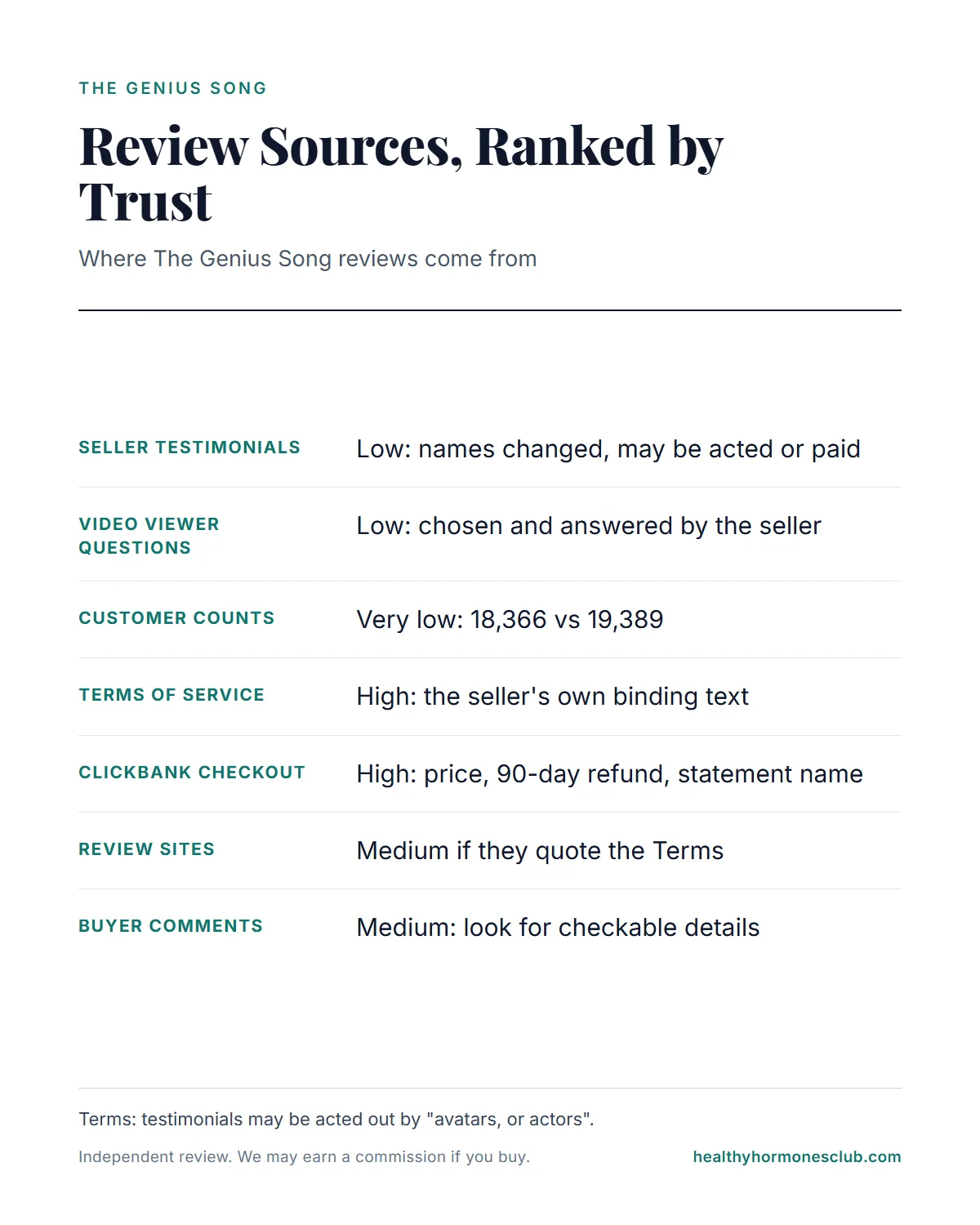
How Much Weight Each Source Deserves
| Source | What it can tell you | Weight we give it |
|---|---|---|
| Seller testimonials | What the seller wants you to expect | Low: names changed, may be acted or compensated |
| Viewer questions in the video | Common doubts the seller chose to answer | Low: written and answered by the seller |
| Seller customer counts | Nothing reliable | Very low: 18,366 and 19,389 on different pages |
| Terms of Service | Refund rules, disclosures, entertainment framing | High: the seller’s own binding document |
| ClickBank checkout | Price, refund window, card statement name | High: the payment processor’s page |
| Review sites | Depends on the writer | Medium if they quote sources; low if they repeat the video |
| Buyer comments | Real experiences, if genuine | Medium: hard to verify, look for specifics |
Check the Terms Before You Trust a Testimonial
The seller’s Terms and the ClickBank checkout are the two documents that tell you what you actually get and how refunds work.
Check the Current Price on the Official Site
90-day refund window per the Terms and ClickBankReading Review Sites, Including This One
Most review articles about this product, ours included, link to the seller and may earn a commission on a sale. That does not make every review useless, but it means you should look for signs that the writer did the work. A careful review of The Genius Song will usually:
- Say that “Dr. Robert Lake” is a pen name, because the seller’s disclaimer says so. A review that calls him a verified NASA scientist has not read the footer.
- Quote the “entertainment purposes only” line from the Terms.
- Explain that the refund window is 90 days in the Terms and at the ClickBank checkout, and that the site’s separate refund page is a leftover policy for “NeuroActivate” bottles (60 days, unopened bottles, an Ohio return address) that does not fit a digital track.
- Note that the bonuses differ between the seller’s pages. The video says “three free bonuses” but names four; the text page says four but lists three.
- Avoid promising a file type. The seller describes delivery two ways: an email download in the video, and a “Private Audio Portal” login on the text page.
- Label any score as the writer’s own opinion, not a customer average.
If a review gives a star rating “from thousands of users” or claims a specific success rate, ask where that number came from. We found no public, independent rating source for this track.
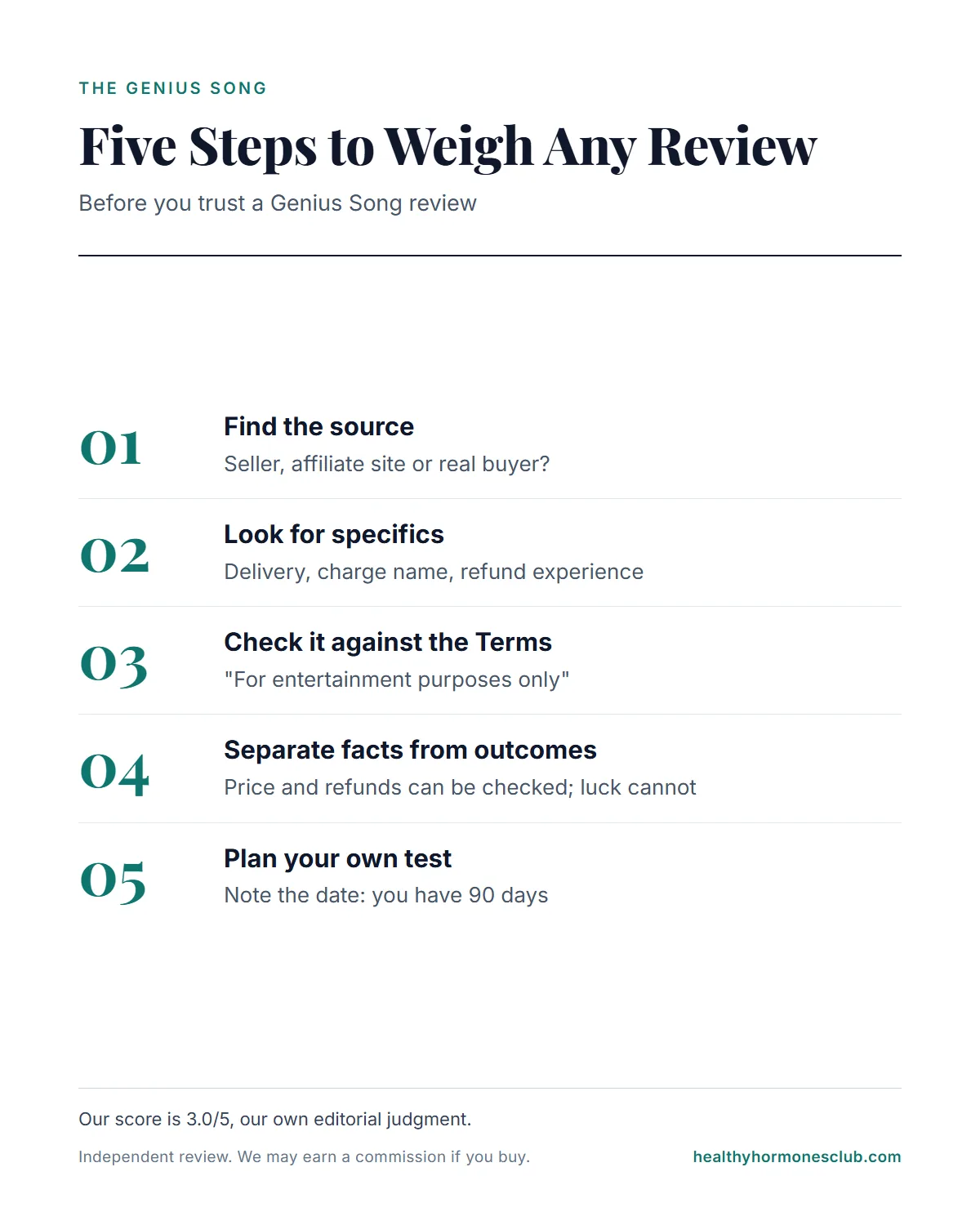
A Five-Step Way to Weigh Any Review
- Find the source. Is it the seller, a commission-earning site, or a buyer? If you cannot tell, treat it as marketing.
- Look for specifics. A real buyer usually mentions delivery, how the track was accessed, or how a refund went. Vague praise tells you little.
- Check claims against the Terms. If a review promises results, remember that the seller’s own Terms call the product entertainment.
- Separate outcomes from purchase details. Price, delivery and refunds can be checked. Luck, money and health outcomes cannot.
- Plan for the refund window. Whatever the reviews say, your own 90 days are the real test. Note your purchase date.
What We Could Verify Ourselves
Here is what holds up when you check the seller’s documents directly:
- Price: $39 one-time, per the Terms of Sale (“You are paying $39 today for The Genius Song”). The sales page shows $200, $100 and $49 crossed out; those are the seller’s reference prices. Checkout shows local currency and tax outside the US.
- Product: a digital audio track the seller says is about 7 minutes long. We could not check the actual length because we did not buy it.
- Delivery: an audio track delivered digitally. The seller describes both a download and an online audio portal.
- Refund: 90 days, per the Terms (“within 90 days of your initial purchase”) and the ClickBank checkout.
- Bonuses: the seller lists up to four digital bonuses, and the exact list differs between the video and the text page.
- Card statement: CLKBANK*Genius Song. ClickBank order support: 1-800-390-6035.
Our own scorecard for the product, with six criteria, is in The Genius Song Review. Our editorial score is 3.0 out of 5, and it is our judgment, not a customer rating.
Where to Buy
The official site’s home page currently features the seller’s related audio, The Genius Wave; The Genius Song presentation is on the same site’s /video/ page.
Visit the Official Website
Charge appears as CLKBANK*Genius SongA Note on Safety
This is our own general advice for any audio-entrainment product: listen at a comfortable volume, never while driving or operating machinery, and if you have epilepsy, a history of seizures or hearing problems, ask a doctor first. The site itself says the product “is not intended to diagnose, treat, cure, or prevent any disease.”
Frequently Asked Questions
Are The Genius Song reviews on the sales page real?
The seller’s Terms say all accounts come from real people, but also that names have been changed, some marketing has been dramatized, feedback may be acted out by digital representations, avatars or actors, and people were compensated for letting the seller highlight their experiences. Treat them as marketing, not as independent reviews.
How many customers does The Genius Song have?
We do not know. The video and the text page body say 18,366 Americans, while the text page headline says 19,389. Neither number is verified, and the two do not match.
Is Dr. Robert Lake a real scientist?
The site’s own disclaimer says Robert Lake is a pen name used with the consent of the seller’s leading neuroscientist. So the name is not a real person’s name, and we cannot verify the credentials described in the video.
Can I trust review sites that link to The Genius Song?
Read them with care, including this one. Most such sites, us included, may earn a commission. A useful review quotes the seller’s Terms, mentions the pen name and the refund details, and labels any score as its own opinion.
What is your own score for The Genius Song?
Our editorial score is 3.0 out of 5. It is our own judgment of the sales materials, Terms and checkout, not an average of customer ratings.
Is there a refund if the reviews oversold it?
Yes. The Terms say digital products can be refunded within 90 days of purchase, and the ClickBank checkout also shows a 90-day window. Keep your ClickBank receipt.
The Bottom Line
Most of The Genius Song reviews you will meet are either the seller’s own testimonials or articles from sites that may earn a commission. The seller’s Terms are honest about the testimonials: changed names, possible actors and avatars, compensated or connected speakers, and “exceptional results.” Give the most weight to the documents you can check, which are the Terms and the ClickBank checkout, and treat outcome stories as marketing. If you are curious, the $39 price and the 90-day refund window make it a low-cost experiment, as long as you go in without expecting the results in the video.
Make Up Your Own Mind
One-time $39, delivered digitally, with 90 days to ask ClickBank or the seller for a refund.
Check the Current Price on the Official Site
Digital delivery, nothing to ship