
The Last Wish reviews are harder to pin down than most product reviews, because the usual sources of customer feedback are thin. The order page we saved shows no testimonials at all. The sales video is a 25-minute story told by a narrator who calls himself Danny Kelly. Most of the rest is written by affiliate sites, which may earn a commission, like ours. This guide sorts those sources, shows what the seller’s own Terms say about testimonials, and gives you a five-step method to weigh any review before you spend $37.44.
The Last Wish is a set of digital audio “recordings” sold through ClickBank with a 60-day refund window. The seller’s Terms describe the content as “For Entertainment Purposes Only.”
See the Seller’s Page for Yourself
A one-time $37.44 digital product sold through ClickBank, with a 60-day refund window at checkout.
Visit the official website
We may earn a commission if you buyTable of Contents
- Five Kinds of The Last Wish Reviews You Will Meet
- What the Seller’s Terms Say About Testimonials
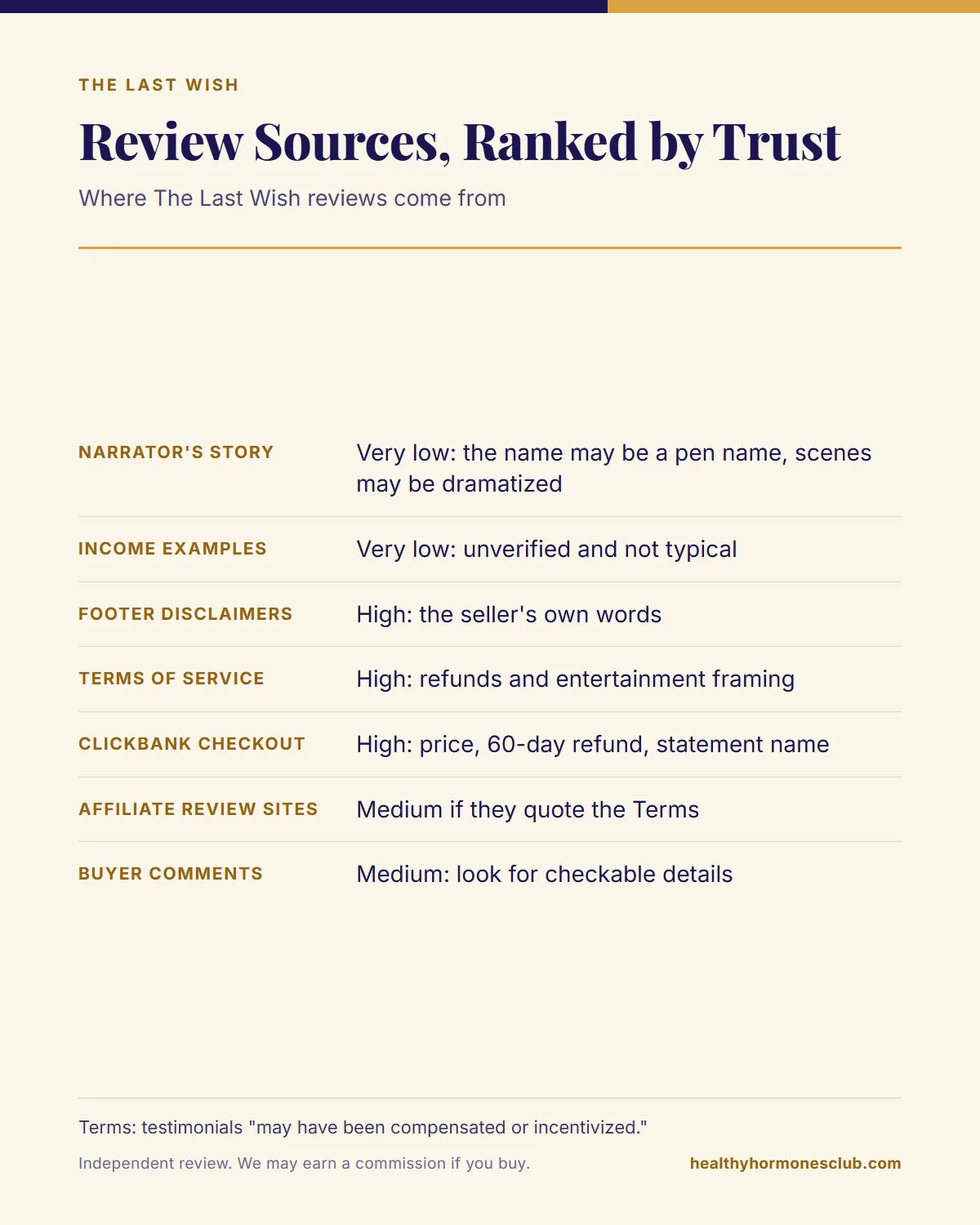
- How Much Weight Each Source Deserves
- Reading Affiliate Review Sites, Including This One
- Red Flags Inside a Review
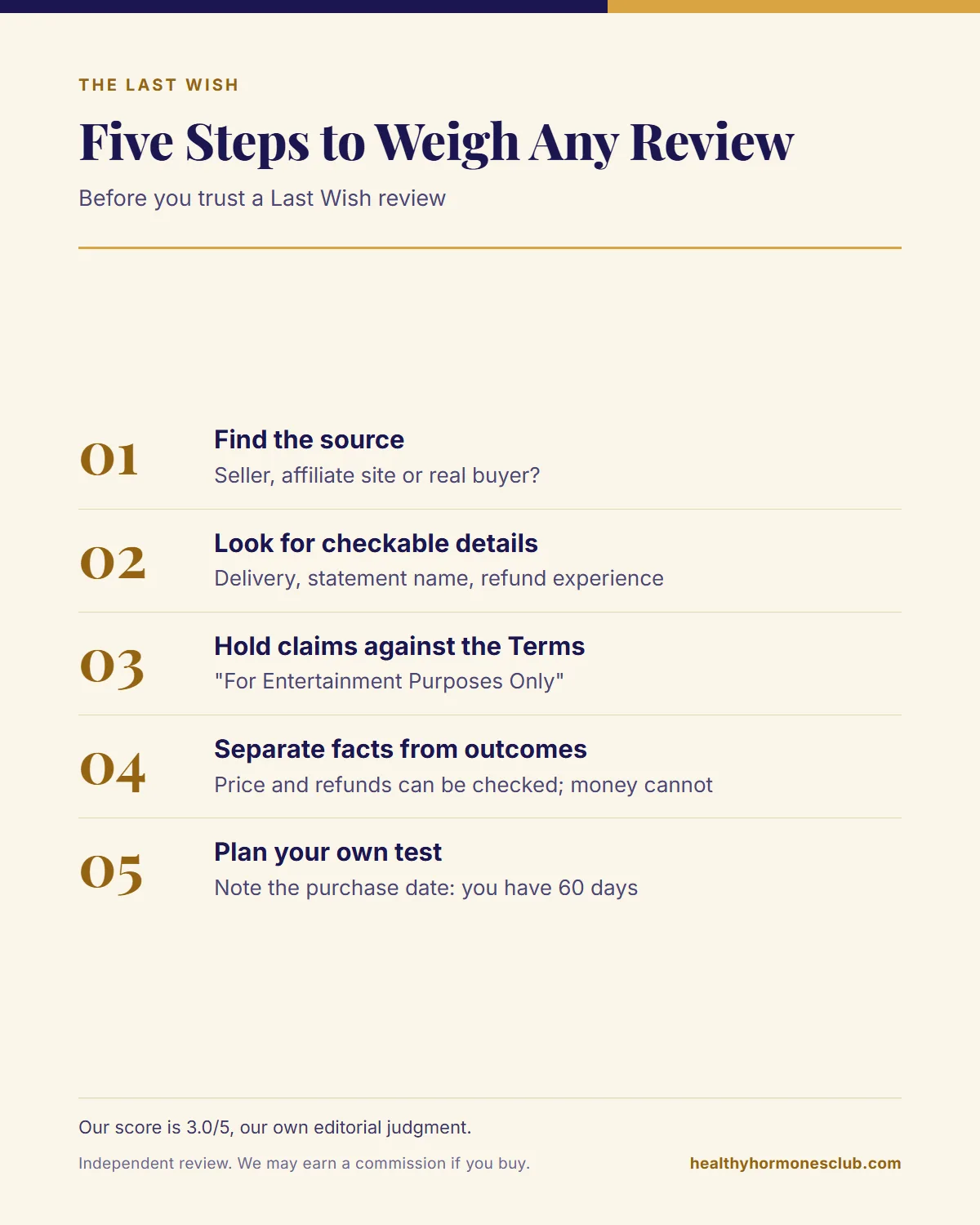
- A Five-Step Way to Weigh Any Review
- What You Can Verify Yourself
- A Note on Faith and Fairness
- Frequently Asked Questions
Five Kinds of The Last Wish Reviews You Will Meet
Searches for reviews of this product usually lead to one of five things:
- The narrator’s story. The video is built around a personal tale of money turning around. It reads like a testimonial, but it is the seller’s own pitch.
- Testimonial claims in the funnel. The footer of the order page says testimonials are “results that have been forwarded to us by users” and are not a guarantee. We saw none displayed on the pages we saved.
- Affiliate review articles. Pages that link to the product and may earn a commission on a sale.
- Buyer comments. Social posts, forum threads or refund stories from people who say they bought it.
- Ads and short clips. Fragments of the video, often with the biggest claims pulled to the front.
Only the fourth kind is close to independent feedback, and it is also the hardest to verify. The first, second and fifth come from the seller. The third depends on how carefully the writer checked.
What the Seller’s Terms Say About Testimonials
The Terms of Service are the most useful document for anyone reading The Last Wish reviews, because the seller explains its own testimonials there. Key lines:
- “Testimonials and user accounts are from real people. In some instances, they may have been compensated or incentivized."
- "Names and details in marketing materials may be changed or represented by pen names to protect individuals’ privacy. Some scenarios may be dramatized for entertainment purposes.”
- Testimonials “represent exceptional results and may not reflect typical experiences."
- "We do not verify the accuracy of testimonials and are not responsible for omissions, errors, or the authenticity of customer experiences."
- "Images or videos may be dramatizations.”
The same page opens its Terms of Service with the heading “For Entertainment Purposes Only.” In plain terms: by the seller’s own description, these are not independent, verified reviews.
Check the Terms Before You Trust a Testimonial
The Terms and the ClickBank checkout tell you what you get and how refunds work.
Check the current price
60-day refund window per the Terms and ClickBankHow Much Weight Each Source Deserves
| Source | What it can tell you | Weight we give it |
|---|---|---|
| Narrator’s story in the video | What the seller wants you to expect | Very low: the narrator uses a name that may be a pen name, and the story may be dramatized |
| Income examples ($3,617, $10,137, $2,000) | Nothing you can rely on | Very low: unverified, and they should not be read as typical |
| Footer testimonial disclaimers | How the seller limits its own claims | High: it is the seller’s own text |
| Terms of Service | Refund rules, entertainment framing, email use | High: the seller’s binding document |
| ClickBank checkout | Price, 60-day guarantee, statement name | High: the retailer’s own page |
| Affiliate review sites | Depends on the writer | Medium if they quote sources, low if they repeat the video |
| Buyer comments | Real experiences, if genuine | Medium: hard to verify, look for details such as delivery and refunds |
Reading Affiliate Review Sites, Including This One
We are independent and we may earn a commission if you buy through our links. That does not make this review worthless, but you should hold every review of this product, ours too, to a checklist. A careful review of The Last Wish will usually:
- Say the narrator “calls himself Danny Kelly” instead of presenting him as a verified person, because the Terms allow pen names and dramatized scenarios.
- Quote the “For Entertainment Purposes Only” heading from the Terms.
- Report that the line “Backed By Research From Harvard and University of Michigan” names no study, author or link.
- Explain the 60-day refund window in the Terms and at the ClickBank checkout, and mention that other badges and linked pages show different refund promises.
- Treat the income stories as unverified claims, with no promise of money.
- Label any score as the writer’s own opinion, not a customer average.
If a review gives a star rating “from thousands of users” or quotes a success rate, ask where the number came from. We found no verified public rating source for this product.
Red Flags Inside a Review
- It repeats the income stories as results. A $3,617 day or a scratch-off win is a seller anecdote, not something a buyer should expect.
- It says the Vatican parchment story is true. The seller tells it; nobody has verified it.
- It says science confirms the gland “activation.” We found no study of these recordings, and none tying sound to the pineal gland in this way.
- It quotes a 365-day guarantee. Badges on the sales pages say that, but the Terms and ClickBank say 60 days.
- It says “only a few left” or “could be taken down.” Those are sales-pressure lines, not facts about stock.
- It never mentions the Terms. The easiest facts to check are skipped.
Read the Seller’s Own Disclaimers
Compare any review you read with the footer notes and the Terms on the seller’s site.
Visit the official website
Digital delivery, nothing to shipA Five-Step Way to Weigh Any Review
- Find the source. Seller, affiliate site or buyer? If you cannot tell, treat it as marketing.
- Look for checkable details. Real buyers tend to mention delivery, the charge on their statement or how a refund went. Vague praise says little.
- Hold claims against the Terms. If a review promises results, remember the seller calls the product entertainment.
- Separate purchase facts from outcomes. Price, delivery and refunds can be checked. Luck, money and love outcomes cannot.
- Plan around your own refund window. Note your purchase date. You have 60 days to decide, whatever any review says.
What You Can Verify Yourself
- Price: “By purchasing The Last Wish, you agree to pay $37.44 today,” says the Terms of Sale. The video page showed 37.11 on the day we looked, so small mismatches exist. Outside the US the checkout shows local currency plus tax.
- Reference price: “Normally $309.77” is the seller’s own comparison figure, not a verified past price.
- Delivery: digital only. The checkout says access is available “once payment is approved.” The exact delivery method is not shown before purchase.
- Refund: the Terms offer 60 days and the ClickBank checkout says “within 60 days from the date of purchase.” Use the ClickBank route and keep the receipt.
- Card statement: CLKBANK*TheLastWish. ClickBank order support: 1-800-390-6035.
- Email: buyers “may be automatically subscribed” to email lists, which can include third-party offers about related topics. Each email has an unsubscribe link.
Our one-page verdict, with a scorecard, is in The Last Wish Review. Our editorial score is 3.0 out of 5. That number is ours, not a customer rating.
Where to Buy
The checkout is run by ClickBank. Your statement will read CLKBANK*TheLastWish.
Check the current price
Local currency and tax may apply at checkoutA Note on Faith and Fairness
The video uses religious imagery, and many readers hold those traditions dear. Weighing a review does not require mocking anyone’s beliefs. It only means separating what a person finds meaningful from what a sales page claims can be measured. If a quiet nightly routine feels calming to you, that is a fair personal reason to try it. It is not evidence that wishes cause money.
If you are under real financial pressure, please do not rely on any audio program. A written budget and a nonprofit credit counselor can help far more.
The seller’s own Terms say the content is “For Entertainment Purposes Only” and should not replace professional advice “in legal, medical, financial, or other professional areas.” If you take medication, are pregnant or nursing, have epilepsy, a seizure history or hearing problems, ask your doctor before using any audio program. Keep the volume comfortable and never listen while driving.
Frequently Asked Questions
Are there verified customer reviews of The Last Wish?
We could not find any we can verify. The pages we saved show no testimonials, and we do not quote a star rating or a review count because we have no trustworthy source for one. Our own score of 3.0 out of 5 is our editorial opinion, not a customer average.
Are the success stories in the sales video real reviews?
Treat them as marketing. The narrator, who calls himself Danny Kelly, tells a personal story with income examples such as $3,617 in one day, a $10,137 IRS refund and a $2,000 scratch-off win. The Terms say names may be pen names and some scenarios may be dramatized, so we cannot confirm the person or the story.
What do the seller’s Terms say about testimonials?
They say testimonials and user accounts are from real people, that some may have been compensated or incentivized, that results shown are exceptional and may not be typical, and that the seller does not verify the accuracy of testimonials.
Can I trust review sites that link to The Last Wish?
Read them with care, including this one. Sites like ours may earn a commission. A useful review quotes the Terms, notes the refund details, treats income stories as unverified and labels any score as its own opinion.
What is the best evidence I can check before buying?
The documents. The Terms of Sale show the $37.44 price, the Terms and the ClickBank checkout both show a 60-day refund window, and the card statement name is CLKBANK*TheLastWish.
What should I do if the reviews I read disagree?
Ignore the outcome stories and go back to what can be checked: price, delivery, refund window and the Terms. Then decide whether a refundable $37.44 experiment fits you, and keep your ClickBank receipt.
The Bottom Line
Most of the reviews of The Last Wish you will read are either the seller’s own story or articles from sites that may earn a commission. The seller’s Terms are candid about that: pen names, dramatized scenarios, possibly compensated testimonials and “exceptional results.” Give the most weight to the documents you can check, which are the Terms and the ClickBank checkout, and treat every outcome story as marketing. A $37.44 purchase with a 60-day refund route is a low-cost experiment, as long as you go in without expecting money to follow.
Make Up Your Own Mind
One-time $37.44, delivered digitally, with 60 days to ask ClickBank for a refund.
Visit the official website
Keep your ClickBank receipt