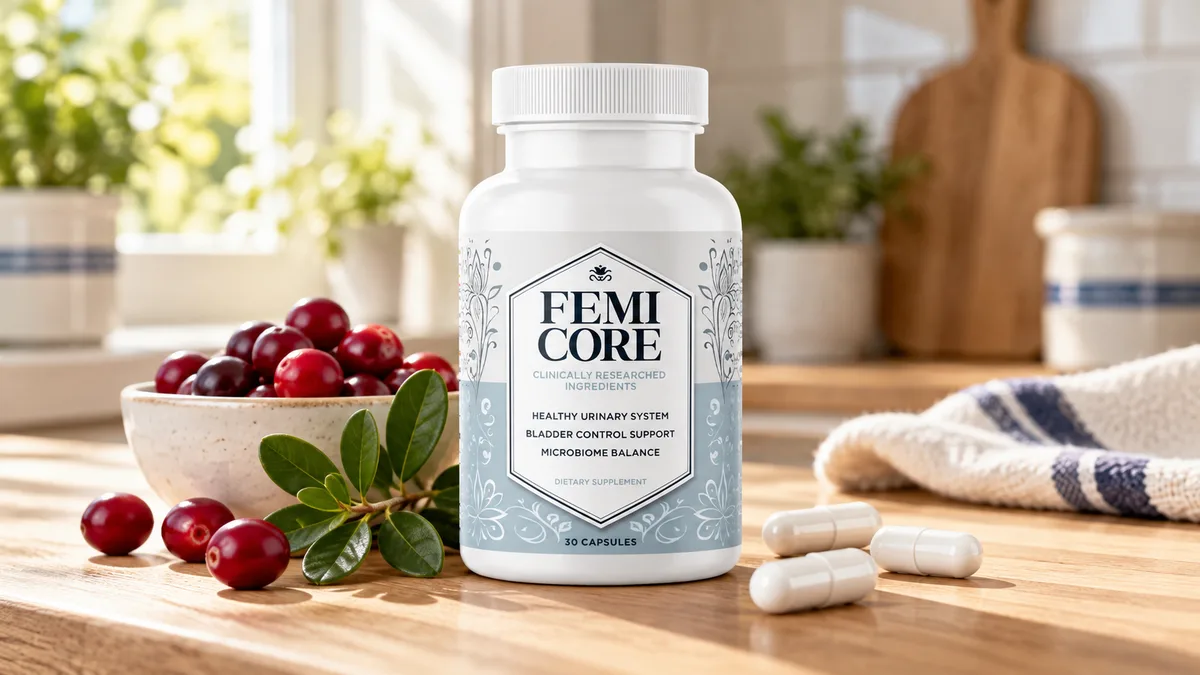
Before you take any supplement every day, it is worth knowing exactly what is inside the capsule. This FemiCore ingredients list walks through all nine components of the formula one at a time: what each ingredient is, why it appears in a bladder and urinary support product, what the research does and does not show, and the details the label leaves out.
FemiCore is a once-daily capsule marketed to women who deal with bladder leaks, sudden urges and night-time bathroom trips. Its formula pairs four plant-based ingredients with five Lactobacillus probiotic species. If you want our overall verdict on the product, read the full FemiCore reviews article. This page stays focused on the ingredients.
See FemiCore on the Official Store
Check the ingredients and current package options directly with the manufacturer. Every order carries a 60-day money-back guarantee.
Visit the Official FemiCore Store
60-Day Money-Back GuaranteeTable of Contents
The Complete FemiCore Ingredients List
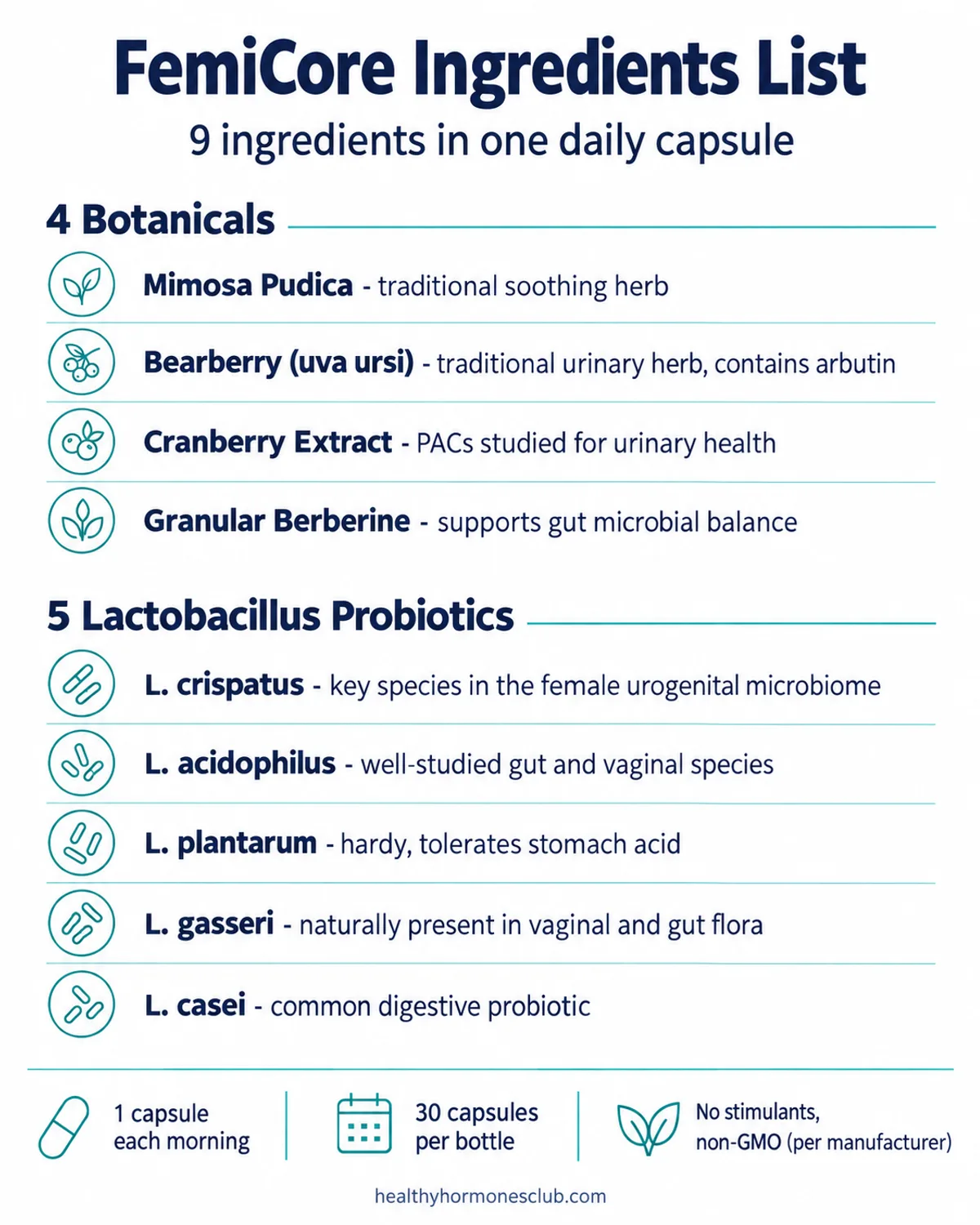
According to the official website, each FemiCore capsule contains the following nine ingredients, combined in what the manufacturer calls an “optimally dosed” proprietary blend:
| # | Ingredient | Type | Main reason it is included |
|---|---|---|---|
| 1 | Mimosa Pudica | Botanical | Traditional soothing, astringent herb |
| 2 | Bearberry (uva ursi) | Botanical | Traditional urinary herb; contains arbutin |
| 3 | Cranberry Extract | Botanical | Proanthocyanidins (PACs) studied for urinary health |
| 4 | Granular Berberine | Plant alkaloid | Gut environment and microbial balance |
| 5 | Lactobacillus crispatus | Probiotic | Key species in a healthy female urogenital microbiome |
| 6 | Lactobacillus acidophilus | Probiotic | Well-studied gut and vaginal health species |
| 7 | Lactobacillus plantarum | Probiotic | Hardy gut species that tolerates stomach acid |
| 8 | Lactobacillus gasseri | Probiotic | Naturally present in vaginal and gut flora |
| 9 | Lactobacillus casei | Probiotic | Common digestive probiotic |
The website also describes FemiCore as a natural formula with no stimulants and non-GMO ingredients. The recommended use is one capsule every morning with a big glass of water, and each bottle holds 30 capsules, so one bottle lasts a month.
Why a Bladder Formula Contains Probiotics
More than half of FemiCore’s ingredients are bacteria. That design comes from a fairly new line of research.
For decades, healthy urine was assumed to be sterile. Starting around 2012, researchers at Loyola University Chicago and other centers used DNA sequencing and enhanced culture methods to show that the female bladder has its own community of bacteria, often called the urinary microbiome. Some of those studies found that women with urgency incontinence tended to have different bacterial communities, with fewer Lactobacillus species, than women without symptoms.
FemiCore’s formula is built on that idea. It is a reasonable hypothesis, but early science: a difference in bacteria between two groups does not prove that swallowing probiotics will change bladder symptoms.
The 4 Botanical Ingredients in FemiCore
1. Mimosa Pudica
What it is: a creeping plant in the pea family, nicknamed the “sensitive plant” or “touch-me-not” because its leaves fold up when touched. It has a long history in Ayurvedic and other traditional medicine systems, where it was used as an astringent, and its seeds are popular in gut “cleanse” products.
Why it is in FemiCore: as a soothing ingredient.
What the research says: laboratory and animal studies have reported anti-inflammatory, antimicrobial and antispasmodic activity. We could not find human clinical trials on Mimosa Pudica for bladder symptoms. Of the nine ingredients, it has the thinnest evidence for this use.
2. Bearberry (Uva Ursi)
What it is: a low evergreen shrub (Arctostaphylos uva-ursi) whose leaves have been used for urinary complaints in European herbal medicine for centuries. Its key compound is arbutin, which the body converts into hydroquinone. Hydroquinone is excreted in urine and has antibacterial activity there.
Why it is in FemiCore: to support a clean urinary tract.
What the research says: the mechanism is well described in the lab, but human trial evidence is limited and mixed. European herbal regulators treat bearberry as a traditional remedy for mild lower urinary complaints and recommend it only for short courses, not continuous daily use. That is worth knowing for a product meant to be taken every day, and it is one reason the undisclosed dose matters. We cover the safety details in our FemiCore side effects guide.
3. Cranberry Extract
What it is: a concentrated extract of the North American cranberry (Vaccinium macrocarpon). Its A-type proanthocyanidins (PACs) appear to make it harder for E. coli bacteria to stick to the lining of the urinary tract.
What the research says: cranberry has the largest body of human research among FemiCore’s plant ingredients, but the results are mixed. A 2023 Cochrane review concluded that cranberry products can reduce the risk of repeat urinary tract infections in women who get them often, while earlier reviews and some large trials found little benefit. Results seem to depend on the product and the amount of PACs it delivers. Note also that cranberry has been studied mainly for infections, not for leaks or urgency on their own.
4. Granular Berberine
What it is: a bright yellow alkaloid found in plants such as barberry, goldenseal and Chinese goldthread.
Why it is in FemiCore: the manufacturer includes it to support the gut environment, since the gut is where many urinary bacteria come from.
What the research says: berberine has solid human research behind it, but mostly for blood sugar and cholesterol. Laboratory work shows antimicrobial effects and changes in gut bacteria. Bladder-specific human evidence is lacking. Berberine is also the ingredient with the most known drug interactions in this formula, so it deserves a conversation with your pharmacist if you take prescription medication.
Compare the Formula for Yourself
Four botanicals and five probiotic species in one daily capsule. Order from the official store to get genuine product and the full 60-day guarantee.
Check FemiCore’s Official Page
The 5 Probiotic Strains in FemiCore
All five probiotics belong to the Lactobacillus group. (Since a 2020 reclassification, you may also see L. plantarum called Lactiplantibacillus plantarum and L. casei called Lacticaseibacillus casei.)
5. Lactobacillus crispatus
The signature species of a healthy vaginal microbiome in many women. It produces lactic acid, which keeps the environment acidic and less welcoming to unwanted bacteria. Its most cited human evidence is a small placebo-controlled trial in which a vaginal L. crispatus product reduced repeat urinary tract infections in women prone to them. That product was delivered vaginally, not swallowed, so whether an oral capsule reaches the urogenital tract in the same way is less certain.
6. Lactobacillus acidophilus
One of the most widely used probiotics, studied mainly for digestive health and often included in combination products aimed at vaginal health.
7. Lactobacillus plantarum
A hardy species that tends to survive stomach acid well, which helps in an oral capsule. Research focuses on gut barrier function and digestive comfort, such as bloating.
8. Lactobacillus gasseri
Naturally found in both the vaginal and gut flora and commonly used in women’s probiotic formulas.
9. Lactobacillus casei
A familiar digestive probiotic found in fermented dairy. It rounds out the blend rather than targeting the bladder.
One important caveat applies to all five: probiotic effects are strain-specific. Research is done on particular strains, identified by codes after the species name. FemiCore lists species only, so you cannot match its probiotics to specific studies.
What the FemiCore Label Does Not Tell You
The ingredient names are public. The amounts are not. Based on the information on the official website, these details are missing:
- Individual doses. The blend is proprietary, so there is no milligram amount for any single ingredient.
- Probiotic count. No colony-forming unit (CFU) figure is published, and no statement on whether any count is guaranteed through the expiration date.
- Strain codes. Only species names are listed.
- Cranberry PAC content. Cranberry research suggests the PAC dose matters, but no standardization is stated.
- Bearberry arbutin content. This is the number that would help you and your doctor judge long-term use.
- Berberine dose. Blood sugar studies typically used around 1,000 to 1,500 mg a day in divided doses. With nine ingredients sharing one capsule, FemiCore likely contains less than that, but the label does not say.
- Testing details. The website displays certification badges, but we did not see a published certificate of analysis or named third-party testing.
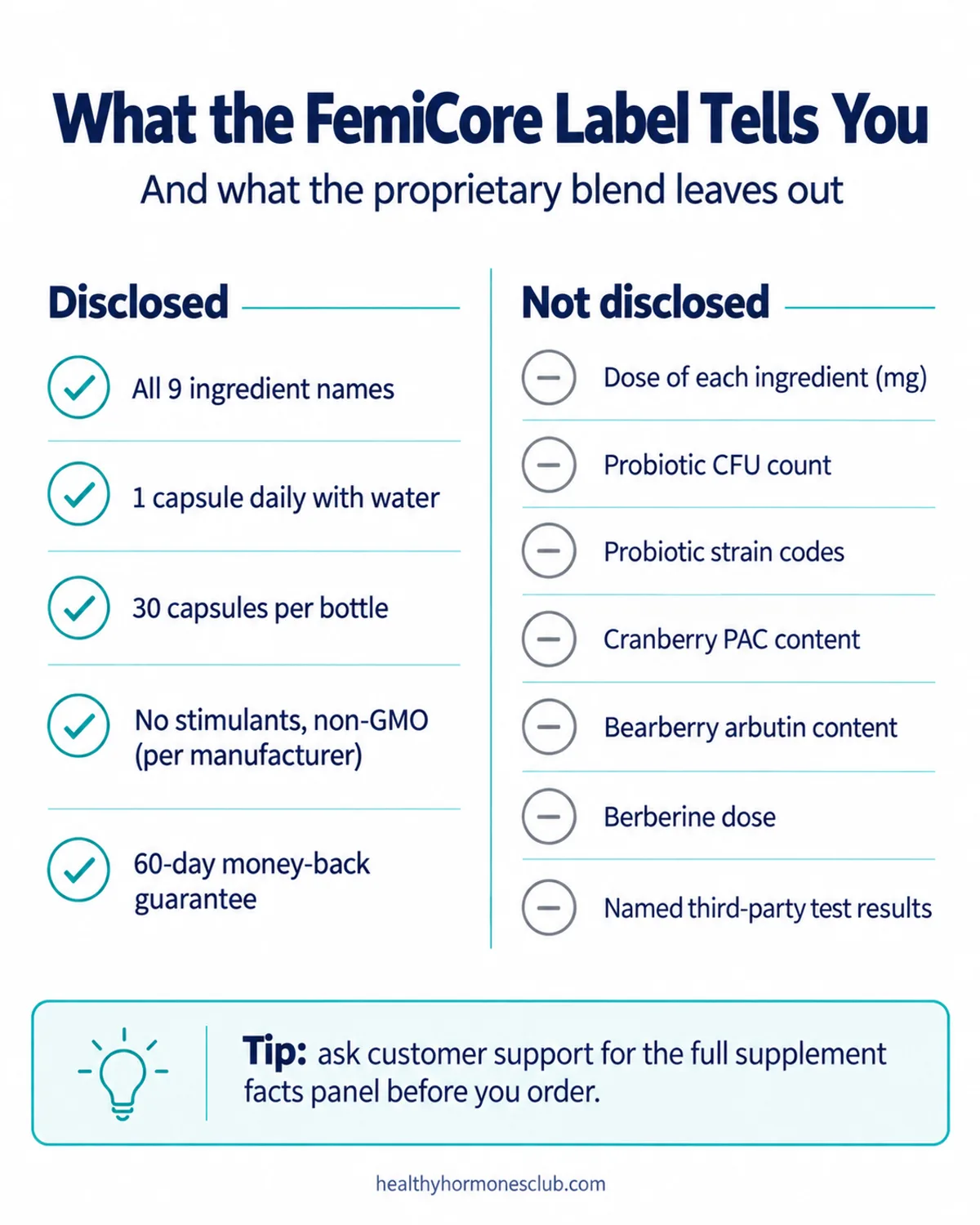
Proprietary blends are legal and common, but they mean you are trusting the manufacturer on dosing. Ask customer support for the full supplement facts panel before ordering, and read the label when the bottle arrives. If anything concerns you or your doctor, the 60-day guarantee lets you return it.
How the FemiCore Ingredients Fit Together
On paper the logic is clear: probiotics for protective bacteria, cranberry and bearberry for a clean urinary tract, berberine for the gut, and Mimosa Pudica as a soothing herb. Here is how we rate the evidence for urinary health:
| Ingredient | Evidence for urinary health |
|---|---|
| Cranberry Extract | Moderate but mixed; mostly for repeat infections |
| L. crispatus | Promising but early; best data uses vaginal delivery |
| Bearberry | Traditional use; limited human trials; short-term herb |
| Other Lactobacillus species | Good general gut and vaginal data; little bladder-specific |
| Berberine | Strong for blood sugar; little bladder-specific |
| Mimosa Pudica | Lab and animal studies only |
We could not find a published clinical trial testing the complete FemiCore formula, so the case rests on the individual ingredients rather than direct proof.
Try the Full 9-Ingredient Formula Risk-Free
Prices start at $49 per bottle on the six-bottle package, with free US shipping on three and six bottles.
See Current FemiCore Prices
60-Day Money-Back GuaranteeFrequently Asked Questions
What ingredients are in FemiCore?
FemiCore contains nine ingredients: four botanicals (Mimosa Pudica, Bearberry, Cranberry Extract and Granular Berberine) and five probiotic species (Lactobacillus crispatus, L. acidophilus, L. plantarum, L. gasseri and L. casei). They are combined in a proprietary blend, taken as one capsule each morning with a large glass of water.
Does FemiCore list the amount of each ingredient?
No. The official website describes the formula as an optimally dosed proprietary blend but does not publish the milligram amount of each botanical or the probiotic count. That makes it impossible to compare FemiCore’s doses with the doses used in research. You can ask customer support for the full supplement facts panel before ordering, and check the label when your bottle arrives.
How many probiotic strains does FemiCore contain?
FemiCore lists five Lactobacillus species: L. crispatus, L. acidophilus, L. plantarum, L. gasseri and L. casei. The website does not state the colony-forming unit (CFU) count or the specific strain codes, which matters because probiotic research results apply to particular strains rather than to a species as a whole.
Is there cranberry in FemiCore?
Yes. Cranberry Extract is one of the four botanicals. Cranberry is the most studied of FemiCore’s plant ingredients for urinary health, mainly for its proanthocyanidins (PACs), although research results are mixed and depend on the product and dose. FemiCore does not disclose its cranberry dose or PAC content.
Are FemiCore’s ingredients safe to take every day?
Most of the ingredients are widely used, but two need extra care. Berberine can interact with several medications, including diabetes drugs and cyclosporine, and is not recommended in pregnancy or breastfeeding. Bearberry (uva ursi) is traditionally used in short courses and is not advised in pregnancy or kidney disease. Talk to your doctor or pharmacist before daily use if you take medication or have a health condition. Our FemiCore side effects guide goes through each one.
Is FemiCore stimulant-free and non-GMO?
The official website describes FemiCore as a natural formula with no stimulants and non-GMO ingredients. None of the nine listed ingredients is a stimulant such as caffeine. For allergen details, such as the capsule material or any fillers, check the label on the bottle or ask customer support.
The Bottom Line
The FemiCore ingredients list is easy to understand: four botanicals with a history in urinary and gut health, plus five Lactobacillus species chosen to support the female urogenital microbiome. Cranberry and L. crispatus have the most relevant research, bearberry and berberine call for some caution, and Mimosa Pudica rests mostly on traditional use. The biggest gap is transparency, because the proprietary blend hides every dose. If the approach makes sense to you, buy from the official store for the 60-day guarantee and show the label to your pharmacist if you take medication. To find the genuine store, see our FemiCore official website guide, or get a quick summary on our FemiCore overview page.
Get Genuine FemiCore From the Official Store
All nine ingredients, one capsule a day, and a full 60-day money-back guarantee.
Order FemiCore Today
Free US Shipping on 3 & 6 Bottles