
If you are thinking about a daily bladder supplement, asking about FemiCore side effects first is exactly the right instinct. FemiCore is a once-daily capsule with nine ingredients: four botanicals and five probiotic species. Most of them have a long track record, but a couple deserve real caution, especially if you take prescription medication.
The manufacturer does not publish side-effect data for the finished formula, so this guide works the way a careful pharmacist would: ingredient by ingredient, using what is known about each one. We also cover medication interactions, who should check with a doctor first, and the bladder symptoms that need medical care rather than a supplement. For a full product review, see our FemiCore reviews.
Read the Label Before You Buy
See FemiCore’s ingredients on the official store, and share them with your pharmacist if you take medication. Every order has a 60-day money-back guarantee.
View FemiCore on the Official Site
60-Day Money-Back GuaranteeTable of Contents
Are FemiCore Side Effects Common?
For most healthy adults, the side effects you are most likely to notice are mild and digestive: some gas or bloating while your gut adjusts to new probiotics, or an upset stomach from the botanicals. The official website lists no side-effect information, and there is no published trial of the complete formula, so nobody can give you an accurate percentage.
The bigger safety questions are not about everyday discomfort. They are about who is taking it (pregnancy, kidney or liver disease) and what else they are taking (blood thinners, diabetes drugs, transplant medicines). FemiCore’s proprietary blend does not disclose individual doses, which makes these questions harder to answer and makes a quick check with your pharmacist more worthwhile.
FemiCore Side Effects by Ingredient
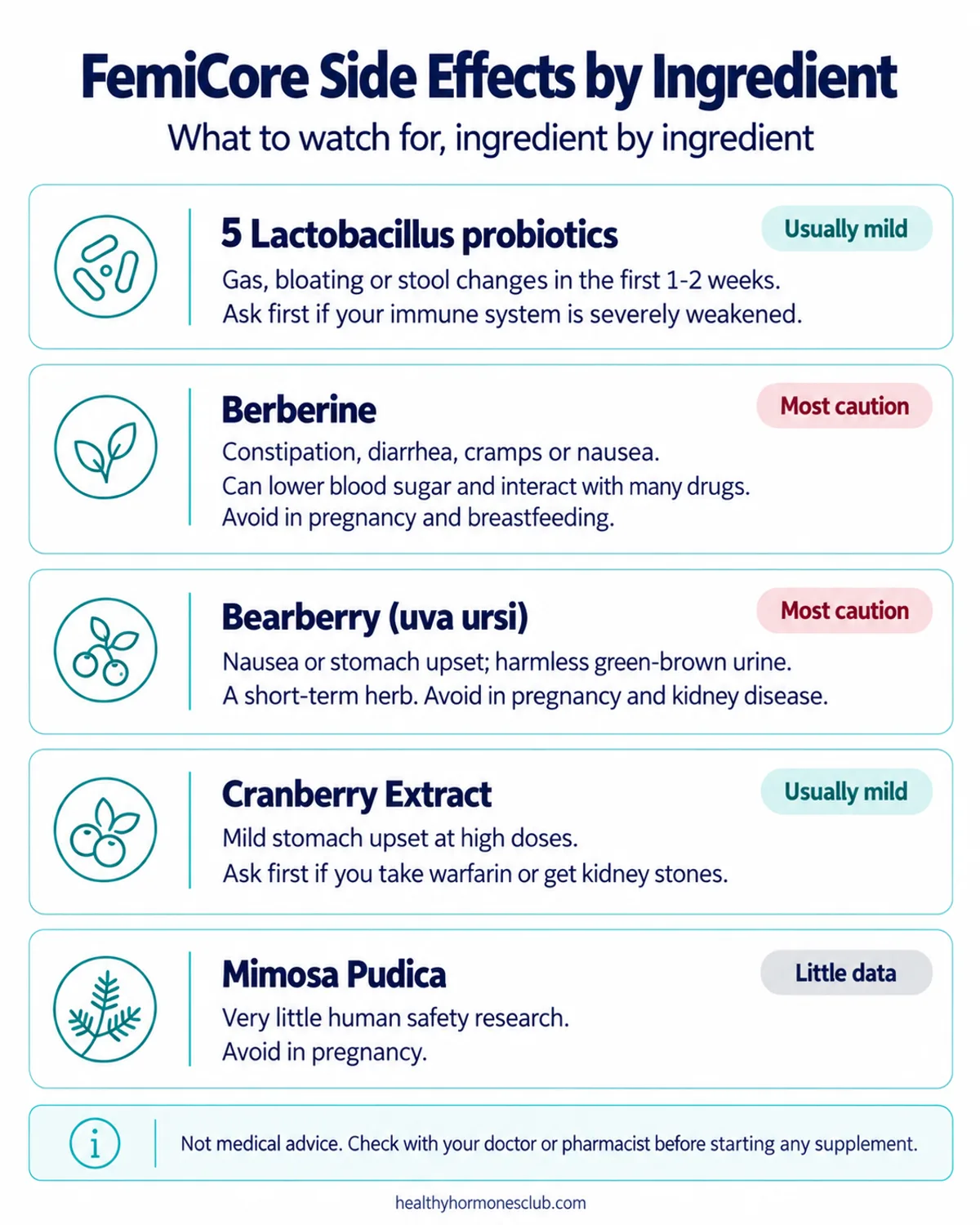
The 5 probiotics: a short adjustment period
FemiCore contains Lactobacillus crispatus, L. acidophilus, L. plantarum, L. gasseri and L. casei. Lactobacillus species are among the most widely used probiotics and are generally well tolerated.
- Common: gas, bloating or a change in stool habits during the first one to two weeks.
- Rare but serious: in people with severely weakened immune systems (for example, during chemotherapy, after an organ transplant, or with a central IV line), probiotics have occasionally caused infections. If that applies to you, do not start any probiotic without your specialist’s approval.
Berberine: the ingredient that needs the most care
Berberine is a plant alkaloid with real biological effects, which is also why it carries more cautions than anything else in the formula.
- Digestive effects: constipation, diarrhea, cramping, gas and nausea are the most reported side effects in studies.
- Blood sugar: berberine can lower blood glucose. Combined with diabetes medication, that could push blood sugar too low.
- Drug metabolism: berberine can slow liver enzymes (such as CYP3A4 and CYP2D6) that clear many prescription drugs, which can raise their levels in your blood.
- Pregnancy, breastfeeding and newborns: berberine is considered unsafe in pregnancy and while breastfeeding, partly because it may worsen jaundice in newborns.
Bearberry (uva ursi): a short-term herb
Bearberry leaf contains arbutin, which the body turns into hydroquinone. That compound is the reason bearberry has been used for urinary complaints, and also the reason it comes with limits.
- Possible effects: nausea, vomiting and stomach upset. It can also turn urine a greenish-brown color, which is harmless.
- Duration: herbal authorities recommend bearberry only for short courses, typically around a week at a time, because of concerns about long-term hydroquinone exposure. FemiCore is designed for daily use, and its bearberry dose is not disclosed. Ask your doctor about this before taking it for months.
- Do not use during pregnancy or breastfeeding, with kidney disease, or in children.
Cranberry extract: mostly gentle
- Possible effects: mild stomach upset or diarrhea, usually at higher doses.
- Warfarin: there are case reports of cranberry products changing warfarin’s effect and increasing bleeding risk. Studies are mixed, but anyone on warfarin should ask before taking cranberry supplements and may need extra INR checks.
- Kidney stones: concentrated cranberry products contain oxalate, so people with a history of oxalate stones should check with their doctor.
Mimosa Pudica: little human data
Mimosa Pudica has a long history of traditional use, but there is very little human safety research. No specific side-effect pattern is well documented. That lack of data is itself a reason to avoid it during pregnancy and breastfeeding.
Not Sure It Suits You? You Have 60 Days
If FemiCore does not agree with you, the official store’s money-back guarantee covers every package, opened or unopened.
See the Official Guarantee
Medication Interactions to Know
This table is not a complete list. It covers the interactions most relevant to women 35 and older, based on the known properties of FemiCore’s ingredients.
| If you take… | Ingredient of concern | Why it matters |
|---|---|---|
| Warfarin or other blood thinners | Cranberry, berberine | Possible change in clotting effect; ask about INR monitoring |
| Diabetes medicines (metformin, insulin, sulfonylureas) | Berberine | Added blood sugar lowering; risk of lows |
| Cyclosporine or tacrolimus | Berberine, probiotics | Berberine can raise cyclosporine levels; probiotics need caution when immunosuppressed |
| Blood pressure medicines | Berberine | May lower blood pressure further |
| Other drugs cleared by the liver (some statins, antidepressants, sedatives) | Berberine | Slower clearance can raise drug levels |
| Lithium | Bearberry | Water-pill-like effect may change lithium levels |
| Antibiotics | Probiotics | Antibiotics may reduce probiotic benefit; ask about spacing doses |
Also avoid stacking: if you already take a separate berberine, uva ursi or cranberry supplement, adding FemiCore increases your total dose of that ingredient.
Who Should Talk to a Doctor Before Taking FemiCore
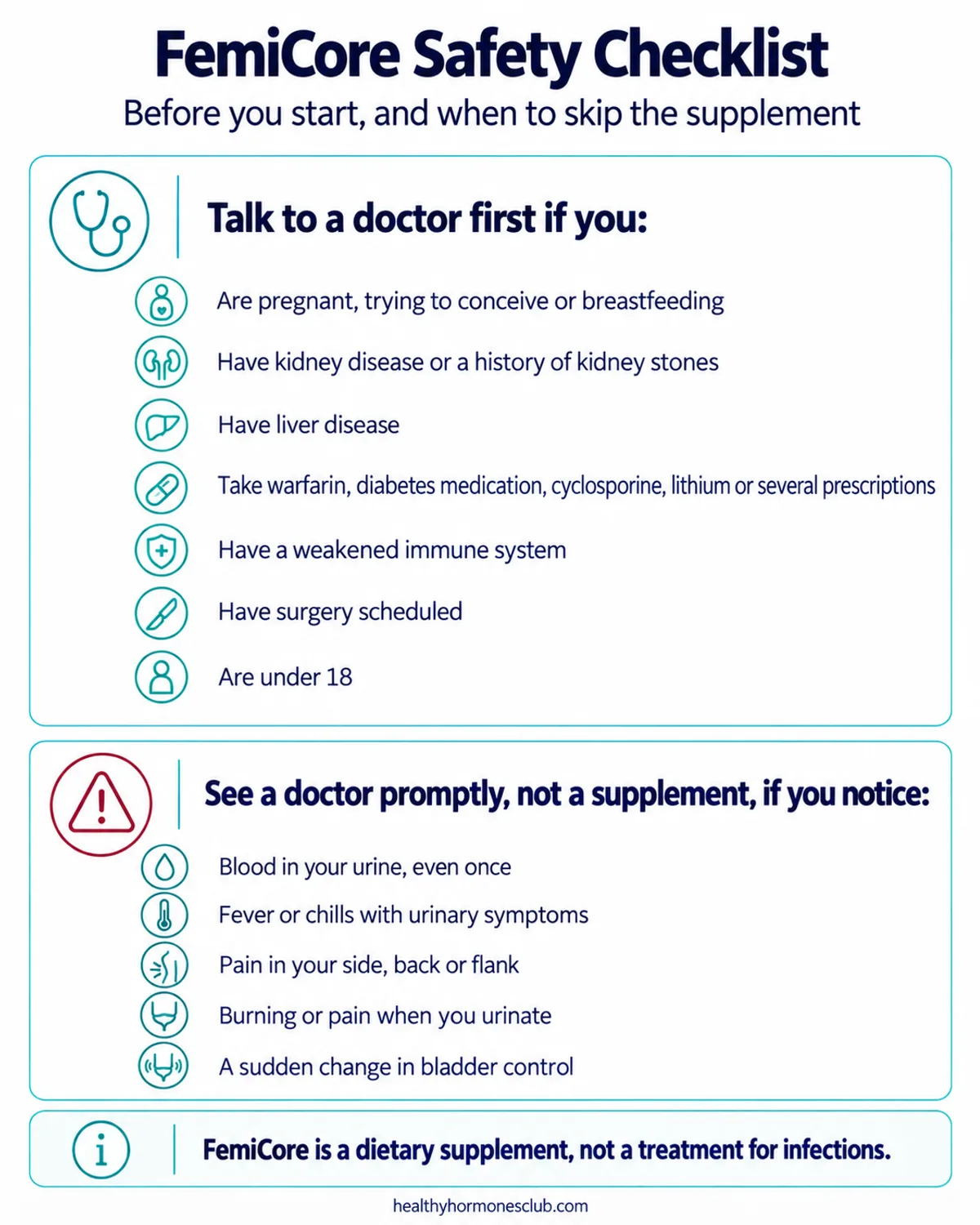
The official website advises consulting a physician if you are pregnant, nursing, taking medication or have a medical condition. In practical terms, get medical advice first if you:
- Are pregnant, trying to conceive or breastfeeding (berberine and bearberry are not recommended)
- Have kidney disease or a history of kidney stones
- Have liver disease
- Take warfarin, diabetes medication, cyclosporine, lithium or several prescription drugs
- Have a weakened immune system or a central IV line
- Have surgery scheduled (berberine can affect blood sugar and blood pressure)
- Are under 18
Bladder Symptoms That Need a Doctor, Not a Supplement
FemiCore is a dietary supplement for general bladder support. It is not a treatment for infections or other medical conditions. See a doctor promptly, rather than trying a supplement, if you notice:
- Blood in your urine, even once
- Fever, chills or feeling generally unwell with urinary symptoms
- Pain in your side, back or flank
- Burning or pain when you urinate
- A sudden change in bladder control, or leaks that appeared with other new symptoms
- Confusion or sudden behavior change in an older relative with urinary symptoms
These can be signs of a urinary tract or kidney infection, or another condition that needs testing. A bladder infection usually needs antibiotics, and delaying treatment can let it reach the kidneys.
How to Lower Your Risk If You Try FemiCore
- Show the label to your pharmacist if you take any prescription medication. Ask FemiCore support for the full supplement facts panel if you need it before ordering.
- Follow the label dose of one capsule each morning with a large glass of water. Taking more will not speed things up.
- Watch the first two weeks. Mild gas or bloating is common with probiotics. Stop and seek advice if you get a rash, ongoing stomach pain, dizziness or anything that worries you.
- Check your blood sugar more often in the first weeks if you have diabetes, as your doctor advises.
- Ask about long-term bearberry before using FemiCore for many months.
- Keep your packing slip. If FemiCore does not suit you, the 60-day guarantee lets you return all bottles, used or unused, for a refund.
To understand what each ingredient is meant to do, read our FemiCore ingredients list. And to make sure you receive genuine, properly stored product, buy only through the FemiCore official website.
Buy Genuine FemiCore, Not a Knock-Off
Unofficial sellers cannot guarantee what is in the capsule. The official store ships genuine product with a 60-day refund policy.
Order From the Official Store
Free US Shipping on 3 & 6 BottlesFrequently Asked Questions
Does FemiCore have side effects?
The manufacturer does not publish side-effect data for the FemiCore formula, so the best guide is what is known about its ingredients. The most likely effects are mild and digestive: gas or bloating from the probiotics in the first week or two, and stomach upset, constipation or diarrhea from berberine or bearberry. More important than these are drug interactions and the groups of people who should not take it without medical advice.
Can FemiCore interact with my medications?
It can. Berberine affects liver enzymes that process many drugs and lowers blood sugar, so it may interact with diabetes medicines, cyclosporine and other prescription drugs. Cranberry has been linked in case reports to changes in warfarin’s effect, and bearberry may affect lithium levels. If you take any prescription medication, show the FemiCore label to your pharmacist or doctor before starting.
Is FemiCore safe during pregnancy or breastfeeding?
No, it should not be taken during pregnancy or breastfeeding unless your doctor specifically approves it. Berberine is considered unsafe in pregnancy and while nursing, bearberry is not recommended in pregnancy, and there is little safety data for Mimosa Pudica. The official website itself advises consulting a physician if you are pregnant or nursing.
Can I take FemiCore if I have kidney disease?
Talk to your doctor first. Bearberry is generally not advised for people with kidney disease, and concentrated cranberry products may not suit people with a history of oxalate kidney stones. Because FemiCore does not disclose its ingredient amounts, your doctor will need to see the label to judge whether it is appropriate for you.
How long do probiotic side effects from FemiCore last?
Digestive changes such as gas, bloating or looser stools from starting a probiotic usually settle within one to two weeks as your gut adjusts. If symptoms are severe, keep getting worse or last beyond two weeks, stop taking FemiCore and speak with your doctor.
When should I see a doctor instead of taking a bladder supplement?
See a doctor promptly if you notice blood in your urine, fever or chills, pain in your side or back, burning when you urinate, or a sudden change in bladder control. These can be signs of an infection or another condition that needs medical treatment. A supplement like FemiCore is not a substitute for diagnosis or antibiotics.
The Bottom Line
For a healthy adult who is not on interacting medication, the FemiCore side effects you are most likely to meet are mild digestive changes that settle within a couple of weeks. The real cautions sit with two ingredients: berberine, which interacts with diabetes drugs, cyclosporine and other medicines and is not for pregnancy, and bearberry, which is traditionally a short-term herb and not for pregnancy or kidney disease. If any of that applies to you, speak to your doctor before ordering. If it does not, buy from the official store, start with the label dose, and use the 60-day guarantee if it does not agree with you. A quick product summary is on our FemiCore overview page.
Try FemiCore With a 60-Day Safety Net
Genuine product from the official store, from $49 per bottle, with a full money-back guarantee.
Visit the Official FemiCore Website
60-Day Money-Back Guarantee