Most genius song reviews repeat the same story: a dormant “genius” brain wave, a discovery at a famous university, and a 7-minute track, The Genius Song, that switches it back on. Stars and testimonials cannot tell you whether that story is true. The claims can be checked, though. So instead of collecting opinions, this article takes the main claims in the seller’s 39-minute sales video, one by one, and compares each with published research and with the seller’s own Terms of Service.
Quick background: The Genius Song is a digital audio track sold for $39 through ClickBank, with a 90-day refund window. The seller says it is about 7 minutes long and meant to be played once a day with headphones.
Read the Claims at the Source
The sales presentation and the Terms are both on the seller’s site. One-time $39, 90-day refund window.
Visit the Official Website
All benefits are the seller’s claimsTable of Contents
Why the Claims Matter More Than Stars
A review that says “it changed my life” tells you about one person, if that person is real. The seller’s Terms say names in its marketing “have been changed,” that feedback may be acted out by “digital representations, avatars, or actors,” and that featured results “may not reflect the experience of a typical customer.” That makes the testimonials a weak guide.
The science story is different. It names universities, studies and dates. If those check out, that would matter. If they do not, no number of positive reviews can fix it. That is why we focus on claims here.
The Claims, One by One
| The seller says | Where | What we found |
|---|---|---|
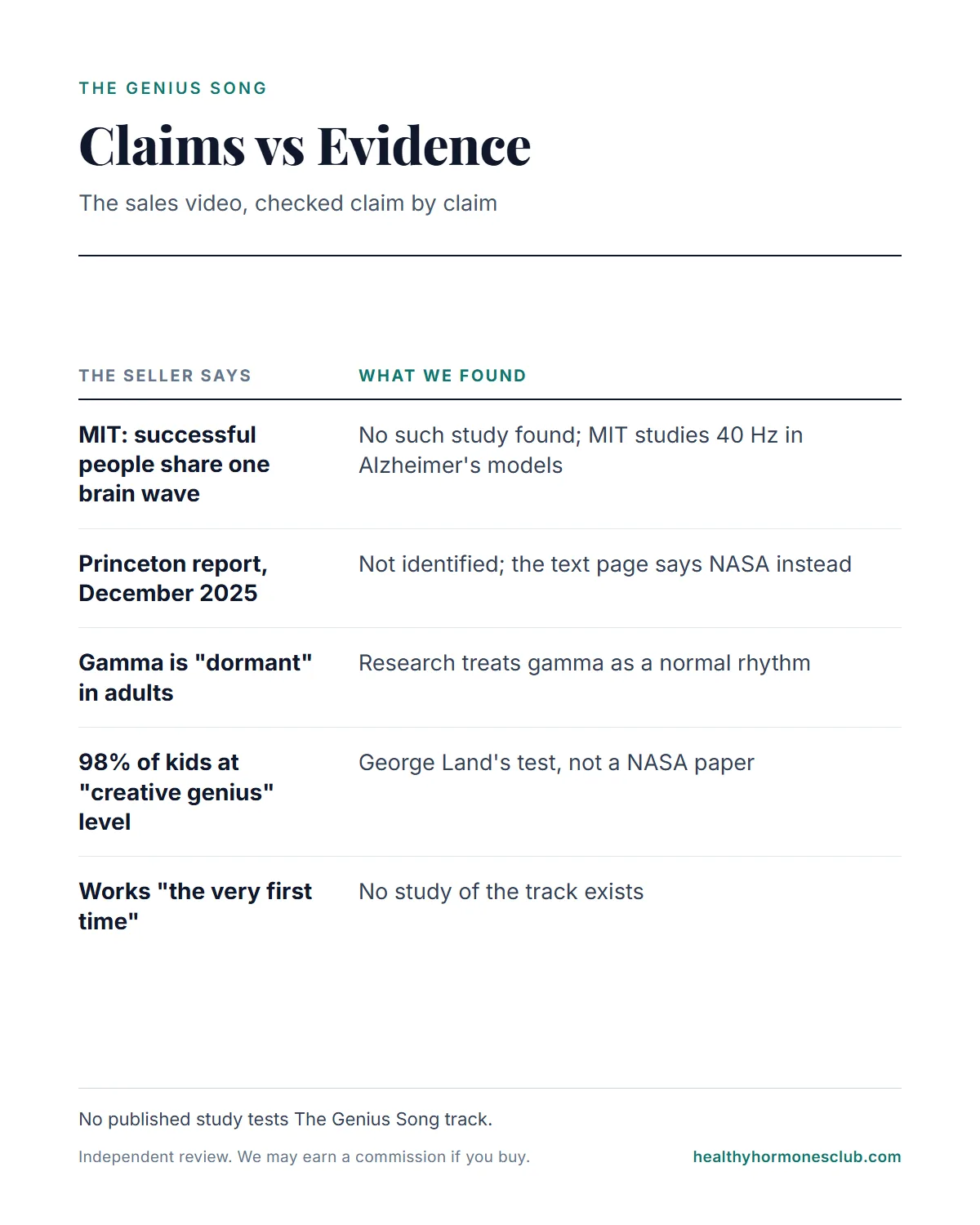
| ”MIT found that all lucky, wealthy, successful people have this one brain wave” | Video 00:14 | No published study shows this. MIT’s 40 Hz work studies Alzheimer’s models, not luck or wealth. |
| A “brand new discovery in twenty twenty six” and a Princeton report published December 27, 2025 | Video 01:25 to 02:13 | We could not identify this report. The text page tells the same story with NASA instead of Princeton. |
| A British double-blind study in which children knew who was calling | Video 02:47 | Not traced to any published study we could find. |
| Gamma is “dormant” or “deactivated” in adults by modern life | Video 01:16, 04:08 | Research treats gamma as a normal rhythm tied to attention and memory processing. We found no study showing it is switched off in adults. |
| Wisconsin researchers studied a monk with powerful gamma | Video 05:04 | Likely a simplified version of a 2004 PNAS study (Lutz et al.) that recorded high-amplitude gamma in long-term meditators. It did not test any audio track. |
| NASA found “98% of the kids scored at ‘creative genius’ levels” | Text page | Traces to George Land’s creativity test, popularized in the 1992 book Breakpoint and Beyond. No peer-reviewed NASA paper reports it. |
| Columbia University showed gamma “could influence another person” | Video 06:13, 17:30, 37:05 | Unverified. We found no such published finding. |
| ”It starts working the very first time you listen” | Video 11:00 | No study of the track exists to support any timeline. |
One more inconsistency: the hook promises a “seven second brain trick,” but the product is a 7-minute track. The video never shows a 7-second trick separate from the track.
What Gamma Research Actually Shows
The core idea is not invented from nothing. Here is the fair version:
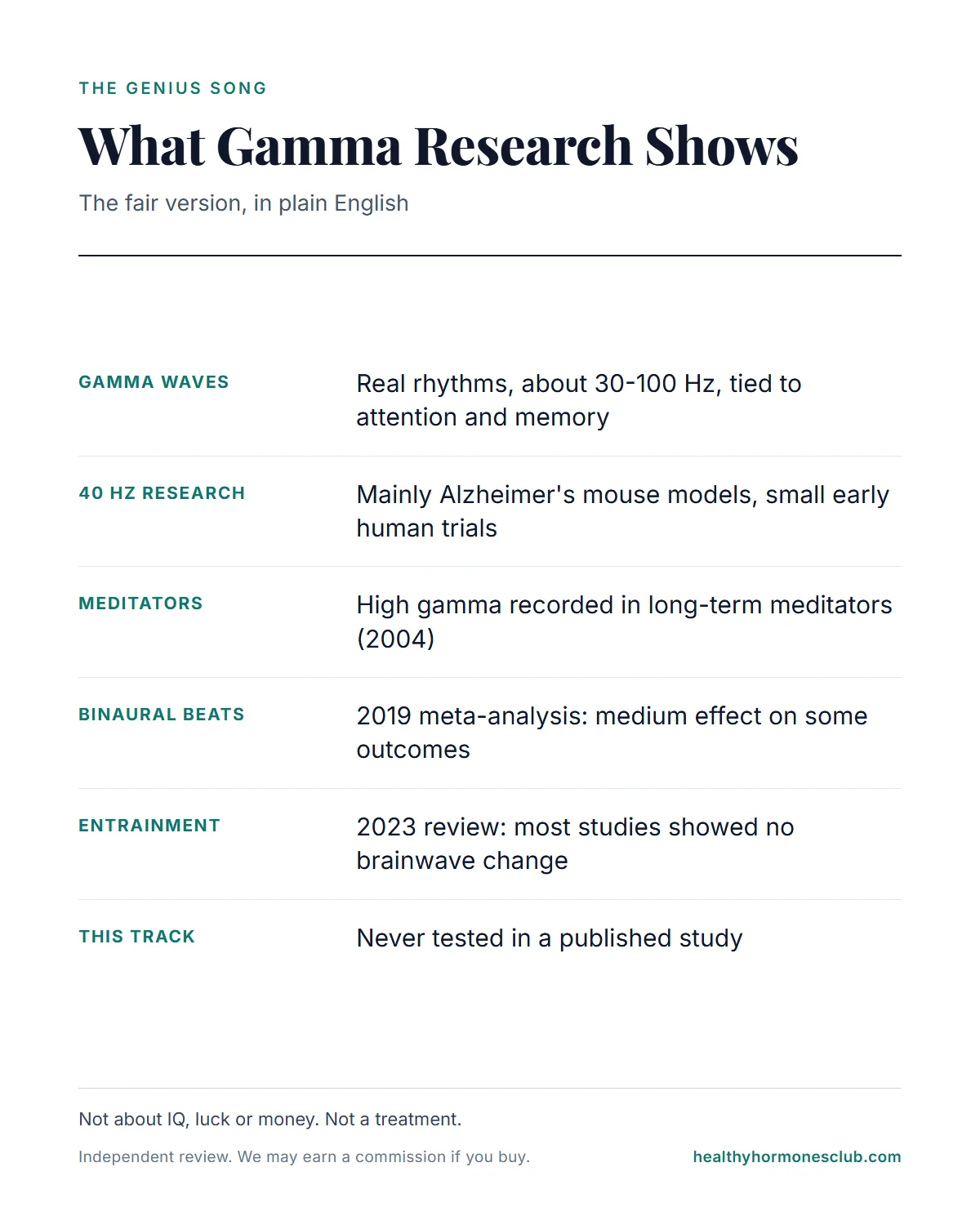
- Gamma waves are real. They are fast brain rhythms, roughly 30 to 100 Hz, linked in research to attention and memory processing.
- 40 Hz stimulation is being studied. MIT researchers in the Tsai lab have tested 40 Hz light and sound, mainly in mouse models of Alzheimer’s disease, with small early human trials. This is medical research, not research into IQ, luck or money.
- Meditators show strong gamma. Long-term meditators were recorded with high-amplitude gamma activity (Lutz et al., 2004, PNAS).
- Binaural beat research is mixed. A 2019 meta-analysis in Psychological Research found a medium overall effect on some outcomes, such as certain cognition, anxiety and pain measures, while a 2023 systematic review found most entrainment studies (8 of 14) did not show the brainwave change. No study has tested this product’s track.
- Nothing tests this track. No published study tests The Genius Song itself.
Low Price, Unproven Claims
If you want to try it anyway, the Terms and the ClickBank checkout both allow a refund within 90 days.
Check the Current Price on the Official Site
90-day refund window per the Terms and ClickBankWhat the Site’s Reference List Cites
The site shows a list of 14 references. When we read it, we noticed three things:
- It cites theta-wave and general entrainment studies, while the video is about gamma.
- It mixes research with creativity articles from Inc.com, Medium and a TED talk.
- It is identical to the list on the page for the related audio, a different audio from the same seller that the seller describes as a 12-minute theta track.
A shared, off-topic reference list does not prove anything false, but it does mean the list does not support the gamma claims in the video.
The Terms are also worth reading here. They say “brain entrainment is not an exact science and we recommend that you do not treat it as such. The products are provided for entertainment purposes only.” The same document states: “All claims regarding brainwave entrainment, focus, and mental energy are substantiated by established scientific research.” Both are the seller’s statements, side by side. We could not find that research for this track.
The Outcome Claims
The video connects the track to a long list of results: eureka moments, problems solved “with little to no effort,” faster learning, memory, luck, “abundance,” promotions, relationships, children’s grades, a colleague losing 16 lb, someone quitting smoking, migraines disappearing and joint pains easing. It says “many of our customers start to notice a difference” in “the first two to three days,” and that most daily listeners “begin to see results within a couple weeks.”
None of these is supported by a study of the track. Health outcomes in particular are not something an audio product should be trusted with: the site’s own line says the product “is not intended to diagnose, treat, cure, or prevent any disease.” On a casino win story, the presenter himself says “there is, of course, no evidence to support that the genius song caused that.” That honesty applies to the other stories too.
How This Changes the Way You Read Reviews
When a review repeats the MIT, Princeton or NASA story as fact, it is repeating marketing. When it presents “Dr. Robert Lake” as a verified scientist, it has missed the site’s own disclaimer: “Robert Lake is a pen name used with the consent of our leading neuroscientist.” A useful review separates three things: what is checkable (price, refund, delivery), what is research (gamma, 40 Hz, entrainment), and what is a sales claim (luck, money, health).
For how to weigh different review sources, see The Genius Song Reviews. For our scored verdict, see The Genius Song Review.
Where to Buy
The official site’s home page currently features the seller’s related audio, The Genius Wave; The Genius Song presentation is on the same site’s /video/ page.
Visit the Official Website
Charge appears as CLKBANK*Genius SongListening Safely
Our own advice for any audio-entrainment product: keep the volume comfortable, never listen while driving or operating machinery, and if you have epilepsy, a history of seizures or hearing problems, ask a doctor first.
Frequently Asked Questions
Do The Genius Song reviews prove that it works?
No. Most reviews repeat the seller’s claims or testimonials. No published study tests The Genius Song track, and the seller’s Terms say the products are provided for entertainment purposes only.
Did MIT find that successful people share one brain wave?
We found no published study showing that all lucky, wealthy, successful people share one brain wave. MIT researchers have studied 40 Hz light and sound stimulation, mainly in mouse models of Alzheimer’s disease with small early human trials, which is a different topic.
Are gamma waves real?
Yes. Gamma waves are real brain rhythms, roughly 30 to 100 Hz, linked in research to attention and memory processing. What is unproven is the seller’s claim that a 7-minute track can activate them to bring luck, money or genius-level thinking.
Can The Genius Song help with weight loss, smoking or migraines?
There is no evidence that it can. The video includes anecdotes about all three, but the site itself says the product is not intended to diagnose, treat, cure, or prevent any disease. See a doctor for those concerns.
Where does the 98% creative genius figure come from?
It traces to George Land’s creativity test, popularized in the 1992 book Breakpoint and Beyond. We found no peer-reviewed NASA paper reporting those figures.
What do the Terms say about the science?
They say two things side by side: that brain entrainment is not an exact science and the products are for entertainment purposes only, and that all claims about brainwave entrainment, focus and mental energy are substantiated by established research. We report both as the seller’s statements.
The Bottom Line
Checked claim by claim, the science in genius song reviews and in the sales video does not hold up. Gamma waves are real and 40 Hz stimulation is a genuine research area, but it is about Alzheimer’s models and small trials, not luck or wealth. The MIT, Princeton, British and Columbia stories could not be traced, the reference list is about other things, and no study tests the track. If you buy it, buy it the way the seller’s Terms describe it: as entertainment, with a 90-day refund window as your safety net.
Decide With the Facts in Hand
One-time $39, delivered digitally, with 90 days to ask for a refund through the seller or ClickBank.
Check the Current Price on the Official Site
Digital delivery, nothing to ship