The Genius Song gamma waves idea is the heart of the sales pitch: the seller says a short audio track can switch on a “dormant” fast brain rhythm called gamma. This post sets that claim next to what published research actually covers. Gamma rhythms are real and well studied. The research, however, is far narrower than the sales video suggests, and none of it tests this track. If you are new to the product itself, start with what is The Genius Song.
The seller’s claims below are quoted from its sales video and pages; the research summary is our own, written in plain terms.
See What the Seller Claims
Our link opens the seller’s official site. The gamma presentation is on its /video/ page.
Visit the Official Website
90-day refund window, keep your receiptTable of Contents
What Gamma Waves Are
Brain cells communicate with tiny electrical signals. When many cells fire in rhythm, the pattern can be picked up on the scalp with an EEG. Researchers group these rhythms by speed:
| Rhythm | Rough speed | Often linked with |
|---|---|---|
| Delta | Under 4 Hz | Deep sleep |
| Theta | About 4 to 8 Hz | Drowsiness, some memory tasks |
| Alpha | About 8 to 12 Hz | Relaxed wakefulness |
| Beta | About 13 to 30 Hz | Active thinking |
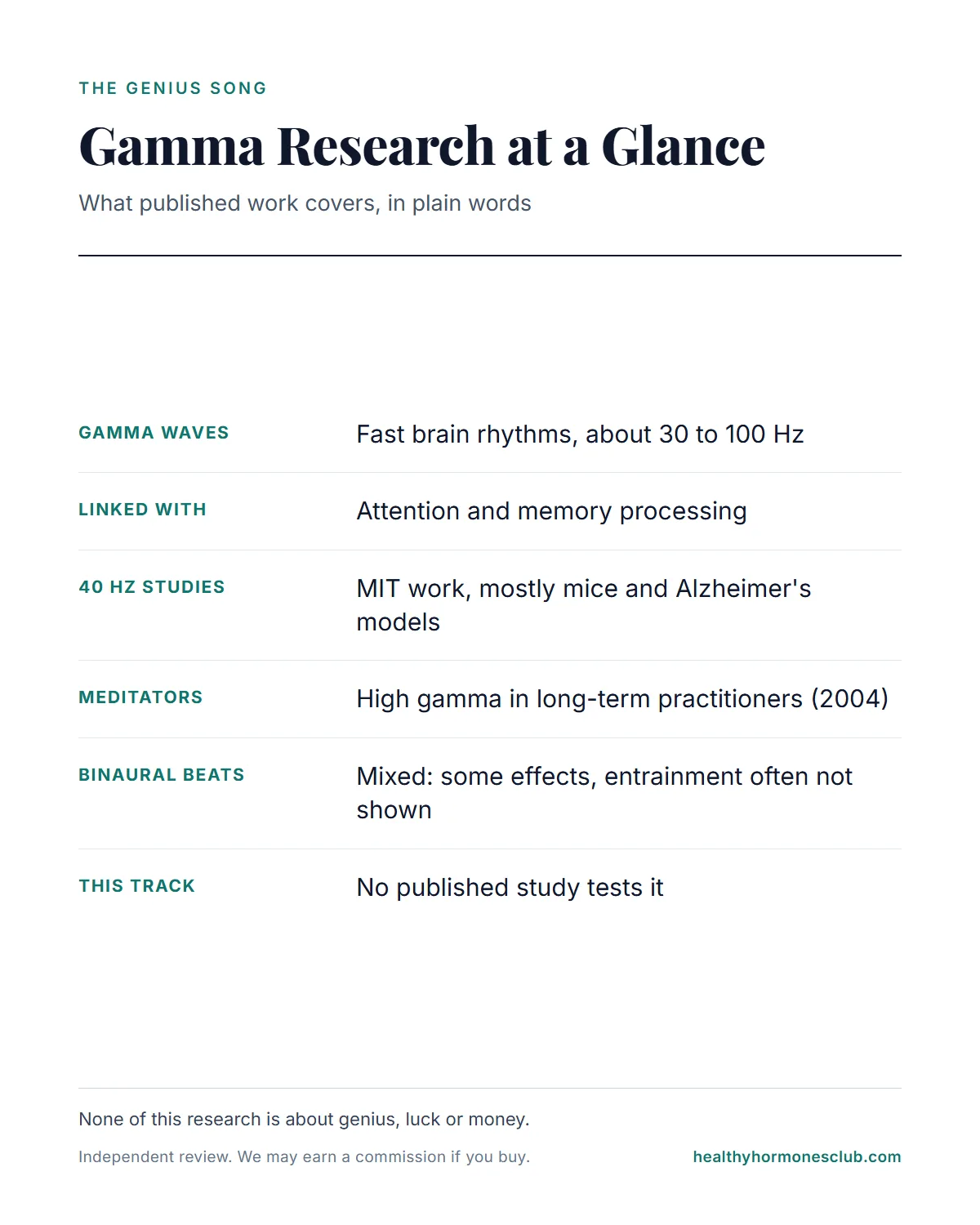
| Gamma | About 30 to 100 Hz | Attention and memory processing |
These bands are a rough guide, and the brain produces several at once. Gamma is the fastest. Research links it to attention and to how the brain processes and holds information. That is a real and active field. It is also a long way from “genius”, luck or wealth.
The Seller’s Gamma Story
The sales video is presented by a man who uses the pen name Dr. Robert Lake (the site says so in its disclaimer). His gamma story goes like this:
- Children have “a very active gamma wave”, while in adults it is “like it’s been deactivated”.
- Gamma is “the super brain wave”, and people with more of it “tend to be geniuses”.
- Four ways to “activate” it: meditate 20 minutes twice a day, wake up at 4 AM, use a biofeedback machine, or use “a special sound wave”.
- ”Brain entrainment normally takes one hour per session”, but his team turned it into “a seven minute sound wave”.
- The track can “activate gamma by connecting several regions of your brain”.
The video also cites research it does not name in full: an MIT finding that “all lucky, wealthy, successful people have this one brain wave”, a Princeton report, colleagues at an “Einstein Center in Berlin” linking flow states to gamma, and a Columbia University finding that your gamma “could influence another person”. The text version of the page swaps Princeton for NASA and Berlin for “colleagues in Japan”.
What 40 Hz Research Has Studied
The best-known gamma research outside the lab bench comes from MIT, where a team led by Li-Huei Tsai has studied 40 Hz stimulation: flickering light and clicking sound at 40 pulses per second. Here is what that work is, in plain terms:
- Who it was tested on: mainly mice bred to model Alzheimer’s disease, plus small, early trials in people.
- What it looked at: brain changes linked to Alzheimer’s disease.
- What it is not about: intelligence, creativity, luck, money or performance in healthy people.
- Where it stands: early. Mouse results do not always carry over to people, and human trials so far are small.
We found no published study showing that “all lucky, wealthy, successful people” share one brain wave, which is the claim the video opens with. The seller’s own reference list, at the bottom of its pages, cites theta and general entrainment studies plus creativity articles. It does not include the 40 Hz work, and it is identical to the list on the seller’s Genius Wave page, a different product built around theta.
Compare the Claims Yourself
Our link opens the seller’s site, where you can read its reference list and disclaimer.
Check the Current Price on the Official Site
90 days under the Terms and ClickBankThe Meditator Studies
The video mentions a man described as the “happiest man alive” whose brain “was pure gamma wave”. The research this probably simplifies is a 2004 study in PNAS from the University of Wisconsin (Lutz and colleagues). It recorded high-amplitude gamma activity in long-term Buddhist practitioners while they meditated, compared with people new to meditation.
What the study shows: experienced meditators produced strong gamma activity during a specific meditation practice. What it does not show: that anyone can reach that state by listening to a recording, or that gamma causes happiness, luck or success. Interestingly, the seller’s own list of ways to “activate” gamma puts meditation first, then calls it “very hard and time consuming”.
A related claim on the text page, that 98% of children score at “creative genius” level, traces to George Land’s creativity test, popularised in the book Breakpoint and Beyond (1992). We found no peer-reviewed NASA paper reporting those figures, and the test was about creativity, not brain waves.
Can Sound Shift Brain Rhythms?
”Brain entrainment” is the idea that a steady rhythm in sound or light can nudge brain rhythms to follow it. Binaural beats (two slightly different tones in each ear) are the best-known version. Research summaries point in different directions:
- A 2019 meta-analysis in Psychological Research (Garcia-Argibay and colleagues) pooled studies of binaural beats on thinking tasks, anxiety and pain, and found a medium overall effect on some of these outcomes.
- A 2023 systematic review (Ingendoh and colleagues) asked whether binaural beats actually entrain brain rhythms. Of 14 studies, 5 supported entrainment, 8 contradicted it and 1 was mixed.
- So the research is mixed: some measured effects on how people feel or perform, but most entrainment studies did not show the brainwave change itself. No study has tested this product’s track.
The seller’s own Terms agree on one point: they say “brain entrainment is not an exact science and we recommend that you do not treat it as such”. The same document also says its brainwave claims “are substantiated by established scientific research”. Both lines sit in the seller’s Terms.
What the Seller Does Not Tell You
- The frequency. On the pages and in the video we checked, the seller does not say what frequency the track uses, whether it is 40 Hz, or what the sound actually is (tones, music, binaural beats or something else).
- The method. “Brain entrainment” and “connecting several regions of your brain” are not explained in technical terms.
- The evidence for this track. No published study tests The Genius Song. “Seven minutes” is the seller’s statement; we did not buy the track and could not measure it.
- The testimonials. The Terms say they may be acted by avatars or actors, may come from friends or family of the founders, and some people were compensated.
To its credit, the video contains one honest line. On a story about luck at a casino, the presenter says “there is, of course, no evidence to support that the genius song caused that.” The same is true of the other outcomes in the video.
Claims and Research, Side by Side
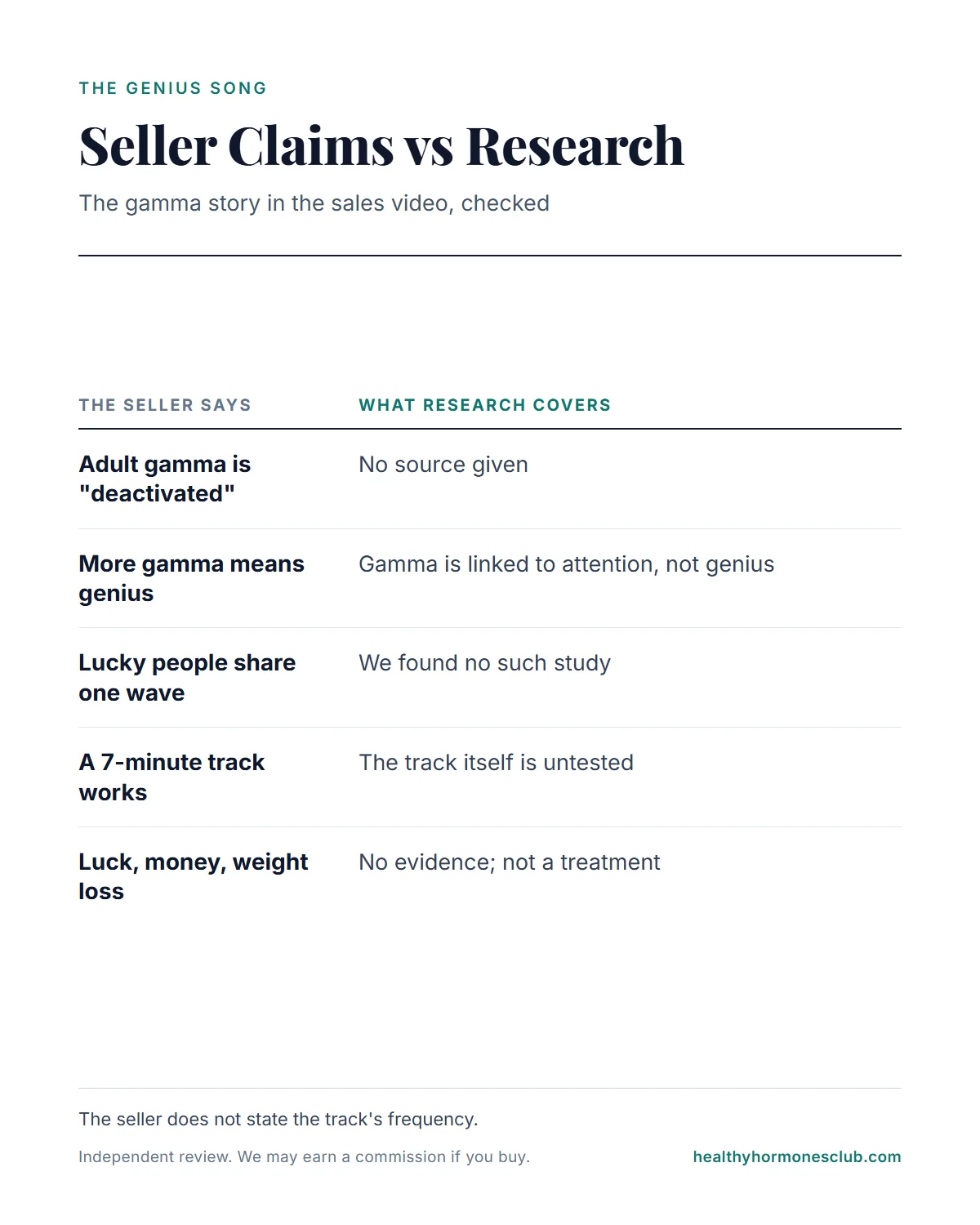
| The seller says | What research covers |
|---|---|
| Adult gamma is “deactivated” | No source given; gamma activity is recorded in adults in many studies |
| More gamma means genius | Gamma is linked to attention and memory processing, not to “genius” |
| Lucky, wealthy people share one brain wave | We found no such study |
| A sound track activates gamma | 40 Hz stimulation is studied mainly in Alzheimer’s models; this track is untested |
| Results from the first listen | The seller’s statement only |
| Luck, money, weight loss, migraines | No evidence; the seller’s FDA line says it treats no disease |
Our Verdict
The Genius Song borrows a real scientific topic and stretches it a long way. Gamma rhythms matter in brain research, and 40 Hz stimulation is a genuine area of study, but that work is early, mostly in animals and in Alzheimer’s disease, and does not test this product. Our editorial score is 3.0 out of 5, our own rating and not a customer average.
If you want to try it as a short listening routine, the facts are simple. It costs $39 once on a ClickBank checkout. The official site’s home page currently features the seller’s related audio, The Genius Wave; The Genius Song presentation is on the same site’s /video/ page, so check the product name on the checkout. Delivery is digital: the video says the track is emailed, while the text page describes a “Private Audio Portal” login, and no file format is stated. The bonus list differs between the video and the text page. The Terms and the checkout both give 90 days for a refund through ClickBank; the site’s /TOS/refunds/ page is a leftover “NeuroActivate” bottle policy and does not apply. Our Genius Song by Dr. Lake post covers the presenter’s pen name, and our Genius Song buy checklist helps you decide.
Go to the Seller’s Official Site
Our link opens geniussongoriginal.com. Payment, if you buy, goes through ClickBank.
Visit the Official Website
Statement shows CLKBANK*Genius SongFrequently Asked Questions
Does The Genius Song use gamma waves?
The seller says the track uses “brain entrainment” to guide the brain into gamma. On the pages and in the video we checked, the seller does not state what frequency the track uses or what kind of sound it is, and no published study has measured its effect on brain waves.
What are gamma waves?
Gamma waves are fast electrical rhythms in the brain, roughly 30 to 100 cycles per second (Hz). Research links them to attention and to how the brain processes and holds information.
What does 40 Hz research show?
Researchers at MIT have studied 40 Hz light and sound stimulation, mainly in mice bred to model Alzheimer’s disease, with small early trials in people. This work is about brain changes linked to that disease, not about intelligence, luck or wealth.
Do meditators really have more gamma activity?
A 2004 study in PNAS from the University of Wisconsin (Lutz and colleagues) recorded high-amplitude gamma activity in long-term meditators during meditation. It does not show that a recording can produce the same state.
Can a sound track change my brain waves?
Binaural beat research is mixed. A 2019 meta-analysis in Psychological Research found a medium overall effect on some outcomes, such as anxiety and some thinking tasks, while a 2023 systematic review found that most of the studies it examined did not show the brainwave change. No study has tested this product’s track.
Is it true adults have almost no gamma waves?
That is the seller’s claim in the video. We found no research cited by the seller showing that adult gamma is “deactivated”, and the site’s own reference list cites theta and general entrainment studies rather than gamma research.
The Bottom Line
Gamma waves are real, and 40 Hz research is worth following, but it is early, mostly in mice and in Alzheimer’s disease, and it does not test The Genius Song. The seller’s links between gamma and genius, luck or money are its own claims. If you try the track, do it as a low-cost listening experiment with a 90-day refund window, not as a proven brain upgrade.
Visit the Official Site
One-time $39 for the audio track and the listed bonuses, paid through ClickBank.
Check the Current Price on the Official Site
90-day refund window under the seller’s Terms