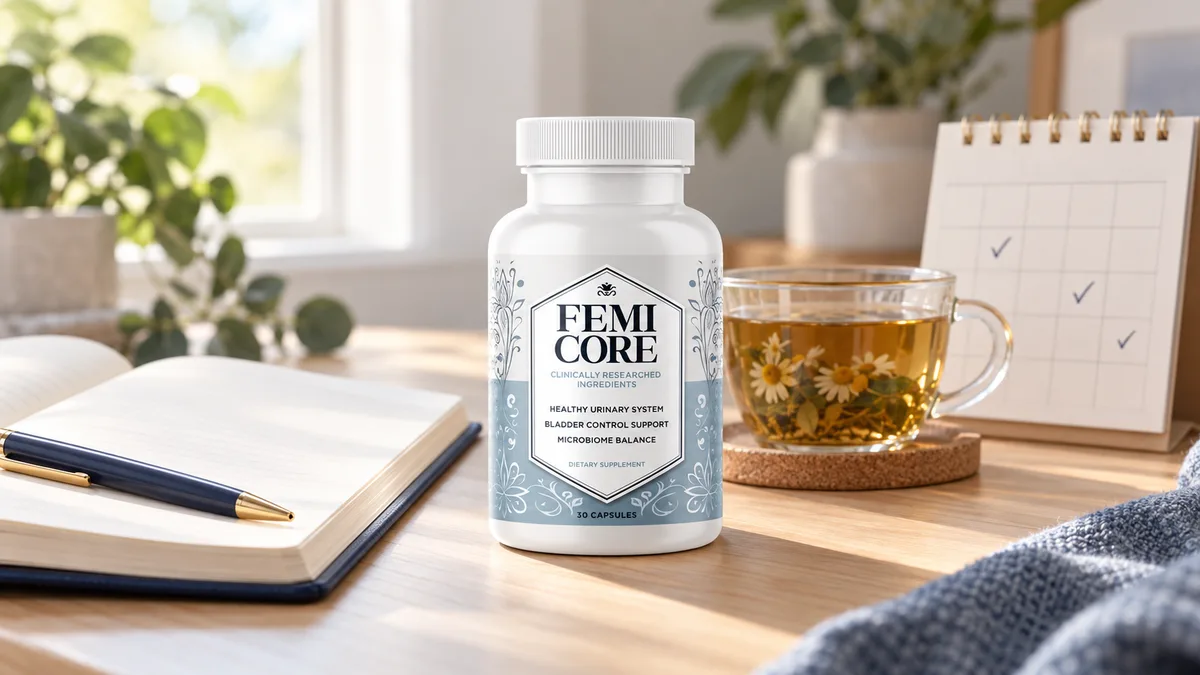
Does FemiCore really work? It is the right question to ask before you spend money on any bladder supplement, and it deserves a straight answer rather than a sales pitch. The short version: FemiCore may help some women with urinary comfort and microbiome balance, it is unlikely to fix every kind of bladder leak, and nobody can promise results because the finished formula has not been tested in a published clinical trial.
This article looks at what the evidence actually supports, which problems the ingredients are and are not suited to, how long a fair trial takes, and how to judge your own results. For the full product breakdown, read our FemiCore reviews. For a closer look at each component, see the FemiCore ingredients list.
Try FemiCore Risk-Free for 60 Days
The fairest way to find out if FemiCore works for you is a full trial backed by the official money-back guarantee.
Visit the Official FemiCore Store
60-Day Money-Back GuaranteeTable of Contents
What FemiCore Claims to Do
FemiCore is a once-daily capsule sold to women who deal with sudden urges, bladder leaks and night-time bathroom trips. According to the official website, the formula supports a healthy urinary system, bladder control and microbiome balance. It combines four botanicals (Mimosa Pudica, Bearberry, Cranberry Extract and Berberine) with five Lactobacillus probiotic species.
The idea behind it is the urinary microbiome. Research over the last decade has shown that the bladder is not sterile, and that a healthy female urogenital tract tends to be dominated by Lactobacillus species, especially L. crispatus. FemiCore’s pitch is that supporting these “good” bacteria, alongside traditional urinary herbs, helps the bladder work more comfortably.
That theory is reasonable and genuinely interesting. The question is how far the evidence goes beyond theory.
Does FemiCore Really Work? The Evidence by Ingredient
Because there is no published trial on FemiCore itself, the best we can do is look at each ingredient. Keep one limitation in mind throughout: FemiCore uses a proprietary blend, so none of the doses are disclosed. Even where an ingredient has good research, we cannot confirm FemiCore contains a similar amount.
Cranberry extract: the strongest case
Cranberry is the best-studied ingredient in the formula. Large research reviews have found that cranberry products can modestly reduce the chance of repeat urinary tract infections in women who get them often. The effect is linked to compounds called proanthocyanidins (PACs), and results depend heavily on the product and dose. Cranberry has not been shown to treat an active infection, and there is little evidence that it improves leaks or urgency.
Lactobacillus crispatus and the other probiotics: promising, early
L. crispatus is the species most associated with a healthy vaginal and urinary environment. A small clinical trial of an L. crispatus product reduced recurrent UTIs, but it was used vaginally, not swallowed as a capsule. Research on oral probiotics for urinary health is mixed and still early. The other four species (L. acidophilus, L. plantarum, L. gasseri, L. casei) are well established for gut health, with less direct urinary evidence.
Bearberry (uva ursi): traditional, short-term
Bearberry has a long history as a urinary herb because of its arbutin content. Modern clinical evidence is limited and old, and herbal authorities recommend it only for short courses. It is a traditional ingredient rather than a proven one.
Berberine: indirect support
Berberine is well studied for blood sugar and has antimicrobial properties in lab research. There is no good human evidence that it improves bladder control. Its role in FemiCore is best described as supporting the gut environment, which is plausible but unproven for bladder symptoms.
Mimosa Pudica: mostly traditional and animal data
Mimosa Pudica appears in traditional medicine and in some animal studies, but there is very little human research. It is the least evidence-backed ingredient in the formula.
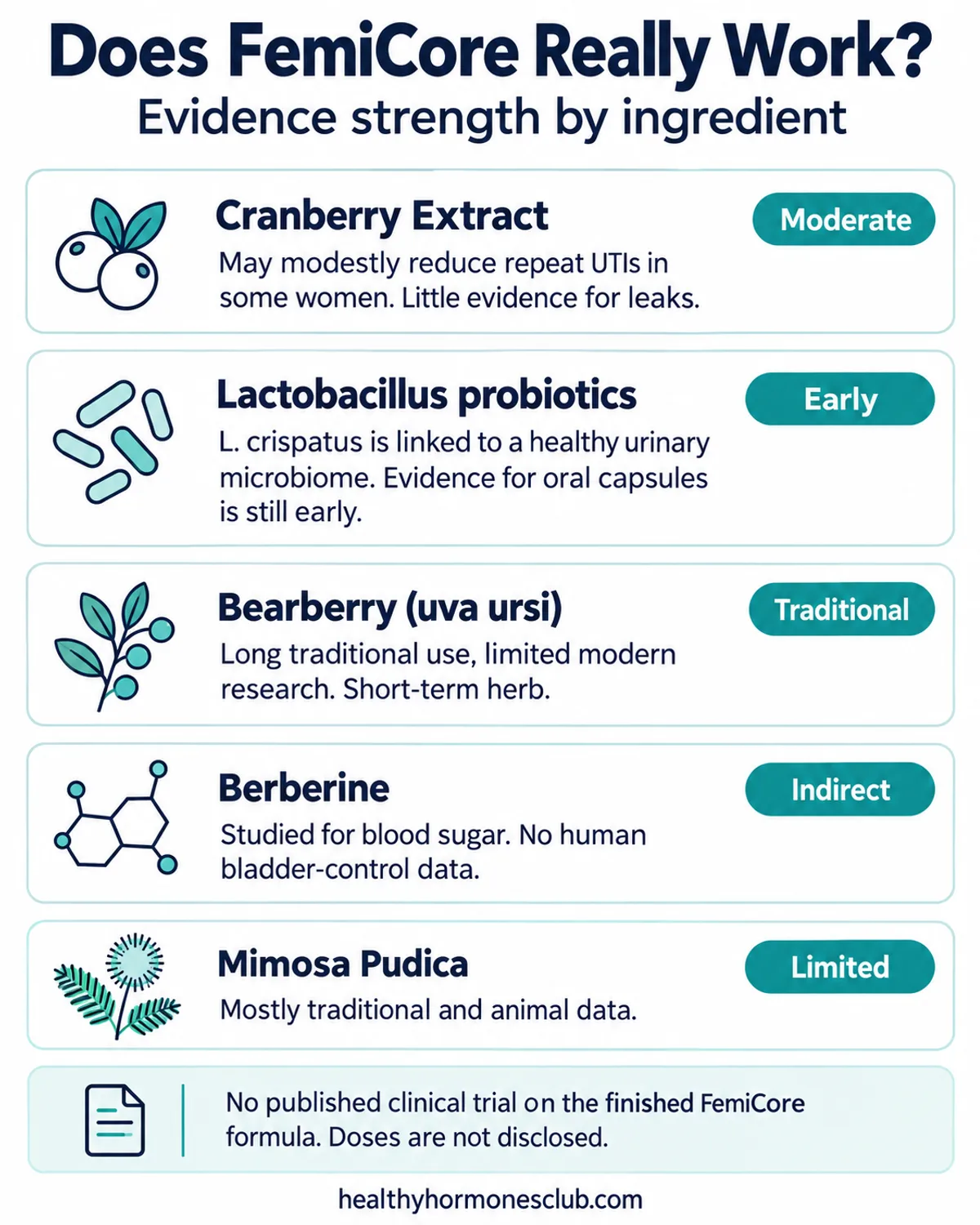
Put together, the evidence is strongest for general urinary tract support and weakest for leaks and urgency. That pattern shapes who is most likely to notice a difference.
See the Full Formula on the Official Site
Review the ingredients and package options for yourself. Every order is covered by the same 60-day guarantee.
Check FemiCore Packages
60-Day Money-Back GuaranteeIt Depends on Your Type of Bladder Problem
”Bladder problems” covers several different conditions, and they do not respond to the same things. Knowing which one you have is the single best predictor of whether FemiCore is worth trying.
| Your main problem | What usually causes it | Can FemiCore realistically help? |
|---|---|---|
| Leaks when you cough, sneeze, laugh or lift | Stress incontinence: weak pelvic floor support | Unlikely on its own. Pelvic floor training is the proven first step. |
| Sudden, strong urges and frequent trips | Urge incontinence or overactive bladder | Limited evidence. Bladder training and medical options have stronger support. |
| Frequent urinary discomfort or repeat UTIs | Infection risk, urinary microbiome balance | Most plausible fit, thanks to cranberry and Lactobacillus, but see a doctor for repeat infections. |
| General urinary comfort and microbiome support | Age, menopause, gut and vaginal flora changes | Reasonable fit for a supplement trial. |
If your leaks happen mainly when you cough or exercise, a supplement is not the right first tool. A pelvic health physiotherapist can teach pelvic floor exercises that have strong research behind them. FemiCore could still sit alongside that work, but it should not replace it.
If you have any warning signs, such as blood in your urine, fever, flank pain or burning, see a doctor before trying any supplement. Our FemiCore side effects guide lists who should check with a doctor first.
How Long FemiCore Takes to Work
Part of answering “does FemiCore really work” is giving it enough time. Probiotic and botanical formulas work gradually, and stopping after two weeks tells you very little.
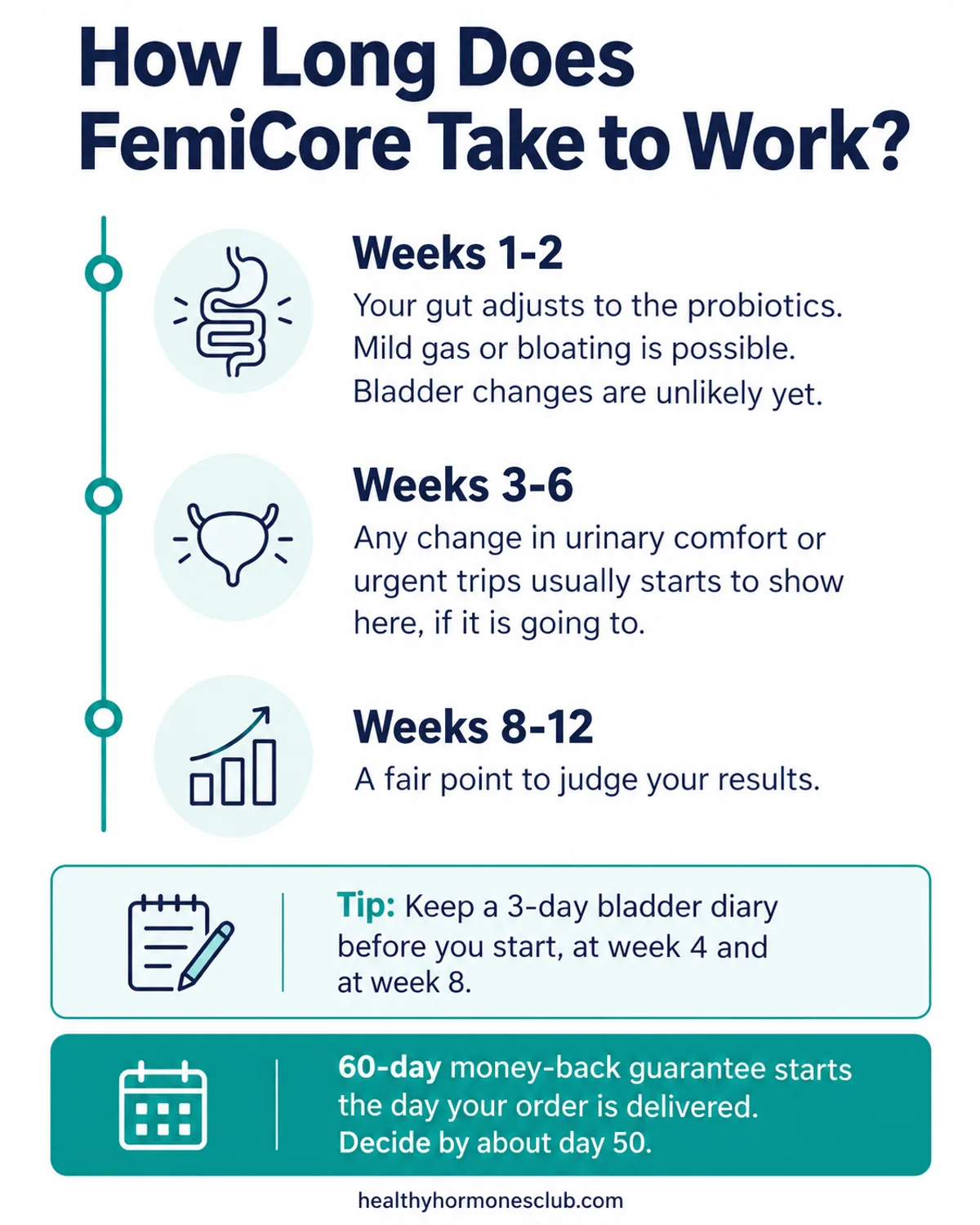
- Weeks 1 to 2: Your gut adjusts to the probiotics. Some women notice mild gas or bloating. Bladder changes are unlikely this early.
- Weeks 3 to 6: Any shift in urinary comfort or the number of urgent trips usually starts to show here, if it is going to.
- Weeks 8 to 12: This is a fair point to judge results. Most probiotic research runs at least this long.
One capsule a day means one bottle lasts 30 days. That is why a two-bottle order often runs out before you can judge it properly. A three-bottle supply covers the full 90 days. For current package prices, see our FemiCore sale guide.
How to Judge Your Own Results
Bladder symptoms vary from day to day, so memory is a poor judge. A simple record makes the decision much clearer.
- Keep a three-day bladder diary before you start. Note how many times you go during the day and at night, any leaks, and any sudden urges.
- Repeat the diary at week 4 and week 8. Use the same days of the week if you can, since routines affect results.
- Keep everything else steady. Big changes in caffeine, alcohol or fluid intake can make a supplement look better or worse than it is.
- Decide before your guarantee runs out. If your week-8 numbers have not improved, it is reasonable to conclude FemiCore is not working for you.
Give FemiCore a Fair 90-Day Trial
The three-bottle package covers a full three months at $69 per bottle, with free US shipping.
Choose Your FemiCore Package
Free US Shipping on 3 & 6 BottlesThe Guarantee Is Your Safety Net
Since no one can promise FemiCore will work for you, the 60-day money-back guarantee is a big part of the value. It applies to every package bought on the official website. To use it, contact customer support within 60 days of delivery and return all bottles, used or unused, with the packing slip.
Two practical points:
- The clock starts at delivery. The 60 days run from the day your package arrives, so note the delivery date from your tracking and start taking FemiCore straight away. Return shipping is at your own cost.
- Buy only from the official store. Marketplace and third-party listings are not covered. Our FemiCore official website guide shows how to make sure you are on the genuine site.
Frequently Asked Questions
Does FemiCore really work?
It can help some women, but it is not a guaranteed fix. FemiCore has not been tested as a finished product in a published clinical trial, so the honest answer rests on its ingredients. Cranberry and certain Lactobacillus species have the most relevant research for urinary tract health, while the evidence for bladder leaks and urgency is weak. Results vary, which is why the 60-day money-back guarantee matters.
How long does FemiCore take to work?
Give it at least 8 to 12 weeks of daily use. Probiotics need time to settle in, and most probiotic studies run for at least eight weeks. Some women notice small changes in the first month, but many need two to three months before they can judge it fairly.
Are there clinical studies on FemiCore?
We could not find a published clinical trial on the FemiCore formula itself. The official website points to research on individual ingredients, such as cranberry and Lactobacillus crispatus. Ingredient research is useful context, but it does not prove that this specific blend, at undisclosed doses, will produce the same effect.
Does FemiCore help with bladder leaks when I cough or sneeze?
Probably not much on its own. Leaks when you cough, sneeze or lift are usually stress incontinence, caused by weak pelvic floor support. No supplement strengthens those muscles. Pelvic floor muscle training, ideally with a pelvic health physiotherapist, is the first-line treatment with strong evidence.
Can FemiCore prevent urinary tract infections?
FemiCore is not approved to prevent or treat infections. Cranberry products have shown a modest reduction in repeat UTIs in some women in research reviews, and FemiCore contains cranberry extract, but its dose is not disclosed. If you get frequent UTIs, see a doctor for testing and a prevention plan.
What if FemiCore does not work for me?
Use the 60-day money-back guarantee. Contact customer support within 60 days of delivery and return all bottles, opened or unopened, with your packing slip. The 60-day window starts on the day your order is delivered, so check your tracking for the delivery date and decide by around day 50.
The Bottom Line
So, does FemiCore really work? For general urinary comfort and microbiome support, it is a reasonable supplement to try, with cranberry and Lactobacillus species as its strongest ingredients. For leaks caused by a weak pelvic floor, or for strong overactive bladder symptoms, the evidence is thin and other approaches should come first. The formula itself has no published trial and its doses are hidden, so treat it as an experiment: track your symptoms, give it 8 to 12 weeks, and lean on the 60-day guarantee if it does not help. You can also read a quick summary on our FemiCore overview page.
Start Your FemiCore Trial From the Official Store
One capsule a day, a full 60-day money-back guarantee, and the lowest price at $49 per bottle on the six-bottle package.
Order FemiCore Today
60-Day Money-Back Guarantee