
How does FemiCore work? The short version from the seller is that it supports a healthy urinary system, bladder control and “microbiome balance.” That tells you the goals, not the mechanism. In this guide we take the nine ingredients and group them into the three pathways the formula seems to rely on, explain the science behind each one in plain language, and show exactly where the evidence is strong, where it is thin and where it has not been tested at all. The aim is not to sell you on FemiCore or to talk you out of it, but to give you a clear picture of what is plausibly going on inside the bottle.
See the Formula on the Official Site
Nine named ingredients in a once-daily capsule, sold with a 60-day money-back guarantee.
Visit the Official FemiCore Site
60-Day Money-Back Guarantee From DeliveryTable of Contents
- The Short Answer
- The Big Idea: The Bladder Has Its Own Bacteria
- Pathway 1: Adding Friendly Bacteria
- Pathway 2: Making It Harder for Germs to Stick
- Pathway 3: The Supporting Botanicals
- From Mouth to Bladder: Why the Route Matters
- Where the Evidence Chain Breaks
- How the Pathways Match Different Bladder Problems
- What a Supplement Label Is Allowed to Say
- Frequently Asked Questions
The Short Answer
FemiCore is a capsule with nine ingredients in a proprietary blend: five probiotic species (Lactobacillus crispatus, L. acidophilus, L. plantarum, L. gasseri and L. casei) and four botanicals (Mimosa pudica, bearberry, cranberry extract and berberine). It appears to work through three overlapping routes:
| Pathway | Ingredients | Proposed effect | Strength of evidence |
|---|---|---|---|
| 1. Add friendly bacteria | Five Lactobacillus species | Support a healthier bacterial balance linked to the urinary tract | Early; mostly from other products and routes |
| 2. Make it harder for germs to stick | Cranberry, bearberry | Reduce the ability of bacteria such as E. coli to settle | Moderate for cranberry and repeat infections; limited for bearberry |
| 3. Supporting botanicals | Mimosa pudica, berberine | Soothing and general metabolic support | Thin for bladder use |
None of these pathways has been tested using FemiCore itself. The label says “clinically researched ingredients,” which refers to research on ingredients in general, not on the finished product.
The Big Idea: The Bladder Has Its Own Bacteria
For a long time, healthy urine was thought to be sterile. Since around 2012, sequencing studies, including work from Loyola University Chicago, have found that the female bladder has its own community of bacteria, often called the urinary microbiome. Some of these studies found fewer Lactobacillus bacteria in women with urgency incontinence than in women without it.
That finding is the foundation of FemiCore’s “microbiome balance” message. The reasoning goes like this: if a lack of friendly bacteria is linked to bladder trouble, adding friendly bacteria might help. It is a reasonable idea, and it is why the formula leans so heavily on probiotics.
It is important to see what the research does and does not show, though. A link between fewer Lactobacillus and symptoms does not prove that one causes the other. And it does not show that swallowing probiotic capsules changes the bacteria in the bladder or improves symptoms. The science here is young and promising, not settled.
Pathway 1: Adding Friendly Bacteria
Five of FemiCore’s nine ingredients are Lactobacillus species. This is the heart of the formula.
What supports it: L. crispatus is the species most often discussed in women’s urinary and vaginal health. In a small placebo-controlled trial, a vaginal L. crispatus product reduced repeat urinary tract infections. That is a meaningful result for the species.
What limits it: probiotic effects depend on the specific strain, not just the species. FemiCore lists species names only, without strain codes, and does not state how many live bacteria each capsule holds. So even where a study found a benefit, there is no way to know whether FemiCore contains the same strain in a similar amount. The other four species are common in general probiotic products, and we know of no strong evidence tying them to bladder symptoms specifically.
For a closer look at each probiotic and botanical, see our FemiCore ingredients list.

Probiotics and Botanicals in One Capsule
One capsule each morning with water. Each bottle is a 30-day supply.
View FemiCore Packages
One-Off Purchase, No Hidden AutoshipPathway 2: Making It Harder for Germs to Stick
The second pathway is the most familiar one, because it is how cranberry has been discussed for decades.
Cranberry
Cranberry contains compounds called A-type proanthocyanidins, usually shortened to PACs. In lab studies, these reduce the ability of E. coli, the most common cause of urinary tract infections, to attach to the lining of the urinary tract. Bacteria that cannot attach are easier for the body to flush out. In people, a 2023 Cochrane review found that cranberry products can reduce repeat UTIs in women who are prone to them. Earlier reviews were more mixed, and the effect seems to depend on how much PAC a product delivers. FemiCore does not disclose its cranberry dose or PAC content, so it is impossible to say whether it matches the amounts studied.
Bearberry
Bearberry, also called uva ursi, contains arbutin. The body converts arbutin to hydroquinone, which ends up in urine and has antibacterial activity in the lab. The human evidence is limited and mixed. European herbal regulators describe bearberry as a traditional remedy for mild lower urinary complaints, but only for short courses of about a week, not for continuous use. FemiCore is designed to be taken every day for months, and its bearberry amount is not disclosed.
Notice what this pathway is about: infections. It does not address leaks from coughing or the sudden urge to go, which are the problems many FemiCore buyers are trying to solve.
Pathway 3: The Supporting Botanicals
Mimosa pudica
Mimosa pudica is a plant that has shown anti-inflammatory, antimicrobial and antispasmodic effects in lab and animal studies. In theory, a calming effect on smooth muscle could matter for an overactive bladder. But we found no human trials for bladder symptoms. Of all nine ingredients, this one has the thinnest evidence.
Berberine
Berberine has good human data, but for something else: blood sugar and cholesterol, in studies that typically used around 1,000 to 1,500 mg a day. Evidence for bladder benefits is lacking. Its role in FemiCore may be general metabolic or gut support. Berberine is also the ingredient with the most potential for drug interactions, which matters more than any theoretical benefit if you take prescription medicines.
Our article on the benefits of FemiCore rates each claimed benefit against its evidence.
From Mouth to Bladder: Why the Route Matters
It is worth following the path a daily dose takes, because it explains several of the open questions.
- You swallow the capsule with a big glass of water, as the directions say.
- It travels through the stomach and gut. The probiotics have to survive this journey to have any effect, and most of their action, if any, starts in the gut.
- Plant compounds are absorbed. Some, like the breakdown products of bearberry’s arbutin, are then filtered by the kidneys into urine, which is where they would act.
- The bladder is reached indirectly. Swallowed bacteria do not travel straight to the bladder. Any effect on the urinary microbiome would have to happen through indirect routes that are still being studied.
This is why the most encouraging probiotic result, the vaginal L. crispatus trial, does not transfer neatly to a swallowed capsule. Different route, different strain information, different dose.
Where the Evidence Chain Breaks
Think of the case for FemiCore as a chain. For the product to work as marketed, every link has to hold. Here is how each link looks today.
| Link in the chain | Status |
|---|---|
| The bladder has its own bacteria | Supported by sequencing studies since about 2012 |
| Fewer Lactobacillus is linked to urgency symptoms | Seen in some studies; cause and effect not shown |
| Swallowed probiotics change bladder bacteria | Not established |
| FemiCore’s strains and counts match studied ones | Unknown; strains and counts not disclosed |
| Cranberry reduces repeat infections | Supported in women prone to them, dose-dependent |
| FemiCore’s cranberry dose matches studied doses | Unknown; dose not disclosed |
| The full formula improves symptoms | Not tested; no published trial |
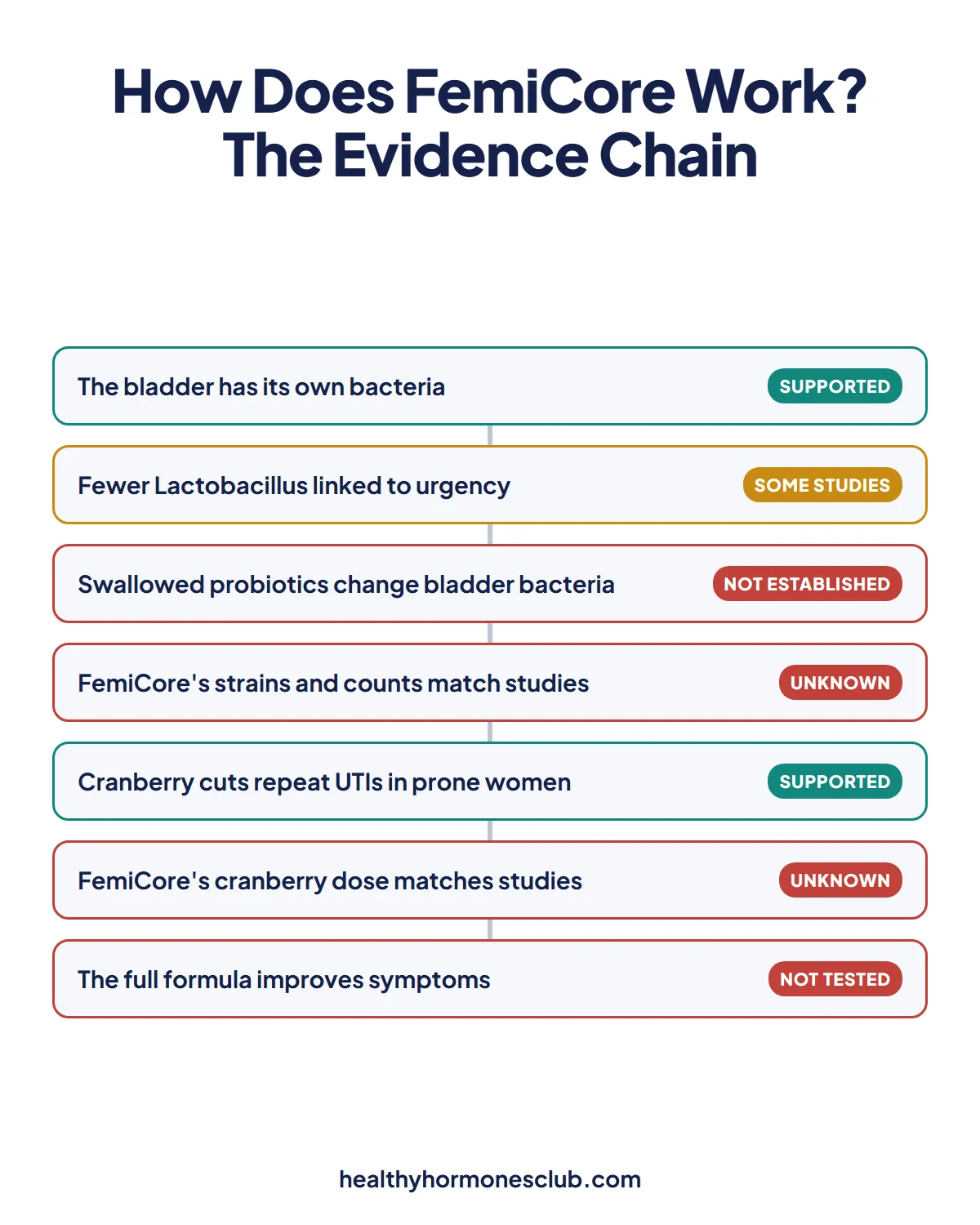
The early links are reasonably strong. The later links, the ones about this specific product, are missing. That is the honest summary of how FemiCore works: it is built on plausible ideas, and the product itself has not been put to the test in public.
Want to Judge It for Yourself?
The 60-day money-back guarantee, counted from delivery, lets you try it with a way out.
Try FemiCore From the Official Store
Free US Shipping on 3 and 6 BottlesHow the Pathways Match Different Bladder Problems
”Bladder trouble” covers several different problems, and the three pathways do not fit them equally.
- Repeat urinary infections: pathway 2 is the most relevant, because cranberry has the best human data here. But an active infection needs a doctor and often antibiotics, and repeat infections deserve a medical review.
- Urgency and frequency: pathway 1 is the one aimed here, through the microbiome idea. The science is the most interesting but also the earliest.
- Leaks when you cough, laugh or lift: these usually relate to the pelvic floor muscles. None of the three pathways targets muscle strength, so pelvic floor training is the more direct approach to discuss with a professional.
For a deeper look at realistic outcomes and timelines, read our does FemiCore really work evidence check.
Why the seller talks in months
The seller advises using FemiCore for at least three months before judging it. That fits the mechanism it describes: if adding friendly bacteria changes anything, it would need steady daily use rather than a few doses. It also means you need patience and a way to track change. Keep in mind that the refund window is 60 days from delivery, which is shorter than the suggested trial.
What a Supplement Label Is Allowed to Say
FemiCore is sold as a dietary supplement, not a drug. That shapes how it is described. The FDA does not pre-approve any supplement, and supplements are not tested for effectiveness before they go on sale. Labels can use general “structure/function” wording such as “bladder control support” or “healthy urinary system,” but they cannot claim to treat or cure a disease.
The official site shows seals for GMP Certified and made in an FDA registered facility. These relate to how and where it is made, and the certifier is not named. Neither seal means the FDA has reviewed whether FemiCore works. The safety side also deserves attention: probiotics can cause gas or bloating early on, berberine interacts with many drugs and lowers blood sugar, bearberry is not for pregnancy, breastfeeding or kidney disease, and cranberry has case reports with warfarin. Talk to your doctor before you start if any of that applies.
For the full product summary, with packages and safety notes, visit our FemiCore product guide.
Frequently Asked Questions
How does FemiCore work, in simple terms?
FemiCore combines five Lactobacillus probiotic species with four botanicals. The idea is that the probiotics support a healthier balance of bacteria linked to the urinary tract, cranberry and bearberry make it harder for unwanted bacteria to settle, and Mimosa pudica and berberine play supporting roles. Each idea has some research behind it, but the finished formula has not been tested in a published trial.
How long does FemiCore take to work?
The seller advises using it for at least three months before judging it. Nothing in the formula is fast-acting, and any change in bacterial balance, if it happens, would need steady daily use. The money-back guarantee lasts 60 days from delivery, so plan a first decision before then.
Do the probiotics in FemiCore reach the bladder?
That is not known for this product. Swallowed probiotics travel through the gut, not directly to the bladder. The most encouraging trial for L. crispatus used a vaginal product, which is a different route, and FemiCore lists species without strain codes or counts.
Can FemiCore help with urinary tract infections?
FemiCore is not a treatment for infection. Cranberry has the best evidence among its ingredients: a 2023 Cochrane review found cranberry products can reduce repeat UTIs in women prone to them, with results depending on the dose of protective compounds. FemiCore does not disclose its cranberry dose. Symptoms of an infection need a doctor.
Is FemiCore proven to work?
No published clinical trial of the FemiCore formula exists. The label phrase clinically researched ingredients refers to research on individual ingredients. Some of that research is solid, some is early or based on lab and animal work.
Is FemiCore a substitute for bladder medication?
No. FemiCore is a dietary supplement, not a drug. The FDA does not pre-approve any supplement, and supplements are not tested for effectiveness before sale the way medicines are. If your bladder symptoms affect daily life, a doctor can discuss proven treatments.
The Bottom Line
FemiCore works, in theory, through three pathways: adding friendly Lactobacillus bacteria, making it harder for germs to stick with cranberry and bearberry, and lending support through Mimosa pudica and berberine. The underlying science ranges from moderate (cranberry for repeat infections) to early (the urinary microbiome) to thin (Mimosa pudica for bladder use). What is missing is proof for the finished product, along with the doses, strains and counts you would need to compare it with research. If you decide to try it, give it the time the seller suggests, track your symptoms, and use the guarantee if it does not help.
Try It With the Guarantee in Place
Order from the official store and you have 60 days from delivery to decide whether it suits you.
Order From the Official Store
60-Day Money-Back Guarantee