
Before you spend money on any bladder supplement, it is worth asking a simple question: is it actually meant for someone like me? Who should use FemiCore is not just a marketing question. The formula contains berberine, bearberry and cranberry alongside five probiotic strains, and each of those ingredients has people it suits well and people who should be careful.
This fit guide walks through who FemiCore is designed for, who is unlikely to get much from it, who should skip it or speak with a doctor first, which medications need a conversation, and which symptoms need medical care rather than a supplement. For the overall verdict on the formula, see our full FemiCore reviews.
Think FemiCore Fits? See the Official Offer
One capsule a day, nine ingredients, and 60 days to decide whether it works for you.
Visit the Official FemiCore Site
60-Day Money-Back GuaranteeTable of Contents
Who FemiCore Is Designed For
FemiCore is marketed to adult women with everyday bladder frustrations: a sudden urge that is hard to put off, frequent trips during the day, getting up at night to urinate and small leaks that come with urgency. Its approach centers on the urinary microbiome. The formula pairs Lactobacillus strains, including L. crispatus, with cranberry, bearberry, berberine and Mimosa pudica.
That focus makes it most relevant to women in their late 30s and beyond. Around perimenopause and menopause, falling estrogen changes the tissues of the urinary and vaginal tract and is associated with fewer protective Lactobacillus bacteria. Many women notice bladder habits shifting in the same years. FemiCore is one of several supplements aimed at that stage of life; it is not a hormone and does not replace any treatment your doctor recommends.
If you want a plain overview of the product before going further, our what is FemiCore explainer covers the basics in a few minutes.
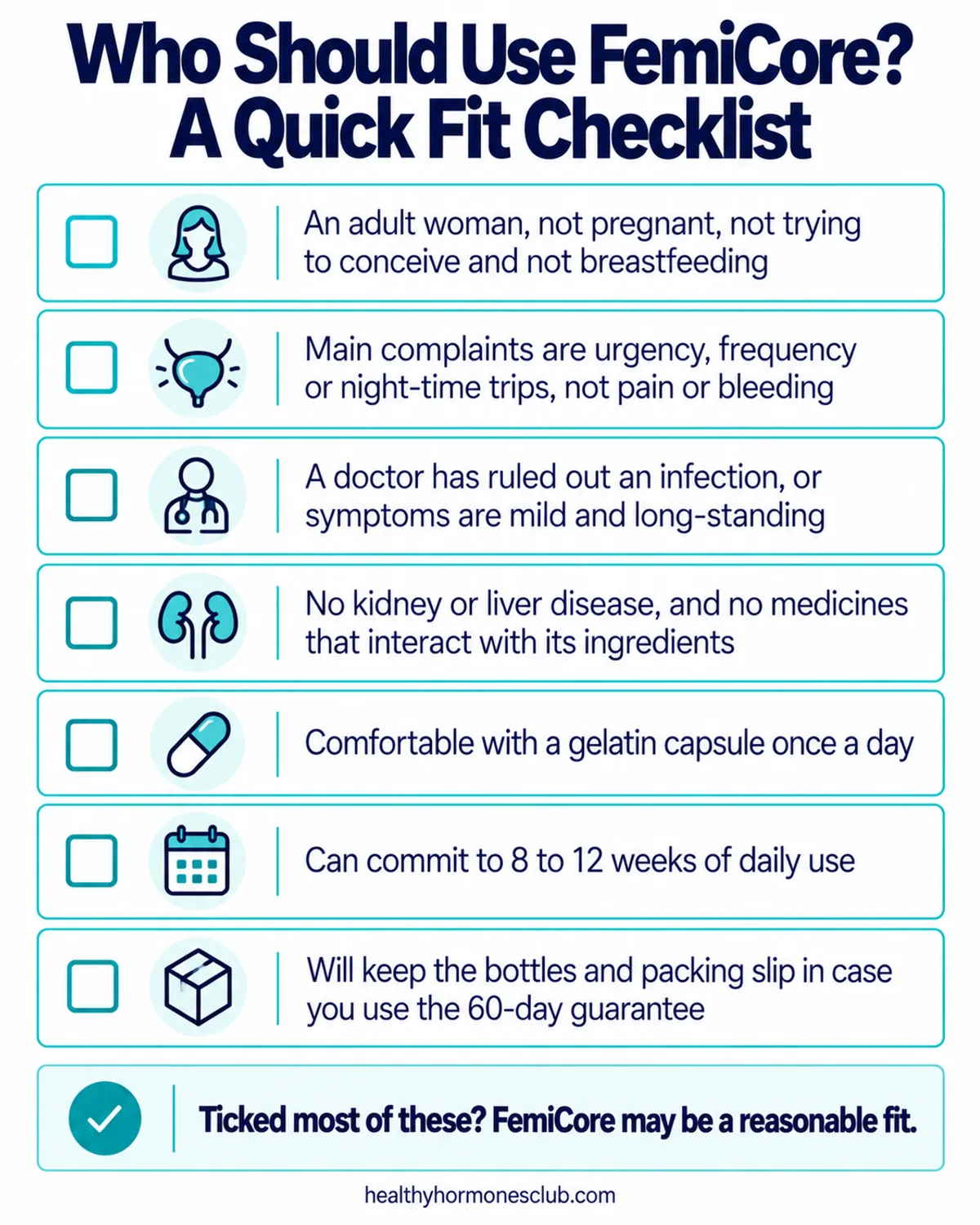
Who Should Use FemiCore: A Quick Fit Checklist
FemiCore is most likely to be a reasonable fit if most of these statements are true for you:
- You are an adult woman, not pregnant, not trying to conceive and not breastfeeding.
- Your main complaints are urgency, frequency or night-time trips, rather than pain or bleeding.
- A doctor has already ruled out an infection or other cause, or your symptoms are mild and long-standing.
- You do not have kidney or liver disease and are not on medications that interact with its ingredients (see below).
- You are comfortable with a gelatin capsule taken once a day.
- You can commit to 8 to 12 weeks of daily use before judging results.
- You are willing to keep the bottles and packing slip in case you use the 60-day guarantee.
If you checked most of these, FemiCore is a sensible thing to try alongside the basics: steady fluid intake, limiting bladder irritants such as caffeine and alcohol, and pelvic floor exercises.
Who Is Unlikely to Get Much From It
Some women are a poor match, not because FemiCore is unsafe for them but because it targets the wrong problem:
- Leaks mainly when you cough, sneeze, laugh or lift. This pattern, called stress incontinence, is largely about pelvic floor support. Pelvic floor physical therapy is the usual first step, and a probiotic formula is unlikely to change the mechanics.
- A feeling of bulging or pressure in the vagina. That can signal pelvic organ prolapse, which needs an exam.
- Anyone who needs a quick fix. Probiotic-based formulas work gradually. If you need relief this week, talk to your doctor.
- Women who want fully disclosed doses. FemiCore lists two proprietary blend totals (350 mg herbal, 50 mg probiotic) but not the amount of each ingredient.
- Vegetarians and vegans. The label lists a gelatin capsule.
For an honest look at what the ingredients can and cannot do, read does FemiCore really work.
Ready for a Full 90-Day Trial?
The three- and six-bottle packages cover the 8 to 12 weeks probiotic formulas need, with free US shipping.
See FemiCore Packages
Who Should Skip FemiCore or Ask a Doctor First
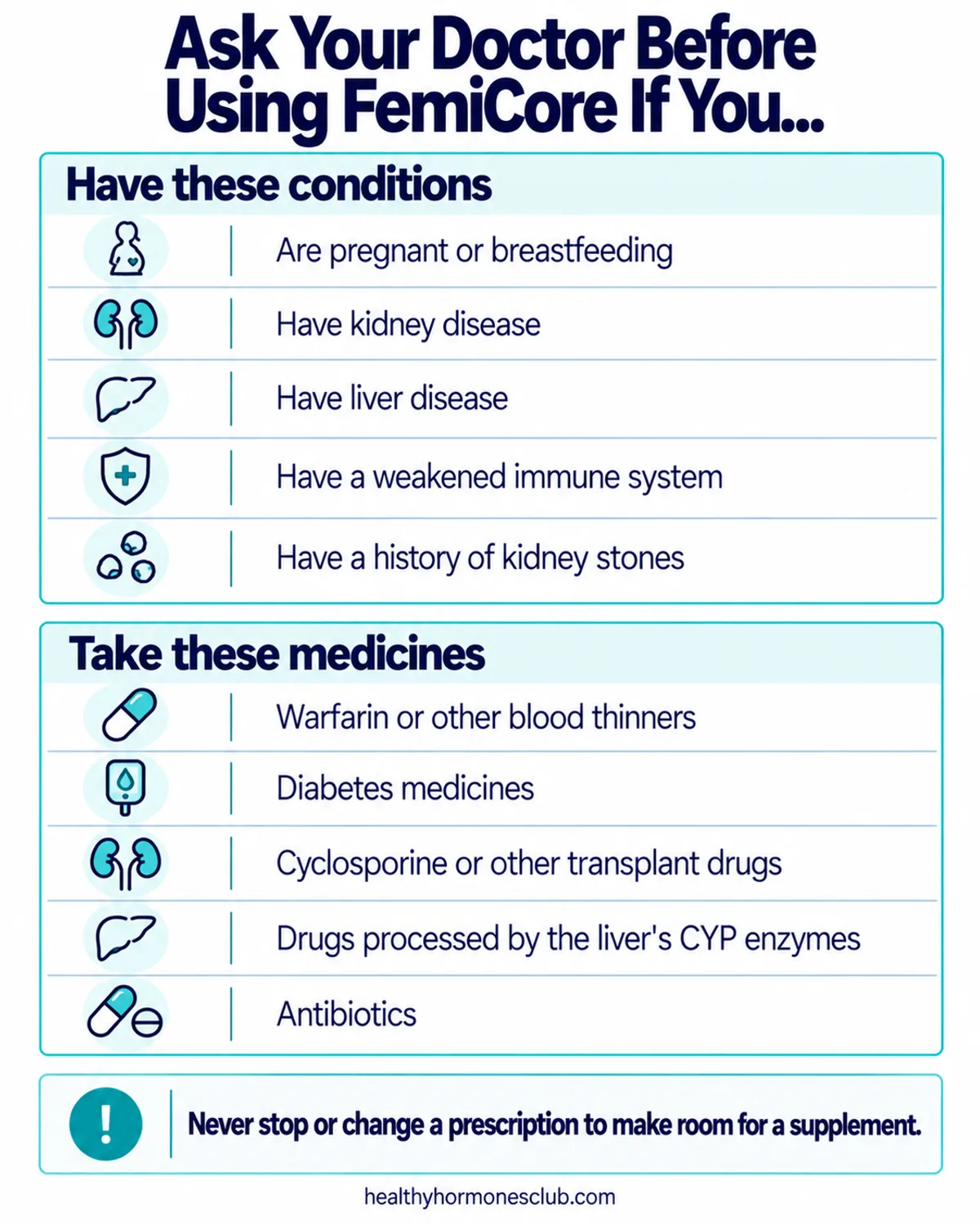
The FemiCore label itself says that pregnant or nursing mothers, anyone under 18 and anyone with a known medical condition should consult a physician before use. Based on the individual ingredients, we would be more specific:
- Pregnant, trying to conceive or breastfeeding: skip it unless your doctor clearly approves. Berberine and bearberry are generally advised against during pregnancy and breastfeeding.
- Kidney disease: bearberry (uva ursi) is generally avoided in kidney disease and is traditionally limited to short-term use. Ask your nephrologist first.
- Liver disease: berberine is processed by the liver, and bearberry’s active compound arbutin is converted to hydroquinone. Get your doctor’s approval.
- Weakened immune system: if you are on chemotherapy, take immunosuppressants or have a central line, ask before taking any probiotic product.
- History of kidney stones: cranberry products contain oxalate, so ask whether a cranberry-containing supplement is appropriate for you.
- Under 18: FemiCore is formulated for adult women.
Our FemiCore side effects guide covers ingredient-by-ingredient safety and the mild digestive changes some people notice when starting a probiotic.
Medications That Need a Conversation First
The official FemiCore FAQ advises anyone with a medical condition or on prescription medication to show the bottle to their doctor before taking it. That is good advice. These are the interactions we would raise:
- Warfarin and other blood thinners: cranberry has been linked to changes in INR in some reports, and berberine may also affect how warfarin is handled. Your INR may need closer monitoring.
- Diabetes medicines (metformin, sulfonylureas, insulin and others): berberine can lower blood sugar, which may add to the effect of your medication and raise the risk of lows.
- Cyclosporine and similar transplant drugs: berberine has been shown to raise cyclosporine levels in the blood.
- Drugs processed by the liver’s CYP enzymes: berberine can slow several of these enzymes, which affects a long list of prescriptions. Your pharmacist can check yours in a minute.
- Antibiotics: if you are prescribed an antibiotic, follow your doctor’s advice on whether and when to take a probiotic product during the course.
Never stop or change a prescription to make room for a supplement without talking to the doctor who prescribed it.
Symptoms That Need Medical Care, Not a Supplement
Bladder changes are common after 35, but some symptoms point to infections or other conditions that need a proper diagnosis. See a doctor promptly, and do not wait to see if a supplement helps, if you notice:
- Blood in your urine, even once and even without pain.
- Fever, chills or pain in your back or side (flank pain). Together with urinary symptoms, these can signal a kidney infection and need same-day care.
- Burning or pain when you urinate, or cloudy, strong-smelling urine with feeling unwell.
- Sudden new urgency or leaking that appeared over days rather than years.
- Trouble emptying your bladder, a weak stream or being unable to urinate.
- Leaking along with numbness, tingling or weakness in your legs or groin.
- Pelvic pain or any vaginal bleeding after menopause.
Once serious causes are ruled out, a supplement can be a reasonable addition. It should come after the check-up, not instead of it.
Cleared by Your Doctor? Try FemiCore Risk-Free
Every official order is covered by a 60-day money-back guarantee.
Check the Official Price
Free US Shipping on 3 & 6 BottlesIf FemiCore Fits: How to Start Sensibly
- Buy only from the official store, so the product is genuine and covered by the guarantee. Our FemiCore official website guide shows how to recognize it.
- Check the safety seal. The label says not to use the product if the seal is damaged or missing.
- Follow the label dose: one capsule a day with 6 to 8 ounces of water. The official site suggests taking it in the morning. Do not exceed the recommended dose.
- Keep a simple bladder diary for a few days before you start and again at weeks 4, 8 and 12: daytime trips, night-time trips and urgent moments. It makes the result much easier to judge.
- Stop and call your doctor if you notice anything that worries you, such as persistent stomach upset or a rash.
- Mind the guarantee window. The official refund policy gives you 60 days from delivery, so start soon after your order arrives.
For directions, storage and how long a bottle lasts, see our FemiCore supplement guide.
Frequently Asked Questions
Who should use FemiCore?
FemiCore is designed for adult women who deal with bladder urgency, frequent bathroom trips, waking at night to urinate or small urge-related leaks, and who want a once-daily supplement with probiotic strains and botanicals. It suits women who have already had their symptoms checked by a doctor, are not pregnant or nursing, and are willing to take it consistently for 8 to 12 weeks.
Can I take FemiCore if I am pregnant or breastfeeding?
No, not without your doctor’s explicit approval, and most doctors will say no. The label advises pregnant and nursing women to consult a physician, and two of its ingredients, berberine and bearberry, are generally advised against during pregnancy and breastfeeding.
Is FemiCore safe with kidney or liver disease?
Talk to your doctor first. Bearberry is traditionally limited to short-term use and is generally avoided in kidney and liver disease, and berberine is processed by the liver. If you have any chronic kidney or liver condition, FemiCore should only be used with your specialist’s approval.
Which medications can interact with FemiCore?
The main ones to ask about are blood thinners such as warfarin (cranberry), diabetes medicines (berberine can lower blood sugar), cyclosporine (berberine can raise its levels) and other drugs processed by the same liver enzymes as berberine. Bring the bottle to your doctor or pharmacist so they can check your full list.
Can FemiCore replace seeing a doctor for bladder problems?
No. Blood in your urine, fever, back or side pain, burning when you urinate, trouble emptying your bladder or symptoms that come on suddenly all need a medical evaluation. FemiCore is a dietary supplement and is not intended to diagnose, treat, cure or prevent any disease.
Is FemiCore suitable for vegetarians?
No. According to the label, the capsule shell is made of gelatin, which is an animal product. The other listed inactive ingredients are brown rice flour, magnesium stearate, olive oil and silicon dioxide.
The Bottom Line
So, who should use FemiCore? Adult women with urgency, frequency or night-time trips who have had serious causes ruled out, are not pregnant or nursing, do not have kidney or liver disease, and either take no interacting medications or have checked with their doctor. It is a weaker fit for leaks caused mainly by coughing or lifting, and it is not a substitute for care when you see blood, run a fever or have pain. If you fit the profile, give it 8 to 12 weeks, track your symptoms and use the 60-day guarantee if it does not help. A short product summary is on our FemiCore overview page.
Get FemiCore From the Official Store
Genuine product, from $49 per bottle, with free US shipping on 3 and 6 bottles.
Order FemiCore Today
60-Day Money-Back Guarantee