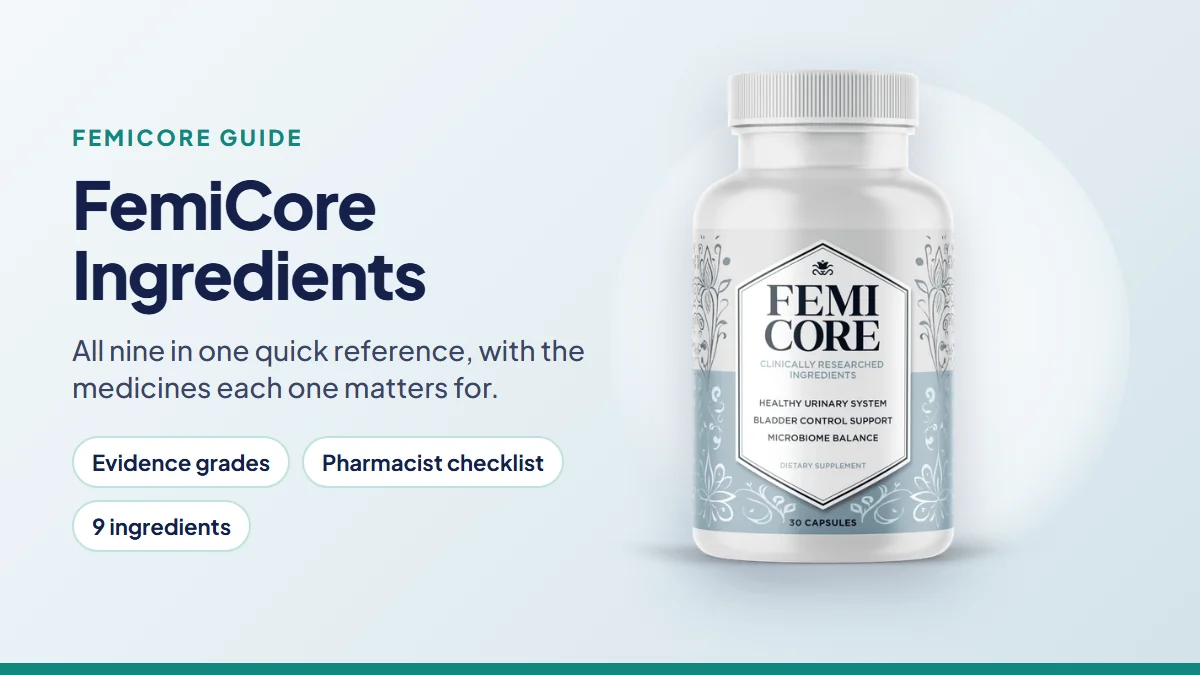
FemiCore ingredients number nine: four botanicals (Mimosa pudica, bearberry, cranberry extract and berberine) and five Lactobacillus probiotic species. This page is built as a quick reference you can use before you buy or while you hold the bottle. For each ingredient you get its evidence grade in one line, the medicines and health situations it matters for, and the questions worth asking before your first capsule. If you would rather read a full explanation of each ingredient, our FemiCore ingredients list goes through all nine one by one.
See the FemiCore Label
Check all nine ingredients on the official store before you decide.
View FemiCore Ingredients
60-Day Money-Back Guarantee From DeliveryTable of Contents
- FemiCore Ingredients: All Nine at a Glance
- The Ingredients Grouped by Job
- Which Ingredient Matters for Which Medicine
- Which Ingredient Matters for Which Health Situation
- Overlaps With Supplements You May Already Take
- Questions to Ask Before You Order
- Checking the Ingredients on Your Bottle
- Frequently Asked Questions
FemiCore Ingredients: All Nine at a Glance
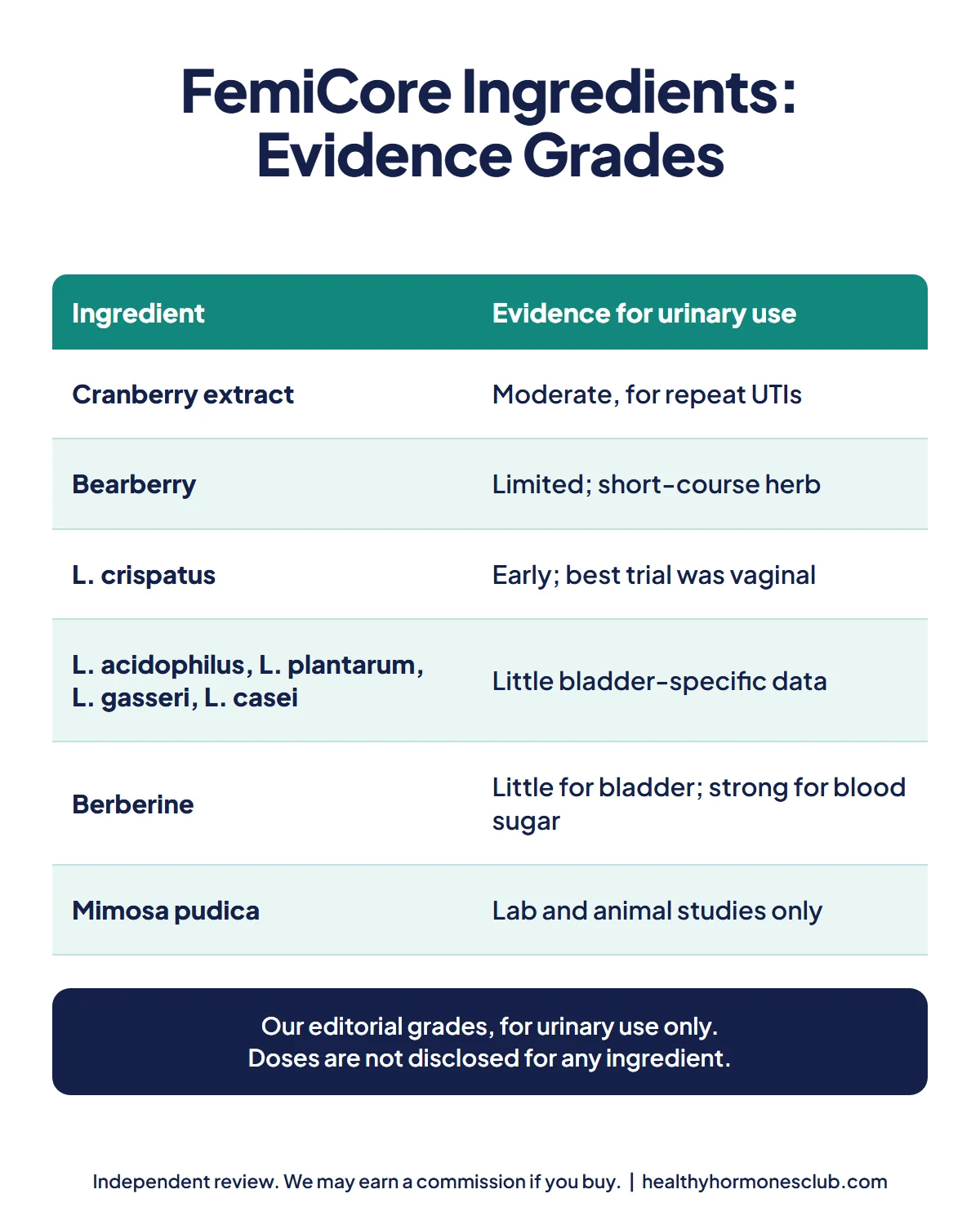
The evidence grade below is our editorial summary of the research for urinary or bladder use, not for every possible use of the ingredient.
| Ingredient | Type | Evidence for urinary use | Check first if you |
|---|---|---|---|
| Cranberry extract | Botanical | Moderate, for repeat UTIs; depends on PAC dose | Take warfarin; have had kidney stones |
| Bearberry (uva ursi) | Botanical | Limited and mixed; traditional short-course use | Have kidney disease; take lithium; are pregnant or breastfeeding |
| Granular berberine | Botanical | Little for bladder; strong for blood sugar | Take diabetes, blood pressure or many other medicines; are pregnant or breastfeeding |
| Mimosa pudica | Botanical | Lab and animal studies only | Want ingredients with human data |
| L. crispatus | Probiotic | Early; best result used a vaginal product | Have a severely weakened immune system |
| L. acidophilus | Probiotic | Little bladder-specific research | Have a severely weakened immune system |
| L. plantarum | Probiotic | Little bladder-specific research | Have a severely weakened immune system |
| L. gasseri | Probiotic | Little bladder-specific research | Have a severely weakened immune system |
| L. casei | Probiotic | Little bladder-specific research | Have a severely weakened immune system |
Two patterns stand out. First, the ingredient with the best urinary evidence, cranberry, was studied for repeat infections rather than leaks or urgency. Second, nearly all of the medication concerns come from the botanicals, and mostly from berberine, while the five probiotics share one rare concern.
The Ingredients Grouped by Job
It is easier to remember nine ingredients as three groups, based on the role each plays in the formula’s design.
- Urinary tract group: cranberry and bearberry. Cranberry’s A-type PACs reduce E. coli sticking in lab work, and bearberry’s arbutin becomes an antibacterial compound in urine in lab studies.
- Microbiome group: the five Lactobacillus species. These support the “microbiome balance” claim, based on research showing the female bladder has its own bacteria.
- Supporting group: berberine and Mimosa pudica. Berberine’s strongest human data is for blood sugar and cholesterol; Mimosa pudica has lab and animal reports of anti-inflammatory, antimicrobial and antispasmodic effects.
For how the groups fit together as a design, including what the proprietary blend label means, see our FemiCore formula guide.
Nine Ingredients, One Capsule a Day
Three bottles cover 90 days at $69 per bottle, with free US shipping.
See FemiCore Packages
Free US Shipping on 3 and 6 BottlesWhich Ingredient Matters for Which Medicine
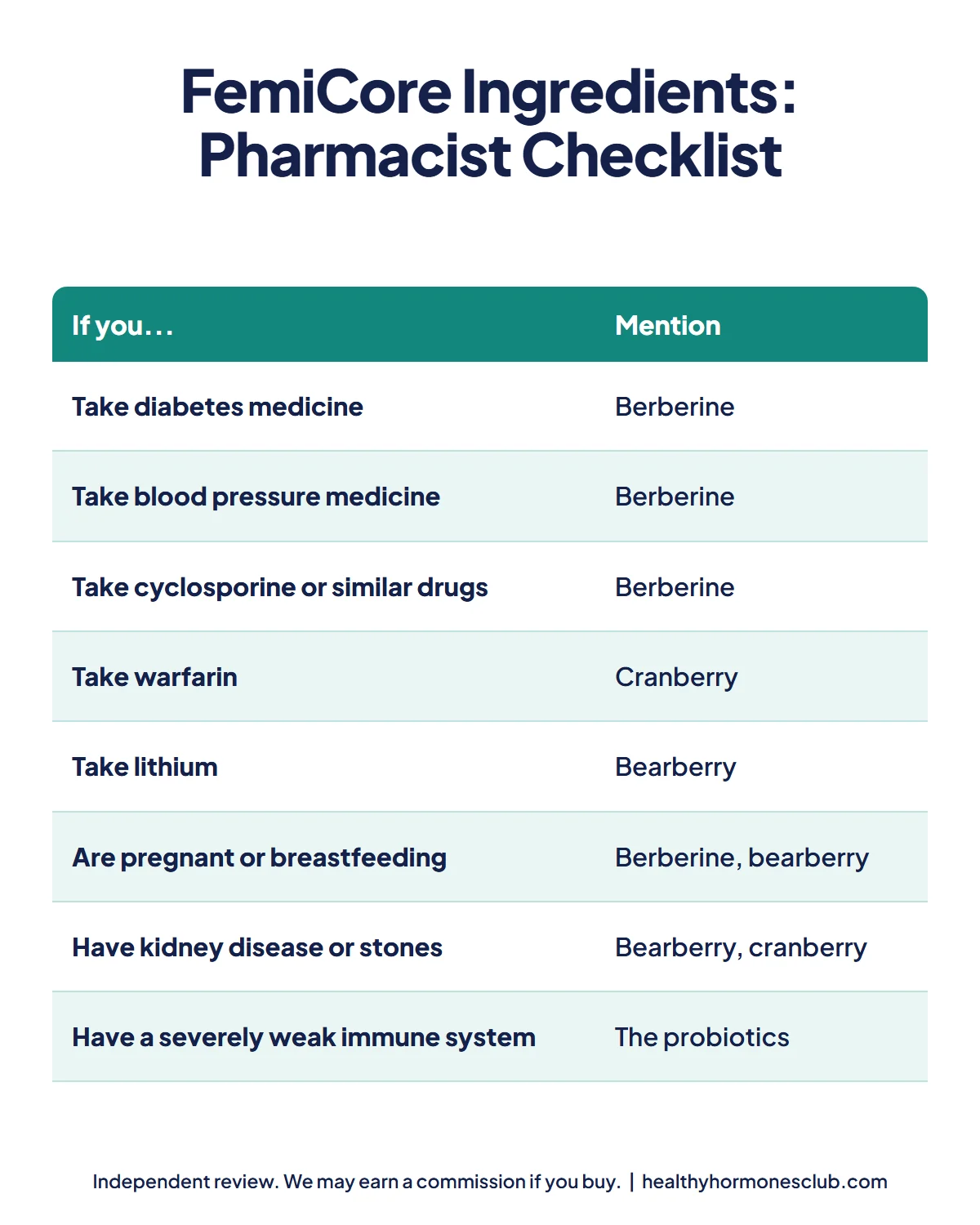
Use this table as a starting point for a conversation with your pharmacist, not as a final answer. FemiCore does not disclose its doses, so a pharmacist cannot judge the size of any interaction from the label alone and will usually advise caution.
| If you take | Ingredient to mention | Why |
|---|---|---|
| Diabetes medicine | Berberine | It can lower blood sugar, adding to the effect of the medicine |
| Blood pressure medicine | Berberine | It may lower blood pressure |
| Cyclosporine and other drugs processed by CYP3A4 or CYP2D6 enzymes | Berberine | It slows these enzymes, which can raise drug levels in the blood |
| Warfarin | Cranberry | There are case reports of changes in INR; checks may be needed |
| Lithium | Bearberry | Listed as an interaction concern |
| Medicines that suppress the immune system | The five probiotics | Rare infections have been reported in severely immunocompromised people |
If you take several medicines, bring the bottle or a photo of the label to the pharmacy counter. That is faster than describing nine ingredients from memory.
A simple way to ask
Pharmacists get supplement questions all the time, and a clear question gets a clear answer. Something like this works well: “I am thinking of taking a supplement called FemiCore, one capsule a day. It contains berberine, bearberry, cranberry, Mimosa pudica and five Lactobacillus probiotics, but the label does not give the amounts. Here is my medicine list. Is any of this a problem for me, and is there anything I should watch for?”
Mention any supplements you already take as well, not just prescriptions. If the pharmacist suggests a check-up, such as a blood sugar or INR test after you start, write it down and book it. And if the advice is not to take it, the cost of asking was a few minutes rather than the price of an order you then have to return.
Which Ingredient Matters for Which Health Situation
| Situation | Ingredients involved | Our guidance |
|---|---|---|
| Pregnancy or breastfeeding | Berberine, bearberry | Considered unsafe; do not take FemiCore unless your doctor approves |
| Kidney disease | Bearberry | Avoid bearberry; talk to your doctor |
| History of kidney stones | Cranberry | Cranberry contains oxalate; ask your doctor |
| Severely weakened immune system | Probiotics | Ask your doctor first |
| Children | Bearberry | Not for children |
| Sensitive stomach | Probiotics, berberine, bearberry | Gas or bloating in the first one to two weeks is common; nausea is possible |
One harmless effect is worth knowing: bearberry can turn urine green-brown. It is not a sign of harm, but mention it to your doctor if you are unsure. Our FemiCore side effects guide covers each effect in more detail.
Overlaps With Supplements You May Already Take
Several FemiCore ingredients are also sold as single supplements. Taking both can double up without you noticing.
- Cranberry capsules, tablets or concentrated juice: you would be adding a second source of cranberry. Ask whether you need both, particularly if you take warfarin.
- Berberine supplements (often sold for blood sugar): avoid stacking. The interactions above become more likely with more berberine.
- Uva ursi products or teas: avoid stacking. Bearberry is traditionally limited to short courses.
- Another probiotic: generally low risk for healthy adults, but it rarely adds much and makes it harder to tell what is helping.
Check the Ingredients, Then Decide
Every package has 60 days from delivery to return all bottles, empty or full.
Visit the Official Store
One-Off Purchase, No Hidden AutoshipQuestions to Ask Before You Order
The official website lists the nine ingredients but not the details below. You can ask customer support for them before buying. The answers help you and your pharmacist judge the product properly.
- How many milligrams of each botanical are in one capsule?
- How much berberine is in one capsule?
- What is the cranberry PAC content and the bearberry arbutin content?
- What is the probiotic count (CFU), and is it guaranteed through the expiry date?
- Which strains are used for each Lactobacillus species?
- What is the capsule shell made of, and what other ingredients are used?
- Is there a certificate of analysis, and who manufactures the product?
If support cannot answer the dose questions, that is useful information too. It tells you that you would be taking the product without knowing the amounts, which matters most if you take medicine.
Checking the Ingredients on Your Bottle
When your order arrives, spend two minutes with the supplement facts panel:
- Match the list. The nine ingredients should match those named on the official site. A bottle with a different list is a reason to contact support.
- Note the order. In a proprietary blend, US labeling rules list ingredients from the largest amount to the smallest. The order hints at which ingredients make up most of the blend.
- Read the other ingredients line. This is where the capsule shell and any fillers appear, which matters for allergies or dietary choices.
- Read the warnings. Compare them with the medicine and health tables above.
- Note the lot number and expiry date. Useful if you need to contact support.
The seller describes FemiCore as containing no stimulants and being non-GMO. For the daily routine, our FemiCore directions guide explains each line of the dose instructions, and the FemiCore product guide has the key facts on one page.
Frequently Asked Questions
What are the main FemiCore ingredients?
FemiCore contains nine ingredients: Mimosa pudica, bearberry (uva ursi), cranberry extract, granular berberine, and five probiotic species: Lactobacillus crispatus, L. acidophilus, L. plantarum, L. gasseri and L. casei. They are combined in a proprietary blend, so individual amounts are not listed.
Which FemiCore ingredient has the most research?
For urinary health, cranberry has the strongest research: a 2023 Cochrane review found cranberry products can reduce repeat UTIs in women prone to them. Berberine has strong human research too, but for blood sugar and cholesterol rather than bladder symptoms.
Which FemiCore ingredients can interact with medication?
Berberine is the main one: it can lower blood sugar, may lower blood pressure and slows enzymes that break down many drugs, such as cyclosporine. Cranberry has case reports with warfarin, and bearberry can interact with lithium. Show the ingredient list to your pharmacist before you start.
Are FemiCore ingredients safe for people with kidney stones?
Ask your doctor first. Cranberry contains oxalate, which matters for some people with a history of kidney stones, and bearberry should be avoided by people with kidney disease.
Does FemiCore contain caffeine or stimulants?
The official website says FemiCore contains no stimulants and is non-GMO. None of the nine listed ingredients is a stimulant.
Should I show the FemiCore ingredients to my pharmacist?
Yes, if you take any prescription medicine, have a health condition, or are pregnant or breastfeeding. A pharmacist can check the nine ingredients against your medicines in a few minutes, which is quicker and cheaper than finding a problem after you start.
The Bottom Line
The nine FemiCore ingredients fall into three groups: cranberry and bearberry for the urinary tract, five Lactobacillus species for the microbiome, and berberine and Mimosa pudica as supporting botanicals. Cranberry has the best urinary evidence, and berberine brings most of the medication concerns. Use the tables above to see which ingredient matters for your medicines and health, take the label to your pharmacist if anything applies to you, and ask support for the doses the label does not show.
Get Genuine FemiCore
Packages from $49 to $79 per bottle on the official store, with 60 days from delivery to change your mind.
Order From the Official Store
60-Day Money-Back Guarantee From Delivery