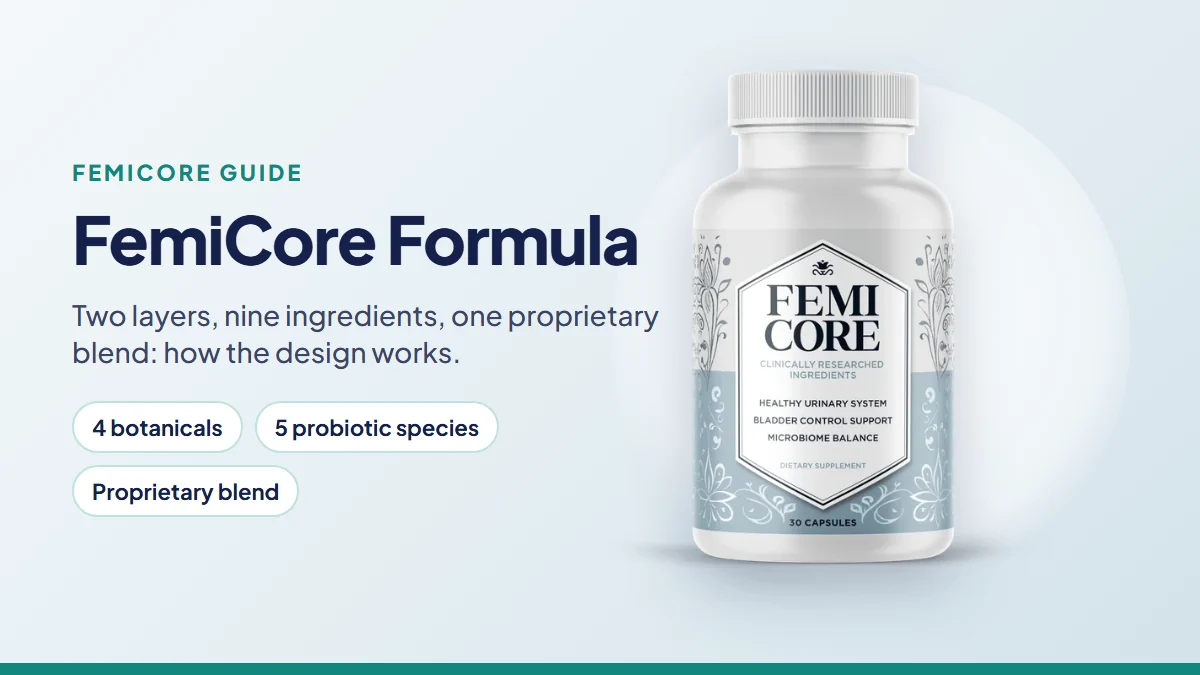
The FemiCore formula puts nine ingredients into one daily capsule: four botanicals and five Lactobacillus probiotic species, combined in a proprietary blend. This article looks at the formula as a design rather than as a list. We cover how the two layers are meant to work together, what the proprietary blend label does and does not tell you, what fitting nine ingredients into one capsule implies, and how this kind of formula compares with simpler approaches. If you want each ingredient explained individually, our FemiCore ingredients list covers all nine in detail.
See the Formula on the Official Site
Nine ingredients in one capsule a day, with a 60-day money-back guarantee from delivery.
View the FemiCore Formula
60-Day Money-Back Guarantee From DeliveryTable of Contents
- The FemiCore Formula at a Glance
- Layer 1: Four Botanicals
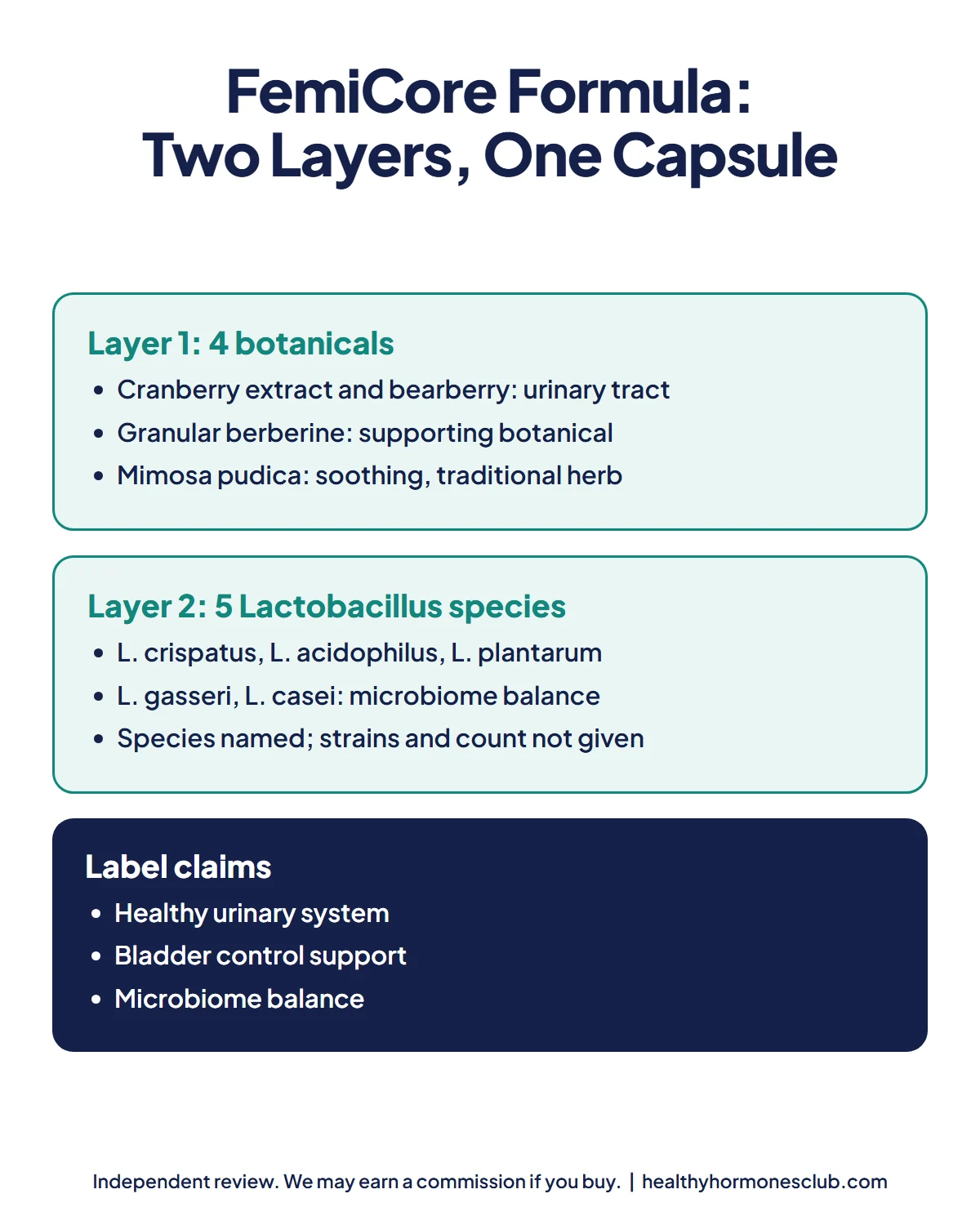
- Layer 2: Five Lactobacillus Species
- What “Proprietary Blend” Means for This Formula
- The One-Capsule Constraint
- How the Formula Compares With Simpler Designs
- Formula Strengths and Weak Spots
- What a Fully Transparent Formula Would Show
- Frequently Asked Questions
The FemiCore Formula at a Glance
| Feature | FemiCore |
|---|---|
| Format | Capsule, one a day, 30 per bottle |
| Structure | Two layers: 4 botanicals + 5 probiotic species |
| Label claims | Healthy urinary system; bladder control support; microbiome balance |
| Blend type | Proprietary blend (no individual amounts) |
| Described as | No stimulants, non-GMO (per the seller) |
| Not disclosed | Individual doses, CFU count, strain codes, cranberry PAC, bearberry arbutin, berberine dose, certificate of analysis |
| Trial of the finished formula | None published that we could find |
Layer 1: Four Botanicals
The botanical layer does most of the “urinary tract” work in the formula’s design. Each botanical has a different job.
| Botanical | Job in the formula | Research context |
|---|---|---|
| Cranberry extract | Urinary tract support | A-type PACs reduce E. coli sticking in lab work; a 2023 Cochrane review found cranberry products can reduce repeat UTIs in women prone to them |
| Bearberry (uva ursi) | Traditional urinary herb | Arbutin becomes hydroquinone in urine, antibacterial in lab work; human data limited; traditionally used in short courses |
| Granular berberine | Supporting botanical | Good human data for blood sugar and cholesterol; little for bladder symptoms |
| Mimosa pudica | Soothing, traditional herb | Lab and animal reports only; no human bladder trials |
Cranberry and bearberry both point at the urinary tract, which gives the botanical layer a clear theme. Berberine and Mimosa pudica are harder to place. Neither has human research for bladder symptoms, so their role in this formula rests on broader or traditional uses.
Layer 2: Five Lactobacillus Species
The probiotic layer carries the “microbiome balance” claim. The idea comes from sequencing studies since about 2012, led in part by researchers at Loyola University Chicago, which found that the female bladder is not sterile. Some studies found fewer Lactobacillus in women with urgency incontinence.
FemiCore uses five species rather than one: L. crispatus, L. acidophilus, L. plantarum, L. gasseri and L. casei. A multi-species design casts a wide net, which is a common approach in probiotic products. The limitation is that probiotic effects are strain-specific, and the label lists species only. Two products can both say “L. crispatus” and contain different strains with different research behind them.
The route matters too. The best-known L. crispatus result for repeat urinary infections used a vaginal product. FemiCore is an oral capsule, so the probiotics have to pass through the digestive system first. Our how does FemiCore work guide follows that path step by step.
Try the Full Formula
Three bottles cover 90 days at $69 per bottle, with free US shipping.
See FemiCore Packages
Free US Shipping on 3 and 6 BottlesWhat “Proprietary Blend” Means for This Formula
A proprietary blend is a legal and common way to label a supplement. It lets the maker name the ingredients without giving the amount of each one. For FemiCore, that means the nine ingredients are visible, but their doses are not.
Under US supplement labeling rules, a proprietary blend must still show two things:
- The total weight of the blend per serving.
- The ingredients in order of weight, from the largest amount to the smallest.
So when your bottle arrives, the supplement facts panel is worth a close look. The order of the nine names tells you which ingredients are present in larger amounts and which are near the bottom. It does not tell you the actual milligrams, and it cannot tell you the probiotic count, which is usually given separately when a maker chooses to disclose it.
Why does this matter? Several FemiCore ingredients depend heavily on dose. Cranberry results depend on PAC content. Berberine studies used specific daily amounts. Bearberry is traditionally limited to short courses. A proprietary blend asks you to trust that the maker chose sensible amounts without being able to check.
The One-Capsule Constraint
The formula is built around a single capsule a day. That choice shapes what the formula can contain.
Common supplement capsules hold roughly a few hundred milligrams up to about a gram of powder, depending on their size and the density of the powder. FemiCore has to fit four botanical extracts and five probiotic species into that space. For scale, human berberine studies for blood sugar used about 1,000 to 1,500 mg a day of berberine alone.
Our reading, which we cannot confirm without the label amounts: FemiCore is most likely a broad formula with modest amounts of each ingredient, rather than a formula that delivers research-level doses of each one. That is a common trade-off for one-capsule products. It makes the routine easy, and it makes any single ingredient’s effect harder to predict.
How the Formula Compares With Simpler Designs
We compare FemiCore with types of products and approaches, not with named brands.
| Design | Strength | Limitation |
|---|---|---|
| FemiCore (multi-ingredient blend) | Several targets in one daily capsule | Doses and strains hidden; no trial of the combination |
| Cranberry-only supplement | One ingredient with the clearest research for repeat UTIs | Narrow; useful only when the PAC content is stated |
| Single-strain women’s probiotic | A named strain that can be matched to its own research | Covers only the microbiome angle |
| Pelvic floor training | Strong evidence for leaks from coughing, sneezing or lifting | Takes regular effort; not a capsule |
| Seeing a urologist | Finds the actual cause | Needs an appointment; essential for warning signs |
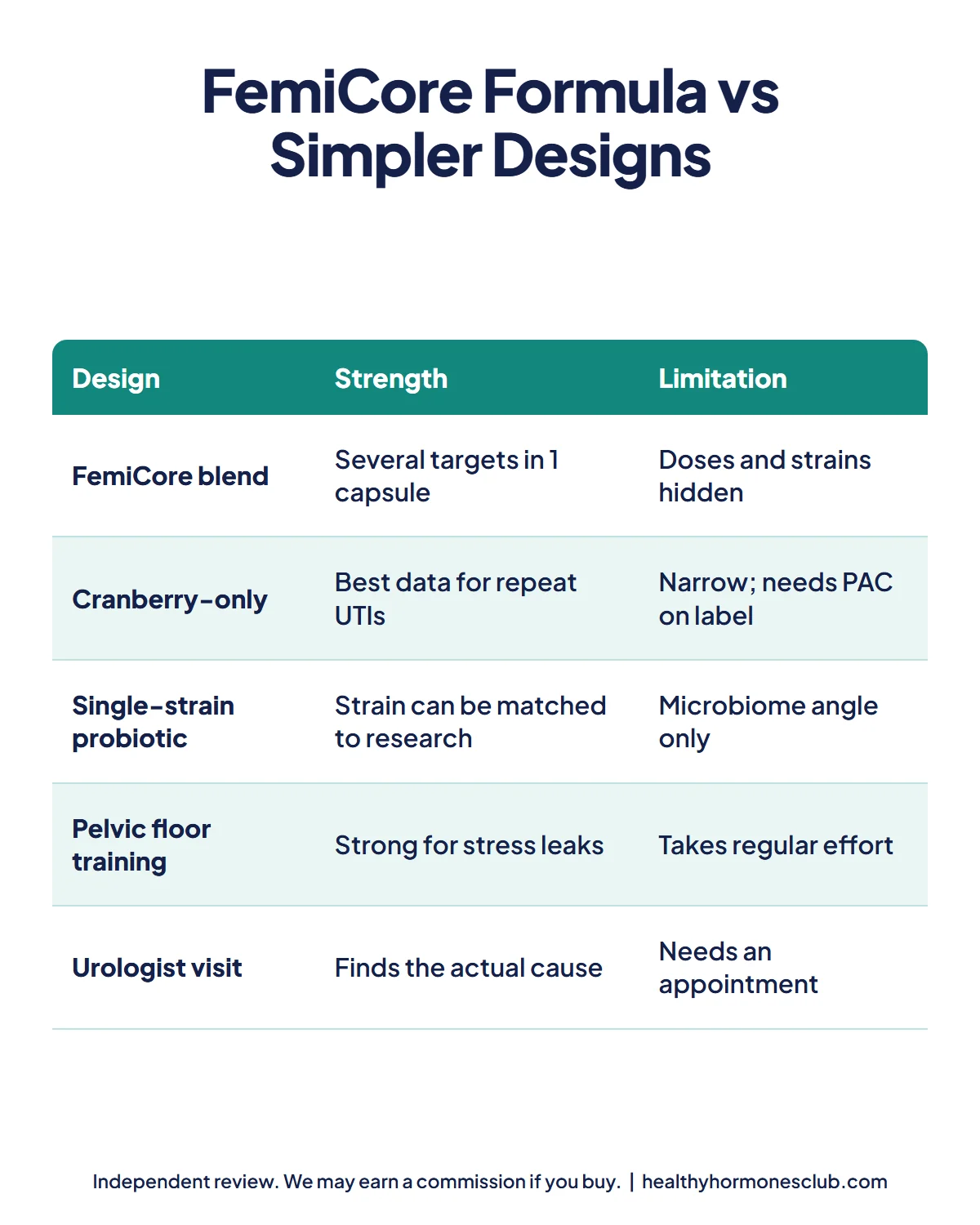
The comparison is less about which is “best” and more about matching the design to your problem. A broad formula suits someone who wants general urinary support in one step. A focused product or a non-supplement approach suits someone with a specific, defined problem. Our does FemiCore work article tests each ingredient against the research in this way.
Compare It for Yourself
See the full label and packages on the official store; every order has 60 days from delivery to return.
Check the Official Label
One-Off Purchase, No Hidden AutoshipFormula Strengths and Weak Spots
Strengths
- A clear theme: two of the four botanicals and all five probiotics point at urinary or microbiome health.
- It includes cranberry, the ingredient with the best research for repeat UTIs in women prone to them.
- It is built on a plausible, current idea: the bladder has its own bacteria.
- One capsule a day, described by the seller as stimulant-free and non-GMO.
Weak spots
- No individual doses, so you cannot match any ingredient to its research.
- Species, not strains, for the probiotics, and no count.
- Bearberry is traditionally a short-course herb, but the formula is meant for daily use for months.
- Berberine adds the most potential drug interactions while having the least bladder-specific research.
- No published trial of the finished formula.
What a Fully Transparent Formula Would Show
If you want to judge the formula properly, these are the details to ask customer support for before you buy, or to look for on the bottle when it arrives:
- Milligrams of each of the four botanicals per capsule.
- The cranberry PAC content and the bearberry arbutin content.
- The probiotic count (CFU), and whether it is guaranteed through the expiry date or only at manufacture.
- Strain codes for each Lactobacillus species.
- A certificate of analysis from testing, and the name of the manufacturer and the certifier behind the seals.
- The capsule shell and any other ingredients.
On regulation: FemiCore is sold as a dietary supplement, so it follows the FDA’s rules for supplements rather than the drug approval process. The FDA does not pre-approve any supplement brand. The official site shows a “made in an FDA registered facility” seal, which means the factory is registered, not that the formula was approved. Our is FemiCore a health supplement guide explains the label rules in more depth, and the FemiCore product guide summarizes the key facts.
Frequently Asked Questions
What is in the FemiCore formula?
Nine ingredients in one daily capsule: four botanicals (Mimosa pudica, bearberry, cranberry extract and granular berberine) and five Lactobacillus species (L. crispatus, L. acidophilus, L. plantarum, L. gasseri and L. casei), all in a proprietary blend.
Why does the FemiCore formula combine herbs and probiotics?
The design aims at several targets at once: cranberry and bearberry for the urinary tract, the Lactobacillus species for the “microbiome balance” claim, and berberine and Mimosa pudica as supporting botanicals. Combining them in one capsule is a convenience choice; it has not been tested as a combination in a published trial.
What does proprietary blend mean on the FemiCore label?
It means the ingredients are listed by name but their individual amounts are not. Under US supplement labeling rules, a proprietary blend shows the total weight of the blend and lists its ingredients in order from most to least by weight, so the order on your bottle hints at which ingredients are present in larger amounts.
Has the FemiCore formula been clinically tested?
We could not find a published clinical trial of the finished FemiCore formula. The label’s “clinically researched ingredients” refers to research on the ingredients in general.
Is the FemiCore formula FDA approved?
FemiCore is sold as a dietary supplement, which follows the FDA’s supplement rules rather than the drug approval process. The FDA does not pre-approve any supplement brand. The “made in an FDA registered facility” seal on the official site means the factory is registered, not that the formula was approved.
Can I get the exact FemiCore formula amounts?
They are not published on the official website. You can ask customer support for the full supplement facts panel, the probiotic count and any certificate of analysis before you order, and read the label when the bottle arrives.
The Bottom Line
The FemiCore formula is a two-layer design: four botanicals aimed mainly at the urinary tract and five Lactobacillus species aimed at the microbiome, all in one daily capsule. The theme is coherent and rests on a plausible idea, and it includes cranberry, the best-studied ingredient for repeat UTIs. Its weak spots are transparency and fit with the research: no doses, no strain codes, a short-course herb used daily, and no trial of the finished blend. Read the order of ingredients on your bottle, ask support for the missing numbers, and judge the formula against your specific problem rather than the label claims.
Get the Genuine FemiCore Formula
Order from the official store for sealed bottles and a 60-day money-back guarantee from delivery.
Visit the Official FemiCore Store
60-Day Money-Back Guarantee From Delivery