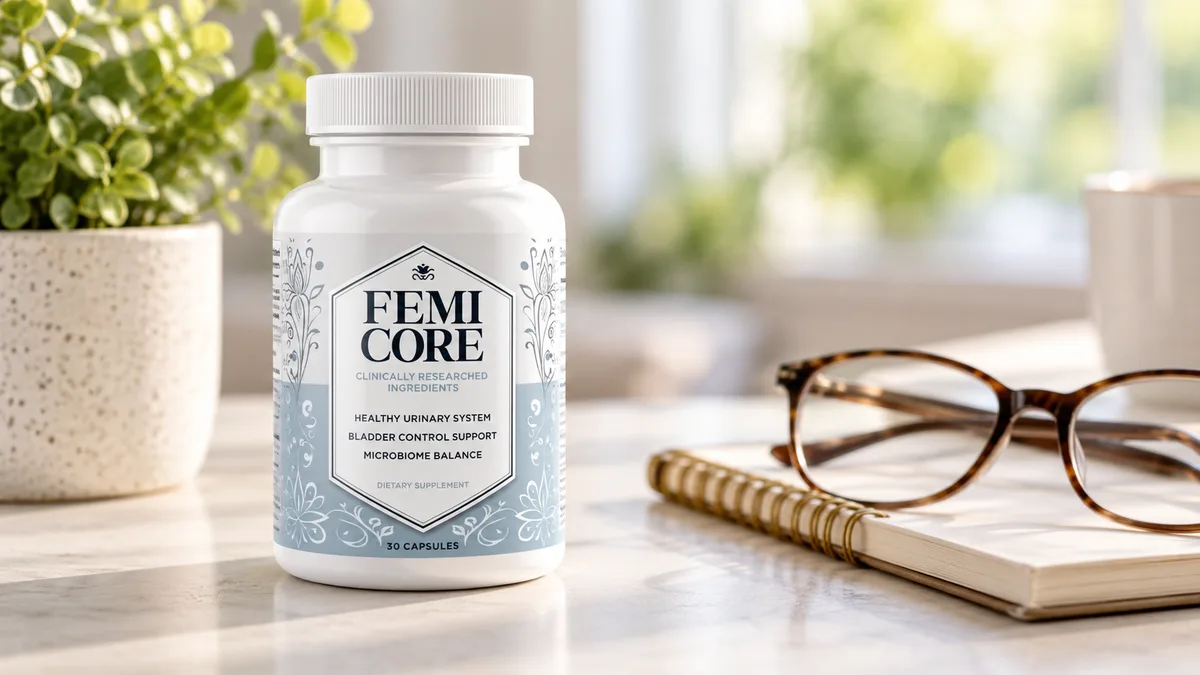
Is FemiCore a health supplement? Yes. FemiCore is sold as a dietary supplement, and the front of the bottle says so in plain print. That one phrase carries a lot of legal weight in the United States. It decides who checks the product before it reaches you, what the company is allowed to say about it, how the label must be laid out and, most importantly, what you can reasonably expect from it.
This guide explains what FemiCore’s supplement status means in practice: the difference between a supplement and a drug, what the FDA does and does not review, what the GMP and “FDA registered facility” seals on the bottle actually tell you, and how to read the Supplement Facts panel line by line. If you want our verdict on whether the formula works, read our full FemiCore reviews; this page is about classification and labeling.
See the Official FemiCore Label and Offer
One capsule a day, nine ingredients, and a 60-day money-back guarantee on every package.
Visit the Official FemiCore Site
60-Day Money-Back GuaranteeTable of Contents
Is FemiCore a Health Supplement? The Short Answer
FemiCore is a once-daily capsule that combines four botanical ingredients (Mimosa pudica seed extract, cranberry extract, bearberry leaf and berberine) with five Lactobacillus probiotic strains. It is labeled, marketed and sold as a dietary supplement for women’s urinary and bladder health. Each bottle holds 30 capsules, and the suggested use on the label is one capsule a day with 6 to 8 ounces of water.
So yes, it is a health supplement in the everyday sense, and a dietary supplement in the legal sense. It is not a prescription drug, not an over-the-counter medicine and not a medical device. For a plain-language overview of the product itself, see what is FemiCore.
Dietary Supplement vs Drug: Why the Difference Matters
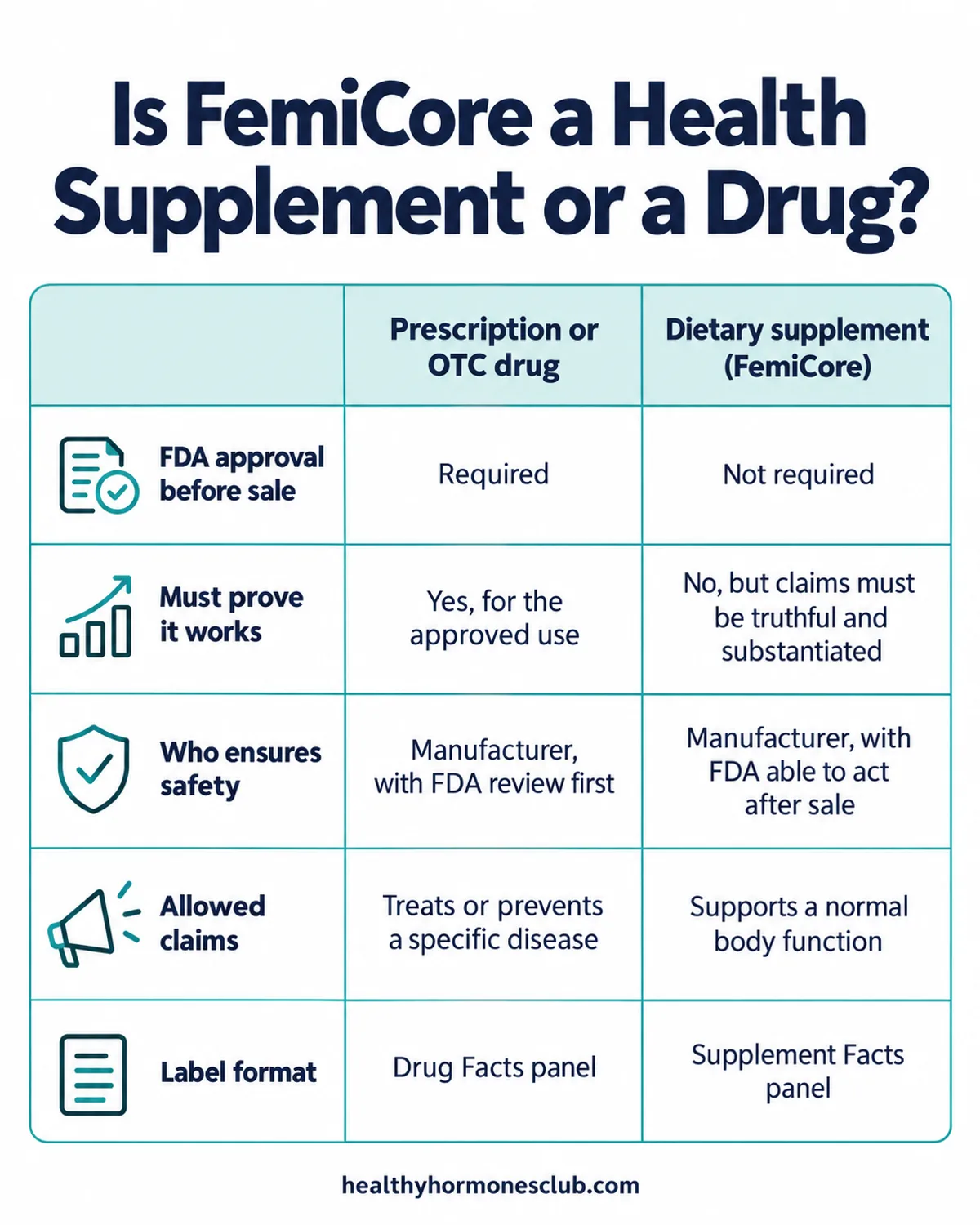
In the US, dietary supplements are governed by the Dietary Supplement Health and Education Act of 1994 (DSHEA). DSHEA treats supplements as a special category of food, not as drugs. That single decision shapes almost everything about how a product like FemiCore reaches the market:
| Question | Prescription or OTC Drug | Dietary Supplement (FemiCore) |
|---|---|---|
| FDA approval before sale? | Yes, after review of clinical trial data | No premarket approval |
| Must prove it works? | Yes, for the approved use | No, but claims must be truthful and substantiated |
| Who ensures safety? | Manufacturer, with FDA review first | Manufacturer, with FDA able to act after sale |
| Allowed claims | Treats or prevents a specific disease | Supports a normal body function (structure/function) |
| Label format | Drug Facts panel | Supplement Facts panel |
None of this makes a supplement good or bad. It means the burden of proof is different: a bladder medicine must show in trials that it reduces urgency, while a supplement must stay safe, follow manufacturing rules and keep its claims to “supports normal function.”
What the FDA Does and Does Not Review
What the FDA does not do:
- It does not approve supplements, including FemiCore, for safety or effectiveness before they go on sale.
- It does not test each product or batch before it ships.
- It does not review or approve the wording on a supplement website or label in advance.
What the FDA does do:
- It sets mandatory manufacturing rules (current Good Manufacturing Practice, covered below) and inspects facilities.
- It requires a premarket safety notification for “new dietary ingredients” not sold in supplements before October 1994.
- It can take action against products that are adulterated, contaminated or mislabeled once they are on the market.
- It collects adverse event reports. Supplement companies must report serious adverse events they receive, and consumers or doctors can report problems directly through the FDA’s Safety Reporting Portal or MedWatch.
Advertising, including website claims and emails, is mainly policed by the Federal Trade Commission (FTC), which expects health claims to be backed by competent and reliable scientific evidence.
Check FemiCore’s Official Product Information
Read the ingredient list, directions and guarantee terms on the official store before you decide.
View FemiCore Details
GMP, “FDA Registered” and the Seals on the FemiCore Label
The official FemiCore website displays a row of quality seals: GMP Certified (Good Manufacturing Practice), Manufactured in USA with imported ingredients, Made in an FDA Registered Facility and Made with Non-GMO Ingredients. Here is what the most important of those phrases mean, and what they do not mean.
GMP (Good Manufacturing Practice)
Every company that makes, packages or holds dietary supplements for the US market must follow the FDA’s current Good Manufacturing Practice rules (21 CFR Part 111). A “GMP Certified” seal usually means a third party has also audited the facility against those rules. The FemiCore label and website do not name the manufacturer or the organization that issued the seal, so we could not verify it independently.
”Manufactured in an FDA registered facility”
Facilities that manufacture, pack or hold food and supplements for US consumers must register with the FDA. Registration is a listing requirement, not a stamp of approval. The FDA states that registration does not mean it has approved or endorsed a facility or its products. Read this seal as “the factory is on the FDA’s list,” not “the FDA checked this product.”
Independent testing
The official FAQ says ingredients are tested and certified for purity by independent labs. We did not find published certificates of analysis on the official site, and the label does not carry a USP Verified or NSF Certified mark. That is common in this category, but it means purity claims rest on the company’s word.
How to Read the FemiCore Supplement Facts Label
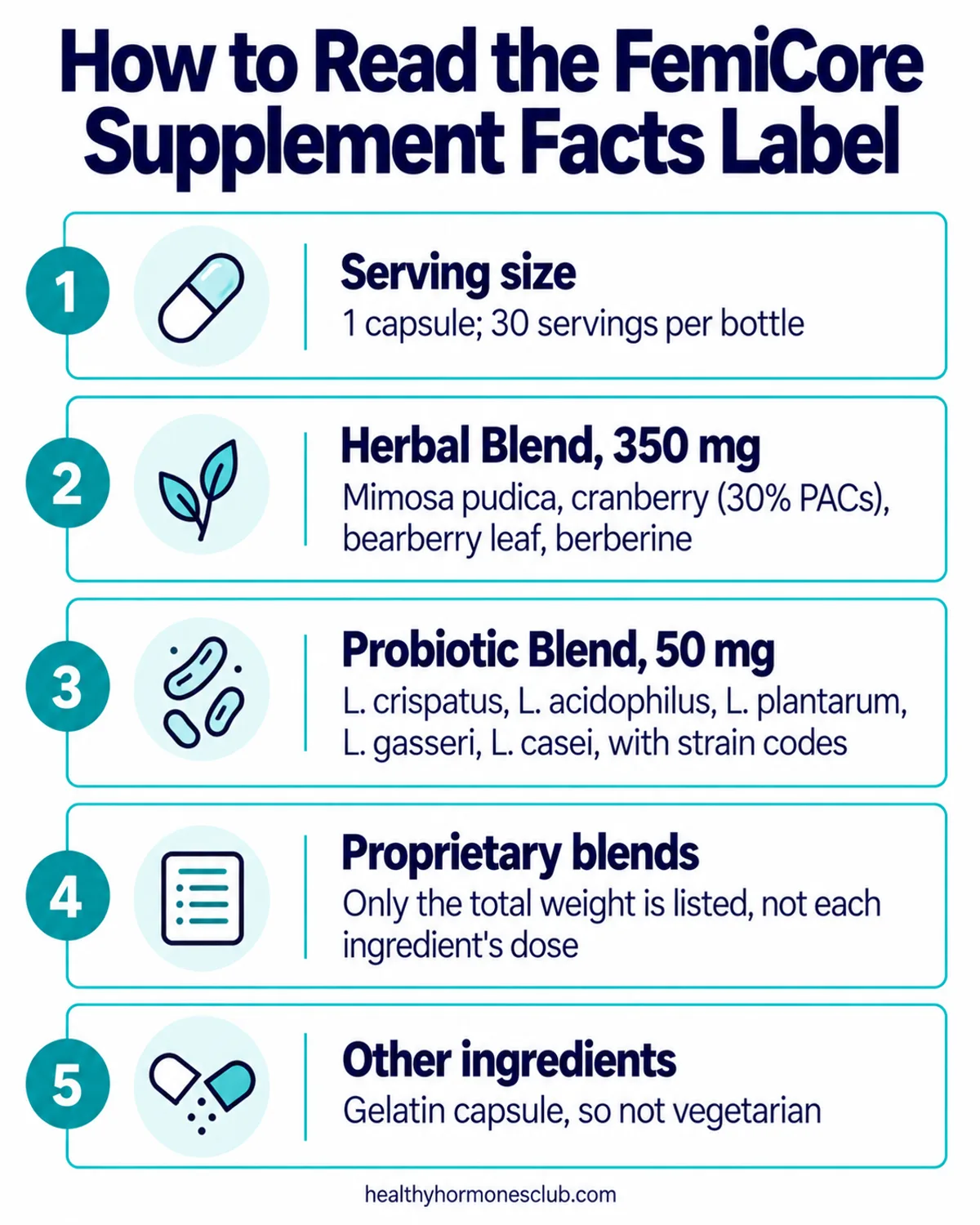
Every supplement sold in the US must carry a Supplement Facts panel. Here is what FemiCore’s panel shows and how to interpret it:
- Serving size: 1 capsule; servings per container: 30. One bottle is a 30-day supply.
- Herbal Blend, 350 mg: Mimosa pudica seed extract, cranberry extract (standardized to 30% proanthocyanidins), bearberry leaf and granular berberine hydrochloride extract 8%.
- Probiotic Blend, 50 mg: L. crispatus LCr86, L. acidophilus LA88, L. plantarum N13, L. gasseri LG08 and L. casei LC16. The strain codes identify specific strains, which is a better sign than species names alone.
- Daily Value not established: normal for botanicals and probiotics, which have no official daily values.
- Other ingredients: gelatin (capsule), brown rice flour, magnesium stearate, olive oil and silicon dioxide. The gelatin capsule means FemiCore is not vegetarian.
Both blends are proprietary blends. US rules let a company list only the total weight of a blend, with ingredients in descending order by weight. So you know the herbal blend totals 350 mg and that Mimosa pudica is the largest component, but not how many milligrams of cranberry or berberine you get. The probiotic blend is listed by weight (50 mg) rather than as colony-forming units (CFU), so the live-culture count is not stated. Our FemiCore ingredients list covers each component in detail.
Structure/Function Claims: What “Bladder Control Support” Means
The front of the FemiCore bottle lists three benefits: Healthy Urinary System, Bladder Control Support and Microbiome Balance, each marked with a small dagger symbol. That dagger points to the required disclaimer on the back: “These statements have not been evaluated by the Food & Drug Administration. This product is not intended to diagnose, treat, cure or prevent any disease.”
These are structure/function claims, the only type of health claim a supplement can make without FDA review. A supplement may say it “supports” a normal body function. It may not say it treats a disease such as a urinary tract infection or overactive bladder. Companies making these claims must notify the FDA within 30 days of marketing and must have evidence that the claim is truthful, although the FDA does not check that evidence in advance.
In practice, “bladder control support” describes an intended effect on normal function. It is not a promise of results or a substitute for a diagnosis.
What Supplement Status Means for Your Expectations
Knowing FemiCore is a dietary supplement should shape how you approach it:
- Evidence is ingredient-level. Cranberry, berberine and Lactobacillus strains have their own published research, but we are not aware of a clinical trial of the finished FemiCore formula. Our article on whether FemiCore really works weighs that evidence.
- Results are gradual. Probiotic-based formulas are usually judged over 8 to 12 weeks of daily use, not days.
- Safety still matters. “Natural” does not mean free of interactions. Berberine, bearberry and cranberry each have cautions, covered in our FemiCore side effects guide.
- The guarantee is your consumer protection. Because no regulator vouches for effectiveness, the 60-day money-back guarantee on official orders is the main way to limit your risk.
- Symptoms deserve a diagnosis. Blood in the urine, fever, burning or sudden changes need a doctor, whatever supplement you take.
For directions, storage and how one bottle fits into a daily routine, see our FemiCore supplement guide.
Try FemiCore With the 60-Day Guarantee
Buy from the official store so every package is covered by the full money-back guarantee.
Order From the Official Store
Free US Shipping on 3 & 6 BottlesFrequently Asked Questions
Is FemiCore a health supplement or a medicine?
FemiCore is a dietary supplement, not a medicine. Its label says Dietary Supplement on the front and carries a Supplement Facts panel, the format required for supplements in the United States. It is not a prescription or over-the-counter drug, and it is not intended to diagnose, treat, cure or prevent any disease.
Is FemiCore FDA approved?
No, and no dietary supplement is. Under the Dietary Supplement Health and Education Act of 1994 (DSHEA), the FDA does not approve supplements for safety or effectiveness before they are sold. The manufacturer is responsible for making sure the product is safe and the label is truthful. The FemiCore label states that its statements have not been evaluated by the FDA.
What does “manufactured in an FDA registered facility” mean?
It means the facility that makes the product is registered with the FDA as a food facility, which is a legal requirement for companies that manufacture, pack or hold food and supplements sold in the US. Registration is not an approval, certification or endorsement of the facility or the product, and the FDA itself says so.
Is FemiCore made under GMP?
The official FemiCore website displays a GMP Certified (Good Manufacturing Practice) seal. All US supplement makers are legally required to follow the FDA’s current Good Manufacturing Practice rules. The website does not name the manufacturer or the organization behind the GMP seal, so we could not verify the certification independently.
Why doesn’t the FemiCore label list the amount of each ingredient?
FemiCore uses two proprietary blends: a 350 mg herbal blend and a 50 mg probiotic blend. US labeling rules allow a proprietary blend to show only its total weight, with the ingredients listed in descending order by weight. That is legal, but it means you cannot see the exact dose of cranberry, bearberry, berberine or each probiotic strain.
Do I need a doctor’s approval to take FemiCore?
You do not need a prescription, but the label itself advises pregnant or nursing women, anyone under 18 and anyone with a known medical condition to consult a physician first. That advice also applies if you take prescription medication, because berberine, bearberry and cranberry can interact with some drugs. Our guide on who should use FemiCore goes through this in detail.
The Bottom Line
Is FemiCore a health supplement? Yes: it is a dietary supplement regulated under DSHEA, not an FDA-approved drug. That means it was not reviewed for effectiveness before sale, its claims are limited to supporting normal urinary and bladder function, and its quality depends on the manufacturer following GMP rules. The label is fairly informative, with strain-level probiotic names and blend totals, but individual doses and CFU counts are not disclosed. Go in with supplement-level expectations, check with your doctor if you have a condition or take medication, and use the 60-day guarantee as your safety net. A short product summary is on our FemiCore overview page.
Get Genuine FemiCore From the Official Store
From $49 per bottle on the six-bottle package, with free US shipping on 3 and 6 bottles.
Check Today’s FemiCore Price
60-Day Money-Back Guarantee