Does FemiCore work? The honest answer is that nobody can say yes or no with confidence yet, and this article shows exactly why. FemiCore is a women’s supplement marketed for bladder control, urinary health and microbiome balance. Its label says “clinically researched ingredients,” and that is true for the ingredients one by one. But a study of an ingredient only tells you something about FemiCore if the study used a similar dose, the same form and a similar group of women. We call that the study-match test, and we run it below for every ingredient and every claim.
Read the Label on the Official Site
See the full ingredient list and the 60-day guarantee before you decide whether FemiCore fits your goal.
View FemiCore on the Official Site
60 Days From Delivery to Ask for a RefundTable of Contents
- Does FemiCore Work? The Short Answer
- Three Questions Behind Any “It Works” Claim
- The Study-Match Test, Ingredient by Ingredient
- What a Real Answer Would Require
- What “Working” Would Look Like Day to Day
- Why It Can Seem to Work (or Not) for the Wrong Reasons
- Who Should Not Wait to Find Out
- Frequently Asked Questions
Does FemiCore Work? The Short Answer
FemiCore combines nine ingredients in one capsule: four botanicals (Mimosa pudica, bearberry, cranberry extract and berberine) and five Lactobacillus species (L. crispatus, L. acidophilus, L. plantarum, L. gasseri and L. casei). We could not find a published clinical trial of the finished FemiCore formula. So any answer has to be built from studies of the individual ingredients.
That approach has a weak spot. The ingredients sit in a proprietary blend, and the label does not give the amount of any single ingredient, the probiotic count or the strain codes. Without those numbers, you cannot confirm that a capsule of FemiCore delivers what the studies tested. Our summary:
- Plausible: the idea behind the formula. Research since about 2012 has shown the female bladder has its own bacteria, and some studies found fewer Lactobacillus in women with urgency incontinence.
- Supported for a different goal: cranberry, for lowering repeat urinary infections in women prone to them.
- Not shown: that FemiCore, at its undisclosed doses, improves bladder control, leaks or urgency.
If you want the mechanism behind each claim, our how does FemiCore work guide explains the three pathways. This article focuses on a narrower question: does the research actually line up with what is in the bottle?
Three Questions Behind Any “It Works” Claim
When a supplement points to research, three follow-up questions decide whether that research applies to you.
1. Same dose?
Many ingredients only show an effect above a certain amount. Berberine studies for blood sugar, for example, typically used about 1,000 to 1,500 mg a day. Cranberry results depend on the amount of A-type proanthocyanidins (PACs). If a product does not state its dose, you cannot tell whether it reaches the level that was tested.
2. Same form and route?
A probiotic placed directly in the vagina and a probiotic swallowed in a capsule take very different paths. The best-known L. crispatus result for repeat urinary infections came from a vaginal product in a small placebo-controlled trial. FemiCore is an oral capsule.
3. Same people and same outcome?
A study in women with repeat infections tells you about infections, not about leaks when you sneeze. A lab or animal study tells you about cells or animals, not about women. The question is always: were the people in the study like you, and did they measure the problem you have?
We apply these three questions to each FemiCore ingredient below. A “match” means the research lines up with FemiCore on all three. A “partial” means it lines up on some. A “gap” means it does not, or that we cannot tell.
The Study-Match Test, Ingredient by Ingredient
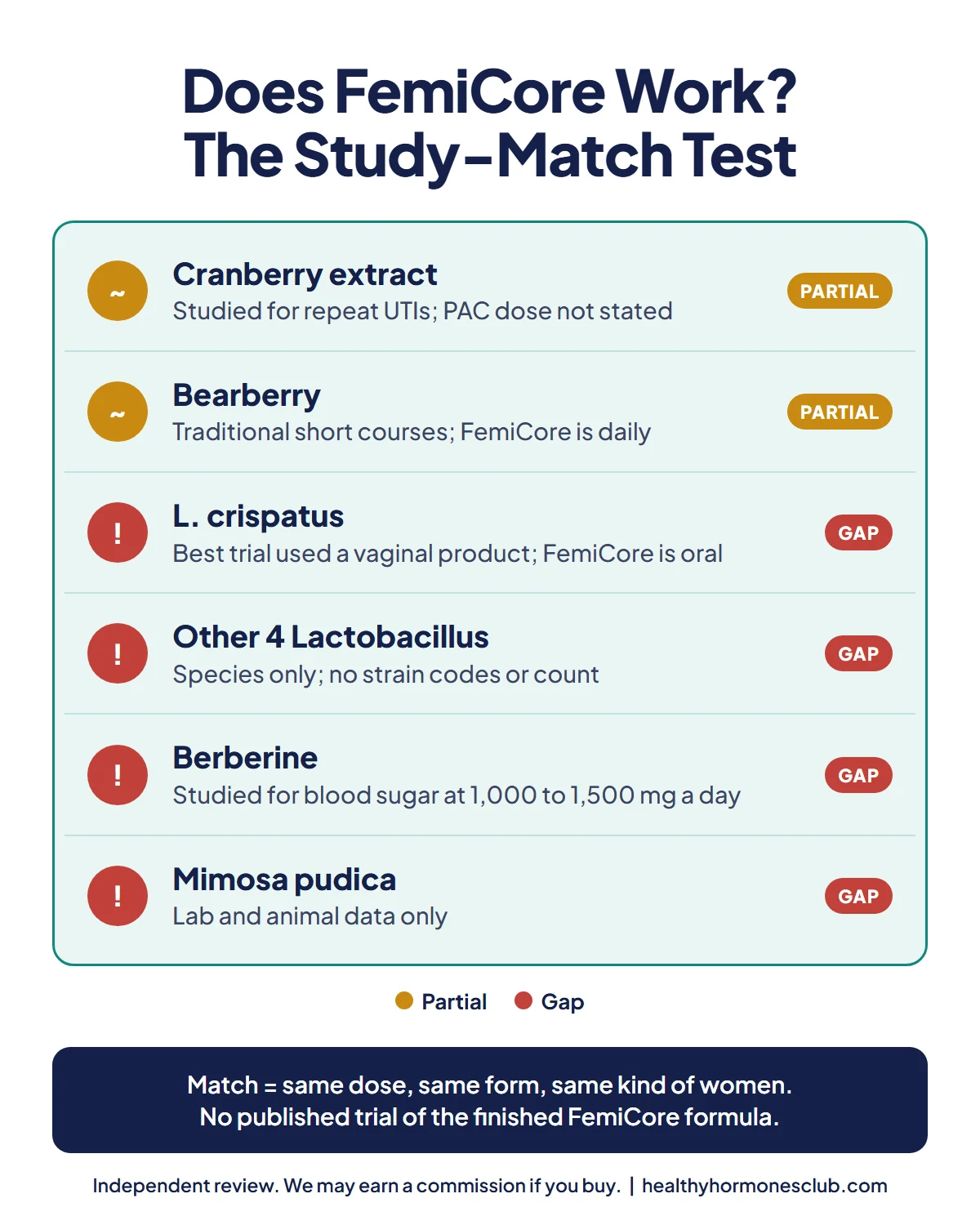
| Ingredient | What research tested | What FemiCore discloses | Our match rating |
|---|---|---|---|
| Cranberry extract | Cranberry products for repeat UTIs in women prone to them; effect depends on PAC dose | Present; PAC content not stated | Partial |
| L. crispatus | A vaginal product in a small trial for repeat UTIs; effects are strain-specific | Species named; oral; no strain code or count | Gap |
| Other Lactobacillus species | General gut and vaginal research; little for bladder symptoms | Species named; no strain codes or count | Gap |
| Bearberry (uva ursi) | Limited, mixed human data; traditional use for mild urinary complaints in short courses | Present; arbutin content not stated; daily use | Partial |
| Berberine | Good human data for blood sugar and cholesterol at about 1,000 to 1,500 mg a day | Present; dose not stated | Gap for bladder goals |
| Mimosa pudica | Lab and animal reports of anti-inflammatory, antimicrobial and antispasmodic effects | Present; dose not stated | Gap |
Cranberry comes closest. A 2023 Cochrane review found cranberry products can reduce repeat urinary infections in women who get them often, although earlier reviews were mixed and the effect depends on the PAC dose. Because FemiCore does not state its PAC content, we rate it a partial match rather than a full one. It is also worth repeating that cranberry was studied for infections, not for leaks or urgency.
Bearberry gets a partial rating for a different reason. Its traditional use matches the urinary theme, but European herbal regulators describe it for short courses of about a week, not the months of daily use that the FemiCore directions imply.
The probiotics are the core of the “microbiome balance” claim, yet they score lowest on the match test. Effects of probiotics are strain-specific, and FemiCore lists species only. The headline L. crispatus trial used a vaginal route, while FemiCore is swallowed.
For the safety side of each ingredient, which matters just as much as whether it works, see our FemiCore side effects guide.
Want to Test It Yourself?
Every package comes with a 60-day money-back guarantee counted from the delivery date.
See Packages and the Guarantee
One-Off Purchase, No Hidden AutoshipWhat a Real Answer Would Require
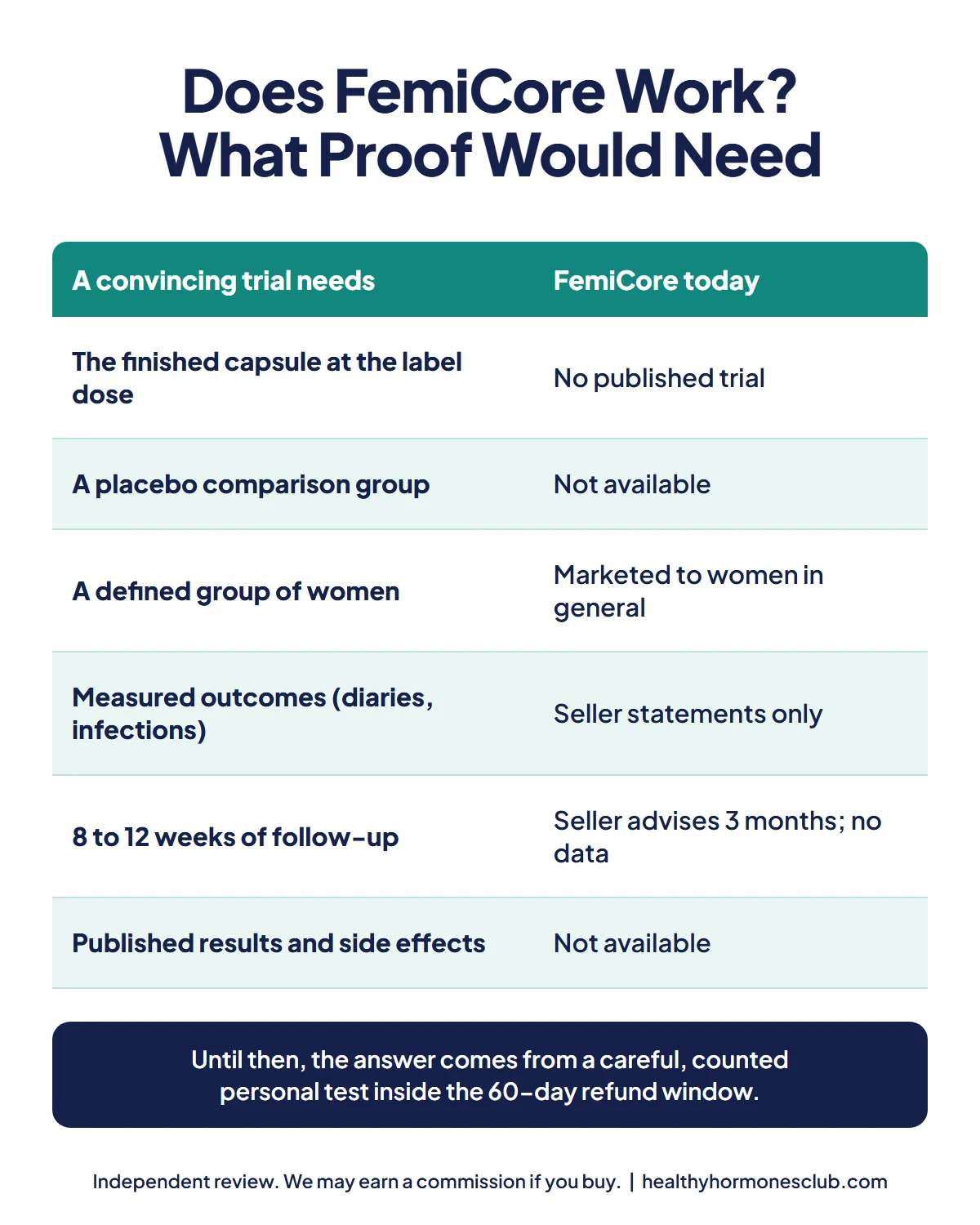
The cleanest way to settle “does FemiCore work” would be a trial of the finished product. Here is what that trial would need, and what exists today.
| A convincing trial would have | What exists for FemiCore |
|---|---|
| The finished FemiCore capsule, at the label dose | No published trial found |
| A placebo group, with neither side knowing who got what | Not available |
| A defined group of women, such as urgency symptoms or repeat UTIs | Marketing speaks to women in general |
| Measured outcomes, such as bladder diaries or infection counts | Seller statements only |
| At least 8 to 12 weeks of follow-up | The seller advises at least 3 months of use, but no data is published |
| Published results, including side effects | Not available |
The official site shows a star graphic and says its rating is “based on 19,263 reviews,” but no individual reviews are displayed and the figure cannot be checked. Its own disclaimer adds that testimonials “may not reflect the typical purchaser’s experience.” Seller figures like these cannot stand in for a trial.
None of this proves FemiCore does not work. It means the question is open, and the burden of finding out falls on you. That is why the guarantee and a careful personal test matter so much.
What “Working” Would Look Like Day to Day
”It works” should mean something you can count. Which numbers to watch depends on your goal, and some goals are much easier to judge inside the 60-day refund window than others.
| Your goal | What to count | Can you judge it in 60 days? |
|---|---|---|
| Fewer urgent trips | Urgent trips per day in a 3-day diary | Often, if you record a baseline first |
| Fewer night trips | Times you wake to urinate | Often, with the same diary |
| Fewer leaks | Leaks per day and what triggered them | Yes, but leaks from coughing or lifting usually respond to pelvic floor training rather than supplements |
| Fewer repeat UTIs | Diagnosed infections over many months | Rarely. Infections are spaced out, so 60 days is too short to tell |
| General urinary comfort | A simple 0 to 10 comfort score once a week | Possibly, though this is the easiest result to over-read |
The repeat-infection row deserves attention. Cranberry is the ingredient with the strongest research for that goal, but the goal itself is the hardest to judge quickly. If you get two or three infections a year, a two-month trial cannot show whether they have become less frequent. Repeat infections also need a doctor’s care, whatever supplement you take.
Our FemiCore how to use guide includes a simple bladder diary and checkpoints that fit inside the refund window.
Why It Can Seem to Work (or Not) for the Wrong Reasons
Bladder symptoms move around on their own. Before you credit or blame FemiCore, rule out these common false signals.
- The glass of water. The directions ask for a big glass of water with every capsule. If you drank little before, that alone can change how often you go and how comfortable you feel. Keep your other fluids steady during the trial.
- Starting on a bad week. Many people begin a supplement when symptoms are at their worst. Symptoms that peak tend to ease again on their own, which can look like a result.
- Other changes at the same time. Cutting caffeine, losing weight or starting pelvic floor exercises in the same month makes it impossible to know which change helped.
- Expectation. Believing a product will help can change how you rate symptoms. Counting events in a diary is less affected by this than a general feeling.
- The early adjustment period. Probiotics can cause gas or bloating in the first one to two weeks. Feeling worse at first is not proof the product is failing, and feeling settled after week two is not proof it is working.
A fair test changes one thing at a time and compares numbers, not impressions. If your counts at week 6 or 7 look the same as your baseline, that is a reasonable sign FemiCore is not working for you, and you still have time to use the guarantee.
Run a Fair 60-Day Test
Three bottles cover 90 days at $69 each with free US shipping, and refunds run 60 days from delivery.
Check Current FemiCore Prices
Free US Shipping on 3 and 6 BottlesWho Should Not Wait to Find Out
Testing a supplement for two months is reasonable for mild, stable symptoms. It is not reasonable when symptoms point to something that needs a diagnosis. See a doctor first, not a supplement, if you have:
- Blood in your urine
- Fever or chills with urinary symptoms
- Pain in your side or back below the ribs (flank pain)
- Burning when you urinate
- A sudden change in bladder control
- An older relative with urinary symptoms who has become confused
Ask your doctor or pharmacist before trying FemiCore if you are pregnant or breastfeeding, have kidney disease, take diabetes medicine, warfarin, lithium, cyclosporine or blood pressure medicine, or have a weakened immune system. Berberine in particular can change how the body handles many drugs. The official site itself advises talking to a physician if you are pregnant, nursing, taking medication or have a medical condition.
For a fuller picture of who is likely to benefit, see our who should use FemiCore fit guide, or the structured summary on our FemiCore product guide.
Frequently Asked Questions
Does FemiCore work for everyone?
No supplement works for everyone, and FemiCore has no published trial showing how many women it helps. Its ingredients were studied for different goals, mostly repeat urinary infections, so the women with the most plausible fit are those focused on urinary tract comfort rather than leaks from coughing or lifting.
Why can’t anyone say for sure whether FemiCore works?
Because the finished FemiCore formula has not been tested in a published clinical trial, and the label does not give the dose of each ingredient. Without doses, nobody can check whether FemiCore matches the amounts used in ingredient studies.
Does FemiCore work faster if I take two capsules a day?
There is no evidence for that. The official direction is one capsule every morning with a big glass of water. Taking more raises the chance of stomach upset from berberine and bearberry without any proof of faster results.
Can drinking more water explain why FemiCore seems to work?
It can play a part. The directions ask for a big glass of water with each capsule, and a change in fluid habits can shift bathroom patterns on its own. Keep the rest of your fluid intake steady while you test FemiCore so you can tell the difference.
Does FemiCore work for repeat UTIs, and how long would I need to tell?
Cranberry has the best research of any FemiCore ingredient for repeat infections in women prone to them, but FemiCore’s cranberry dose is not disclosed. Infections come and go over months, so a 60-day trial is usually too short to judge this goal. Repeat infections also need a doctor’s care.
Does “clinically researched ingredients” mean FemiCore works?
No. The phrase refers to research on the ingredients in general, not a trial of FemiCore itself. It tells you the ingredients have been studied, not that this combination at these doses gives a result.
The Bottom Line
Does FemiCore work? The research behind its ingredients is real, but it does not line up neatly with the bottle. Cranberry is the closest match, and even that was studied for repeat infections, not leaks, at PAC doses FemiCore does not disclose. The probiotics, which carry the microbiome claim, fail the match test on form and strain. With no trial of the finished formula, the only way to answer the question for yourself is a careful, counted test inside the 60-day refund window, after you have ruled out symptoms that need a doctor. For a longer look at the evidence by bladder problem type, read does FemiCore really work.
Decide With the Guarantee Behind You
Packages from $49 to $79 per bottle on the official store, with 60 days from delivery to change your mind.
Visit the Official FemiCore Store
60-Day Money-Back Guarantee From Delivery