
A supplement label has little room for warnings, and the official FemiCore site gives one general line: see a physician if you are pregnant, nursing, taking medication or have a medical condition. That advice is sound but broad. This page sets out FemiCore safety warnings in the format you would expect on a medicine leaflet: who should not use it, who should ask first, which medicines interact, when to stop, and when to get medical care instead. The warnings come from what is known about the nine listed ingredients. They are our guidance, not the seller’s, and they are not a substitute for advice from your own doctor or pharmacist.
Check the Full Ingredient List
The official store lists all nine ingredients. Take the list to your pharmacist if you take any medicine.
View FemiCore on the Official Site
60-Day Money-Back Guarantee From DeliveryTable of Contents
- Safety Warnings at a Glance
- Do Not Use FemiCore If
- Ask a Doctor or Pharmacist First If
- Medicine Interaction Warnings
- The Long-Term Use Warning
- Stop Taking It and Get Advice If
- Get Medical Care Instead If
- Warnings About the Bottle and the Seller
- What the Seals Do and Do Not Mean
- Taking These Warnings to Your Doctor
- Frequently Asked Questions
FemiCore Safety Warnings at a Glance
Most of the safety questions around FemiCore come from three of its nine ingredients. The five Lactobacillus probiotics and Mimosa pudica raise fewer concerns, although Mimosa pudica has no human safety research for this use.
| Ingredient | Main warnings |
|---|---|
| Berberine | Stomach upset; can lower blood sugar; may lower blood pressure; slows CYP3A4 and CYP2D6, raising levels of many drugs; unsafe in pregnancy and breastfeeding |
| Bearberry (uva ursi) | Nausea; harmless green-brown urine; short-term use only; avoid in pregnancy, breastfeeding, kidney disease and children; lithium interaction |
| Cranberry extract | Warfarin case reports (INR checks); oxalate and kidney stones |
| 5 Lactobacillus species | Gas and bloating in the first 1 to 2 weeks; rare infections in severely immunocompromised people |
| Mimosa pudica | Lab and animal data only; no human safety data for bladder use |
The label does not disclose the dose of any ingredient. That matters for safety as well as results, because the risk from berberine and bearberry depends on how much you take and for how long. For a fuller explanation of each ingredient’s side effects, see our FemiCore side effects guide.
Do Not Use FemiCore If
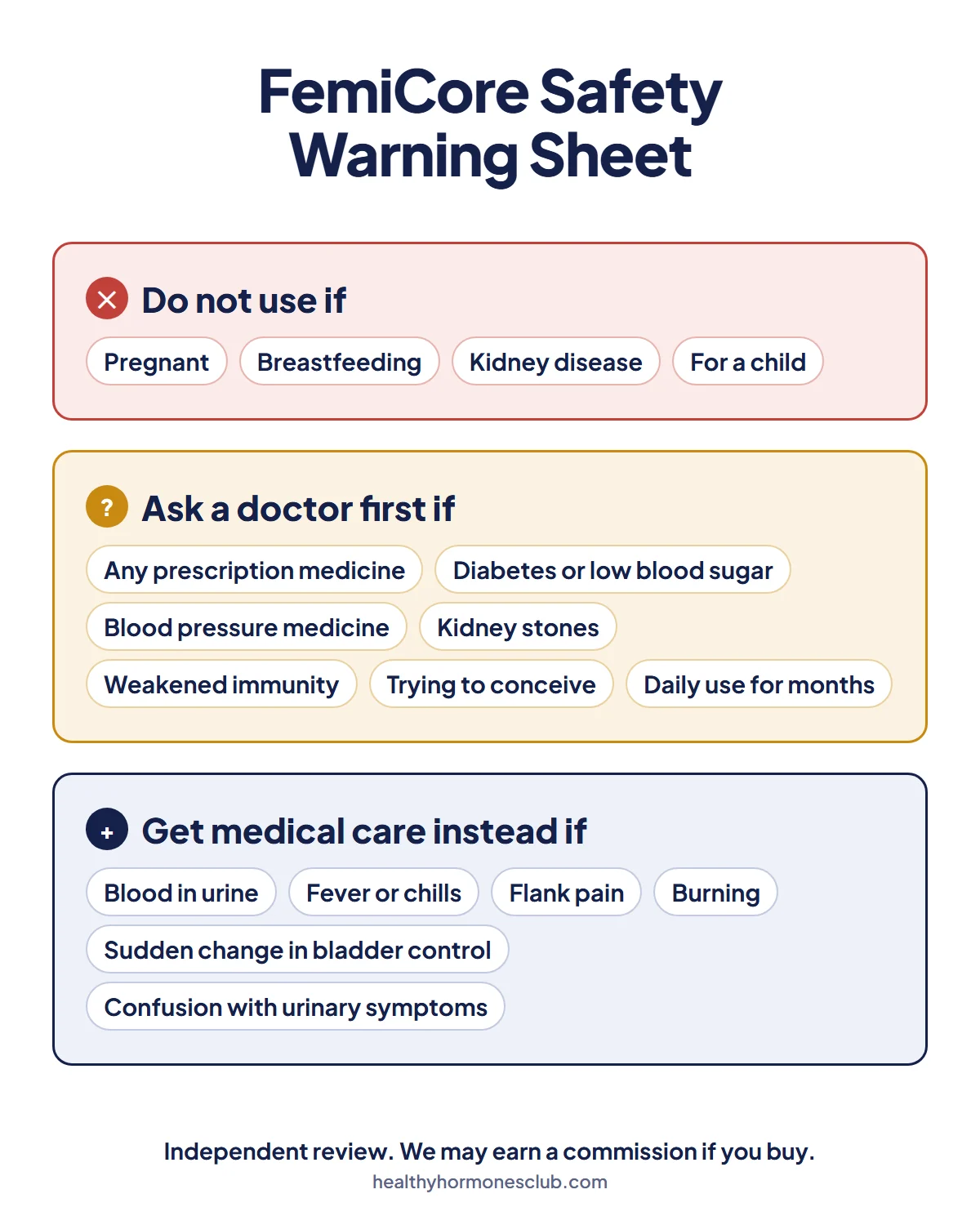
In our view, FemiCore is not suitable for these groups:
- You are pregnant. Berberine is considered unsafe in pregnancy, and bearberry should be avoided.
- You are breastfeeding. The same two ingredients carry the same warnings.
- You have kidney disease. Bearberry should be avoided.
- It is for a child. Bearberry should be avoided in children, and FemiCore is marketed for adult women.
- You have warning symptoms that have not been checked, such as blood in the urine, fever or flank pain. Those need a diagnosis first.
Ask a Doctor or Pharmacist First If
- You take any prescription medicine, especially those in the interaction table below.
- You have diabetes or problems with low blood sugar.
- You have low blood pressure or take medicine for blood pressure.
- You have had kidney stones.
- Your immune system is severely weakened, for example during cancer treatment or after a transplant.
- You have liver disease, since berberine affects liver enzymes that process many drugs.
- You are trying to conceive.
- You are buying FemiCore for an older relative who takes several medicines.
The official site’s own advice points the same way: see a physician if you are pregnant, nursing, taking medication or have a medical condition.
Cleared by Your Doctor?
Order from the official store for genuine bottles and the full 60-day guarantee from delivery.
Visit the Official FemiCore Store
One-Off Purchase, No Hidden AutoshipMedicine Interaction Warnings
| Medicine | Ingredient | What can happen |
|---|---|---|
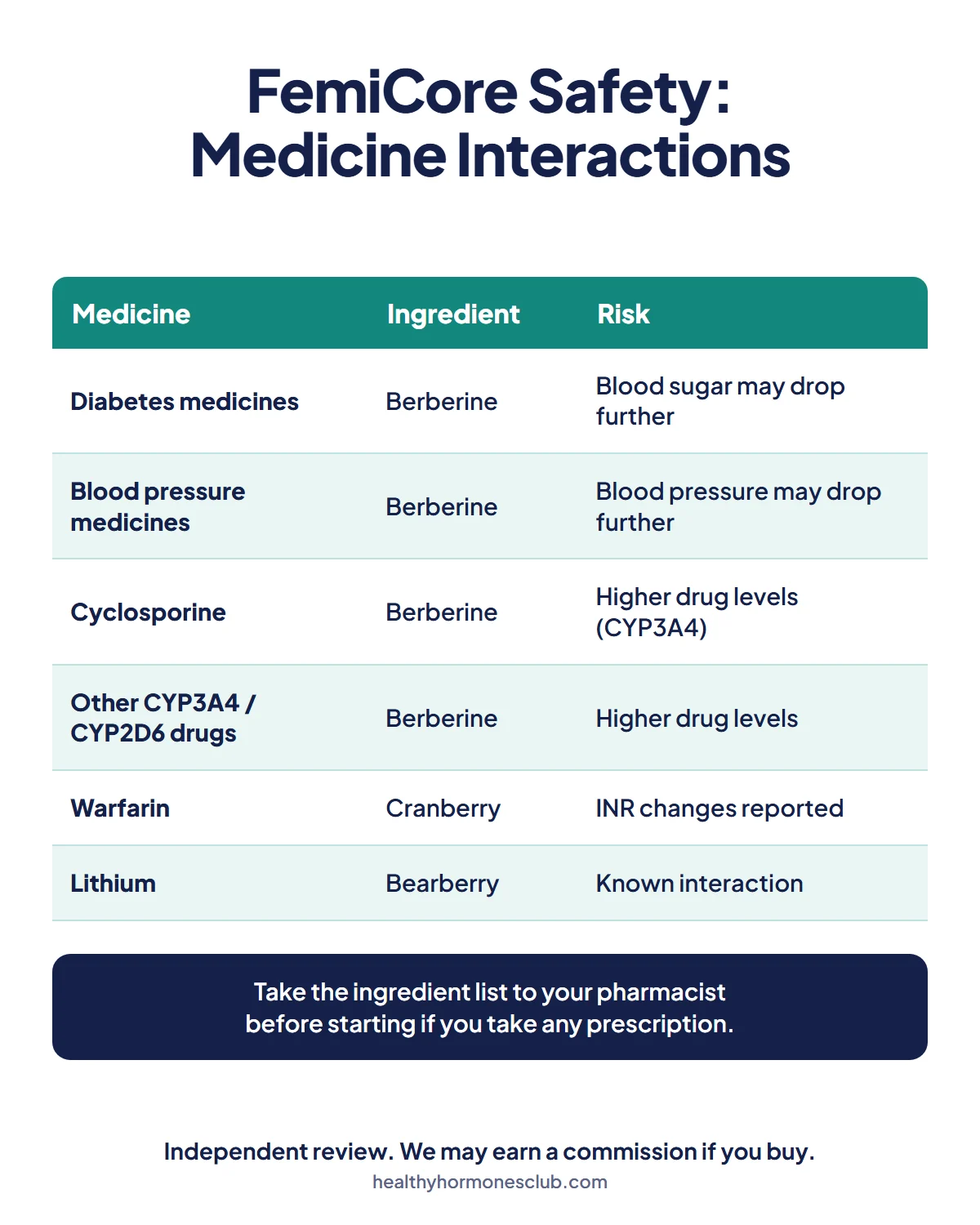
| Diabetes medicines | Berberine | Berberine can lower blood sugar, adding to the medicine’s effect |
| Blood pressure medicines | Berberine | Berberine may lower blood pressure further |
| Cyclosporine | Berberine | Berberine slows CYP3A4, which can raise cyclosporine levels |
| Other drugs processed by CYP3A4 or CYP2D6 | Berberine | Higher drug levels; many common prescriptions use these enzymes |
| Warfarin | Cranberry | Case reports of changes in INR; checks are advised |
| Lithium | Bearberry | Known interaction |
Because so many drugs are processed by CYP3A4 and CYP2D6, the safest approach is simple: if you take any regular prescription, ask your pharmacist before starting FemiCore. Bring the ingredient list.
The Long-Term Use Warning
This warning is easy to miss. The seller advises taking FemiCore every day for at least three months before judging it, and the six-bottle package covers six months. Bearberry, though, is a herb that European herbal regulators accept for traditional use in mild lower urinary complaints only in short courses of about a week, not for continuous use.
FemiCore does not disclose how much bearberry, or how much of its active compound arbutin, is in each capsule. It may be a small amount. We cannot tell, and neither can you from the label. If you plan to take FemiCore for months, mention the bearberry content to your doctor, especially if you have any kidney concerns.
Stop Taking FemiCore and Get Advice If
- Stomach symptoms are severe, or gas and bloating have not settled after the first couple of weeks.
- You notice signs of low blood sugar, such as shakiness, sweating or sudden hunger, particularly if you take diabetes medicines.
- You feel dizzy or lightheaded, which may point to lower blood pressure.
- A prescription medicine seems to be working differently, or your doctor reports changed blood test results such as INR.
- You find out you are pregnant.
- You develop any symptom you cannot explain after starting.
Green-brown urine is the one change you do not need to worry about. Bearberry can cause it, and it is harmless.
Get Medical Care Instead of a Supplement If
These symptoms are not side effects to manage at home and not something a supplement should be tried for. See a doctor promptly:
- Blood in your urine
- Fever or chills
- Flank pain, in the side or lower back
- Burning when you urinate
- A sudden change in bladder control
- Confusion together with urinary symptoms in an older relative
Warnings About the Bottle and Where You Buy It
Some safety risks have nothing to do with the formula and everything to do with the bottle.
- Buy only from the official site. The seller says FemiCore is not an authorized Amazon, Walmart or eBay product. Marketplace bottles may be fakes or old stock, and you cannot know what is inside. Our FemiCore Amazon guide explains the risks.
- Check the seal before the first capsule. If it is broken, loose or looks glued back, do not use it.
- Check the expiry date. Probiotics are live bacteria, and their numbers fall over time.
- Count and look at the capsules. A bottle holds 30. Damp, clumped or broken capsules are a reason to stop and contact support.
- Keep it away from children. Bearberry should be avoided in children.
- Take one capsule a day. The directions are one capsule every morning with a big glass of water. Taking more will not speed things up and raises the dose of every ingredient, including berberine and bearberry.
What the Safety Seals Do and Do Not Mean
The official site shows five seals: GMP Certified; Made in USA with imported ingredients; Natural ingredients; Made in an FDA registered facility; and Non-GMO. The site does not name the manufacturer or the certifier. Here is how to read them:
- FDA rules. FemiCore is a dietary supplement, so it follows the FDA’s rules for supplements rather than the drug approval process. The FDA does not pre-approve any supplement brand, FemiCore included.
- ”FDA registered facility” means the factory is registered with the FDA. It is not approval of the product.
- ”GMP Certified” refers to manufacturing practices. It is about how a product is made, not whether it works or suits you.
- ”Natural ingredients” does not mean free of side effects or interactions. Berberine and bearberry are natural and still carry the warnings above.
Our is FemiCore a health supplement article explains the regulatory side in more depth.
Genuine Bottles From the Official Store
Fresh stock, an intact seal and an order number the seller can look up.
Order Genuine FemiCore
Free US Shipping on 3 and 6 BottlesTaking These Warnings to Your Doctor
A five-minute conversation with your doctor or pharmacist covers almost every warning on this page. To make it quick:
- Bring the ingredient list: Mimosa pudica, bearberry, cranberry extract, granular berberine, L. crispatus, L. acidophilus, L. plantarum, L. gasseri and L. casei.
- Say the doses are not disclosed. Your doctor will want to know that the label shows a proprietary blend.
- Bring your medicine list, including other supplements.
- Describe your symptoms, ideally with a few days of bladder diary notes, so any infection or other cause can be ruled out first.
- Ask about duration: is daily use for three months or more sensible for you, given the bearberry content?
For a broader guide to who FemiCore suits, see our who should use FemiCore article, and for women-specific checks, our FemiCore review 2026 women page.
Frequently Asked Questions
Who should not take FemiCore?
In our view, women who are pregnant or breastfeeding (berberine is considered unsafe and bearberry should be avoided), people with kidney disease (bearberry), and children. Anyone with warning signs such as blood in the urine, fever or flank pain should see a doctor rather than start a supplement.
Which medicines interact with FemiCore?
The main ones are diabetes medicines and blood pressure medicines (berberine can lower blood sugar and may lower blood pressure), cyclosporine and other drugs processed by CYP3A4 or CYP2D6 (berberine slows these enzymes), warfarin (cranberry case reports, so INR checks are advised) and lithium (bearberry).
Is it safe to take FemiCore every day for months?
The seller suggests daily use for at least three months. European herbal regulators accept bearberry only for short courses of about a week, and FemiCore does not disclose its bearberry dose. That is a reason to discuss long-term use with your doctor, especially if you have any kidney concerns.
Is green or brown urine on FemiCore dangerous?
Bearberry can turn urine green-brown, and that color change is harmless. Red or pink urine is different: blood in the urine needs a doctor.
Is FemiCore approved by the FDA?
The FDA does not pre-approve any supplement. FemiCore follows the FDA’s dietary-supplement rules rather than the drug approval process. The “Made in an FDA registered facility” seal on the official site refers to the factory being registered, not to approval of the product.
When should I stop taking FemiCore?
Stop and get advice if stomach symptoms are severe or do not settle after the first couple of weeks, if you notice signs of low blood sugar or dizziness, if a prescription medicine seems to work differently, or if you become pregnant. Seek medical care promptly for blood in the urine, fever, chills, flank pain or burning.
The Bottom Line
FemiCore’s safety warnings center on three ingredients. Berberine brings the medicine interactions and the pregnancy warning, bearberry brings the kidney, pregnancy and long-term use warnings, and cranberry brings the warfarin and kidney stone notes. Do not use it if you are pregnant, breastfeeding, have kidney disease or are buying for a child. Ask first if you take any prescription. Stop if something feels wrong, and see a doctor rather than a supplement for blood in the urine, fever, flank pain, burning or a sudden change. If your doctor is happy for you to try it, buy from the official store and take one capsule a day. Our FemiCore product guide has every fact on one page.
Try FemiCore Safely
Official store, one capsule a day and 60 days from delivery to decide.
Order From the Official Store
60-Day Money-Back Guarantee